Category Archives: Uncategorized

Mobility on Demand & Remotely Operated Vehicles

In September 2010, I first pitched a concept to Cisco for remotely piloted vehicles. This was early–the month before Google announced the first driverless car and before Uber was publicly announced in 2011.

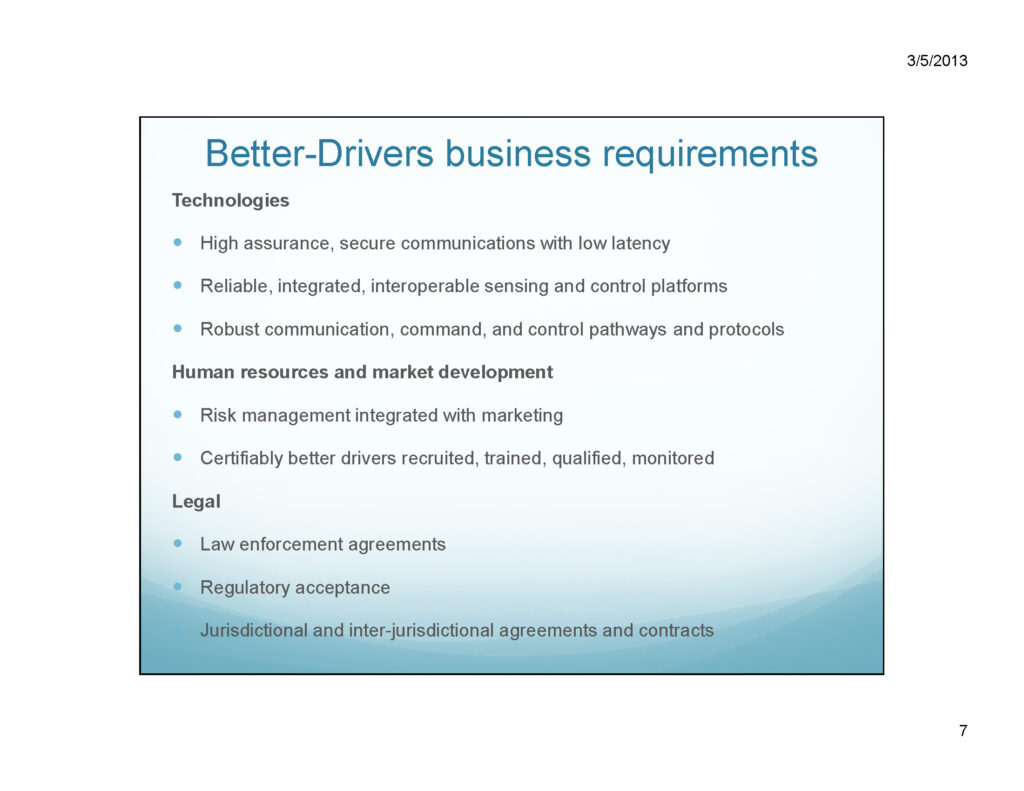
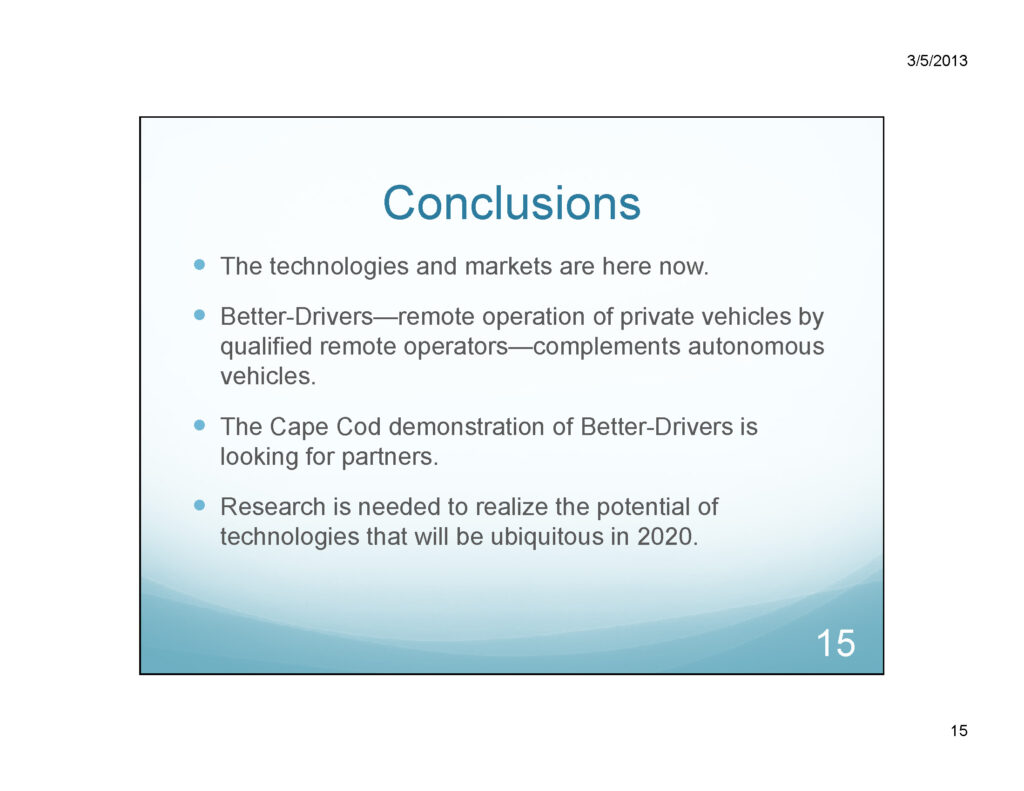
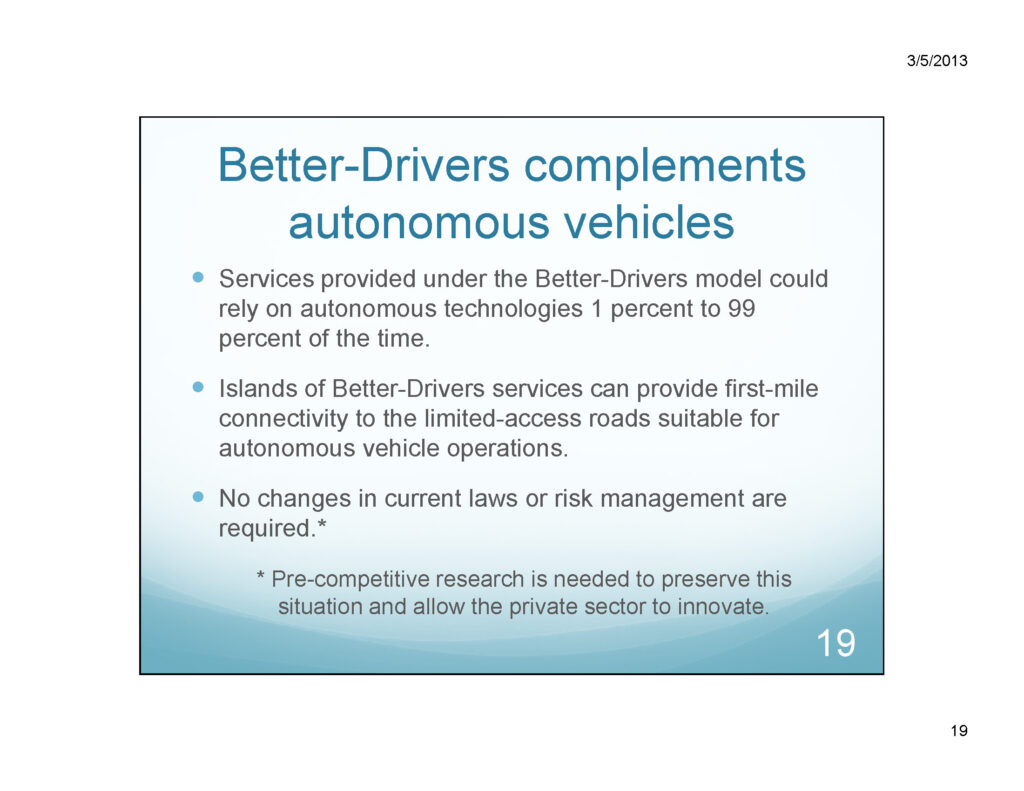
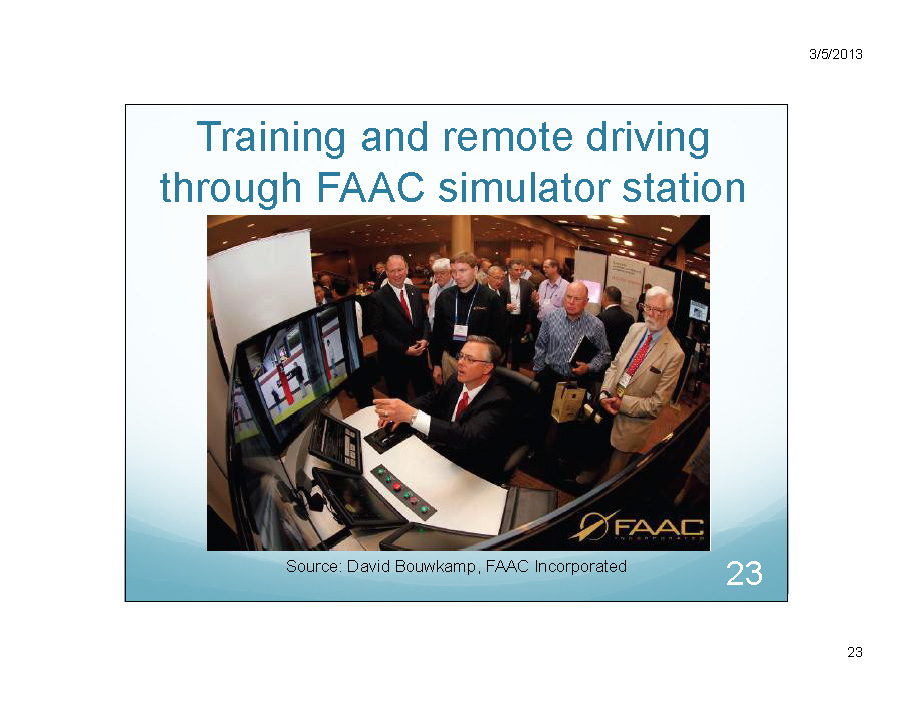
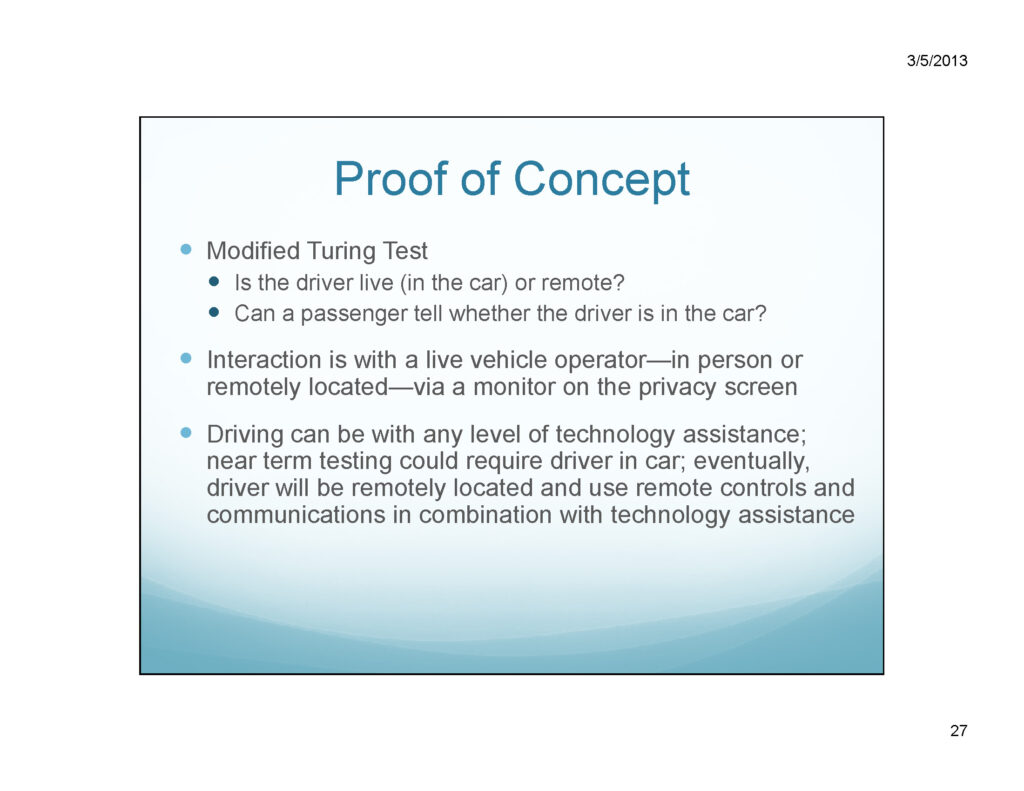
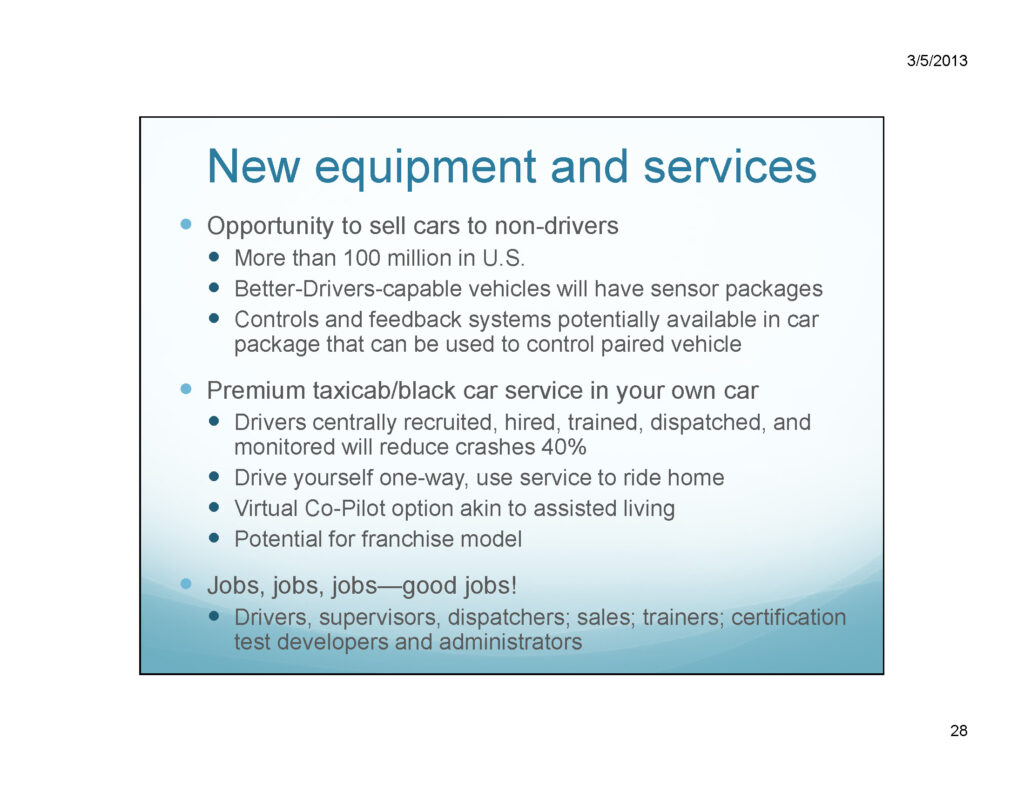
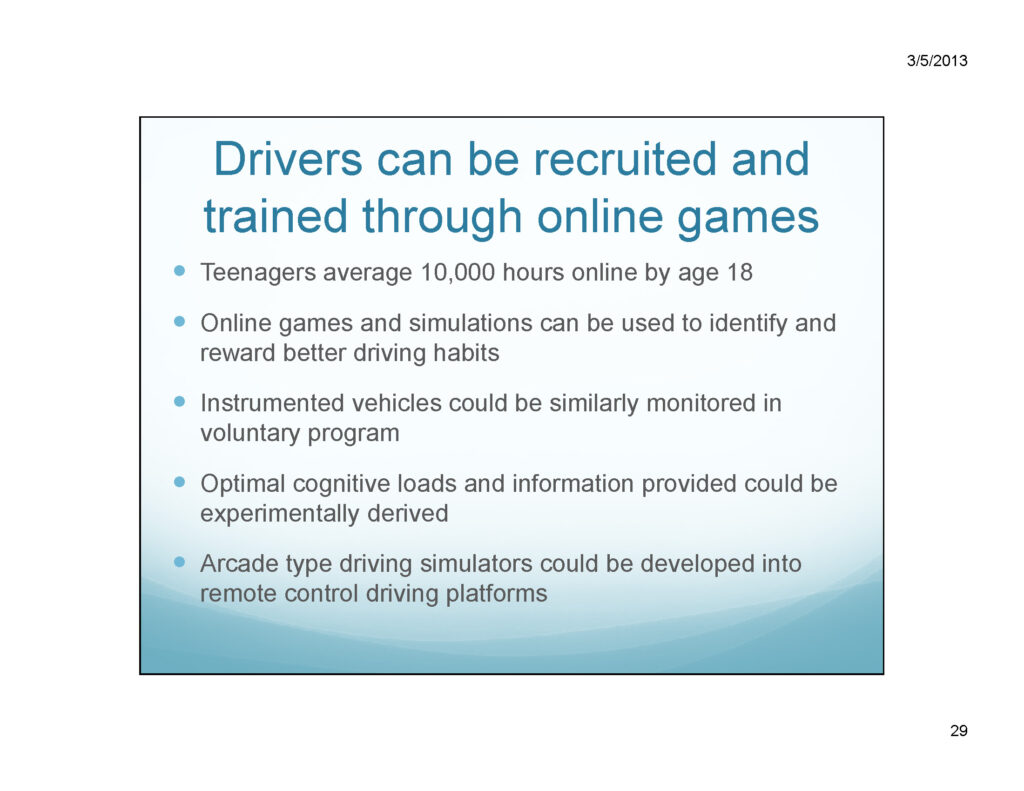
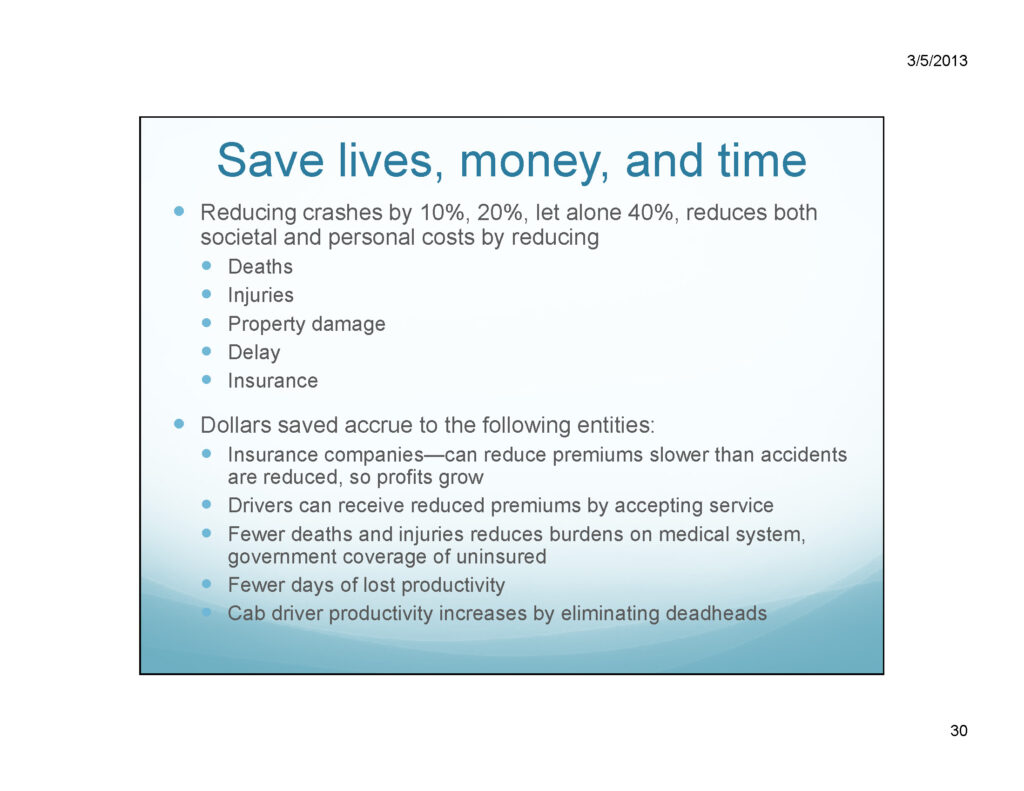
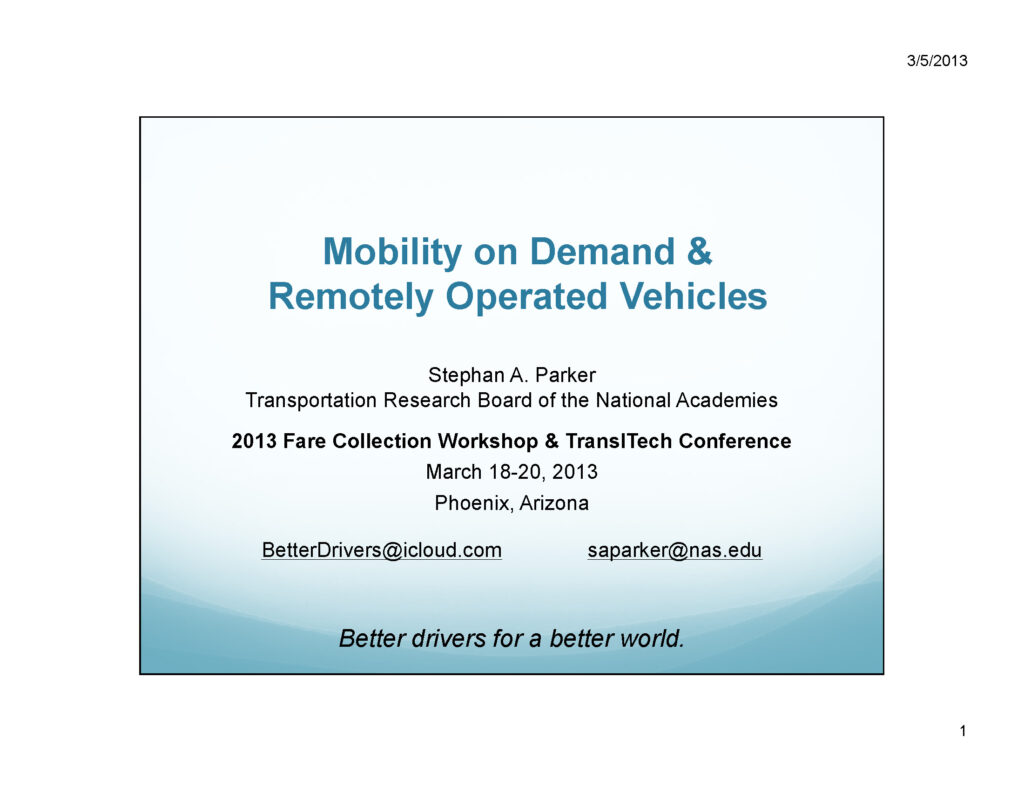
The business case for Better-Drivers–remote piloting of vehicles by qualified operators–was presented at these conferences: (1) 2013 National Rural Intelligent Transportation Systems Conference, St. Cloud, Minnesota; (2) 2013 American Public Transportation Association’s TransITech Conference, Phoenix, Arizona; (3) 2012 Intelligent Transportation Systems World Congress, Vienna, Austria.

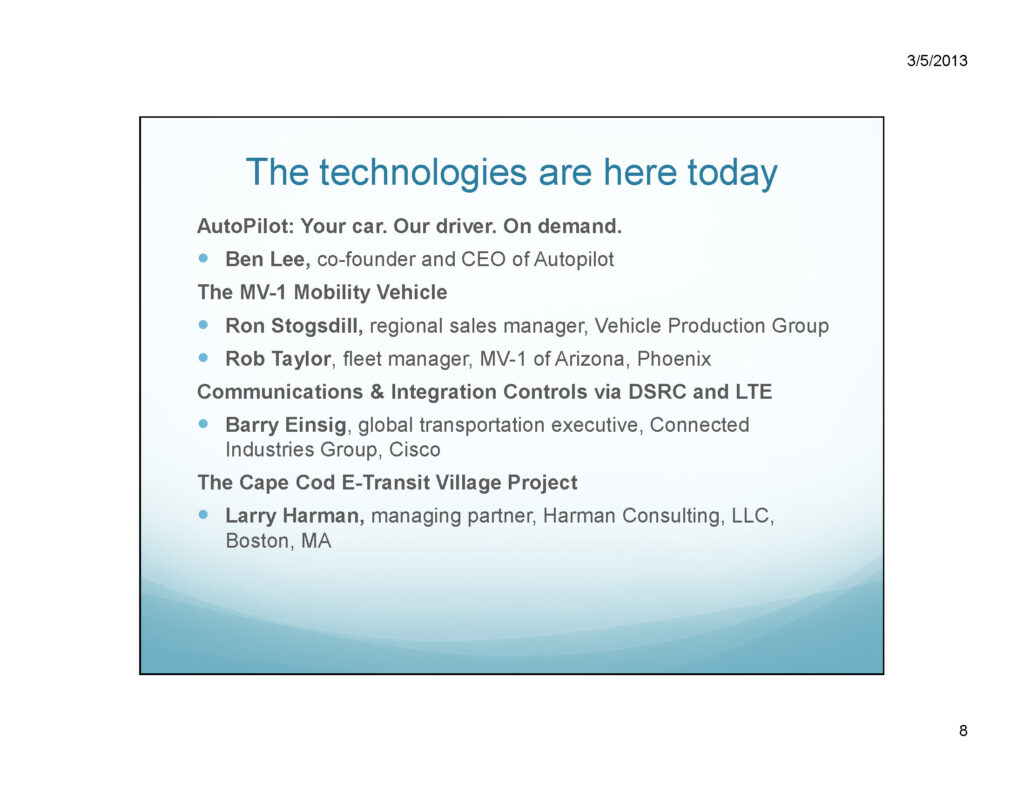
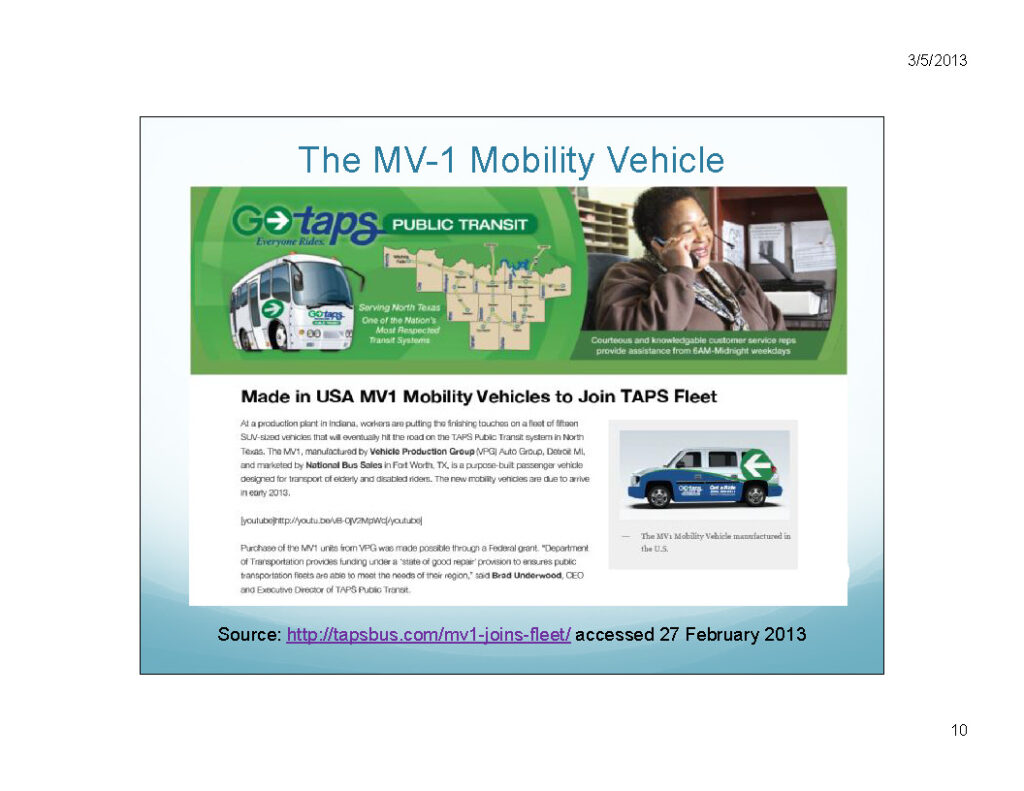
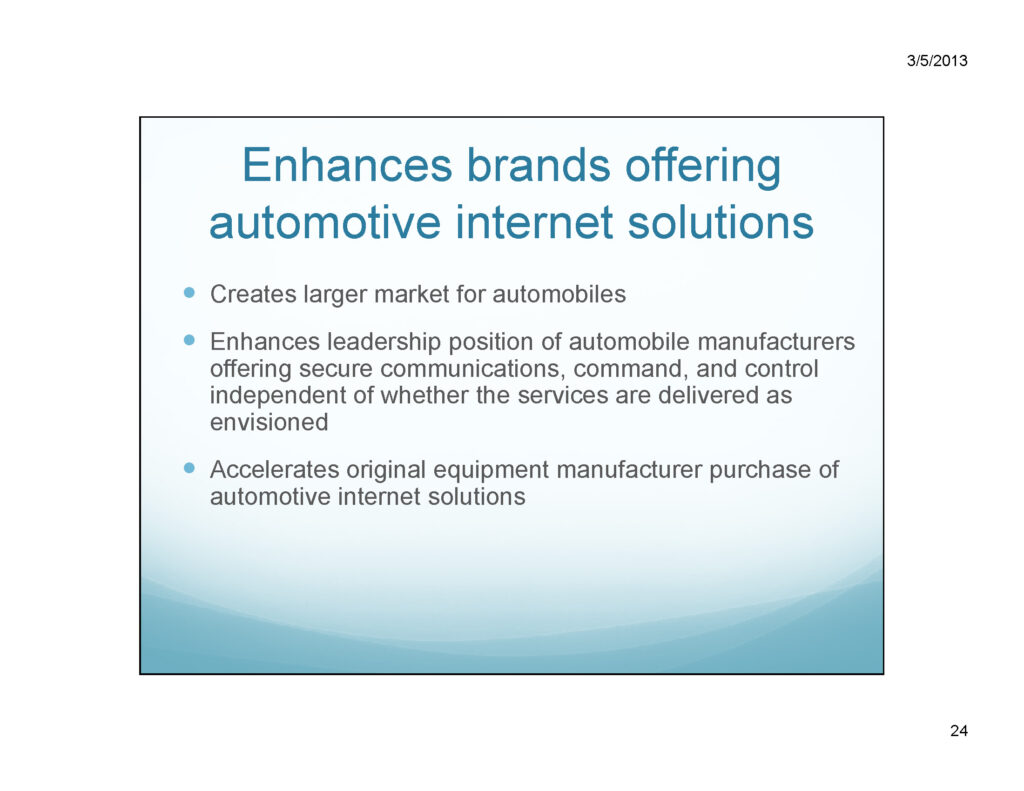
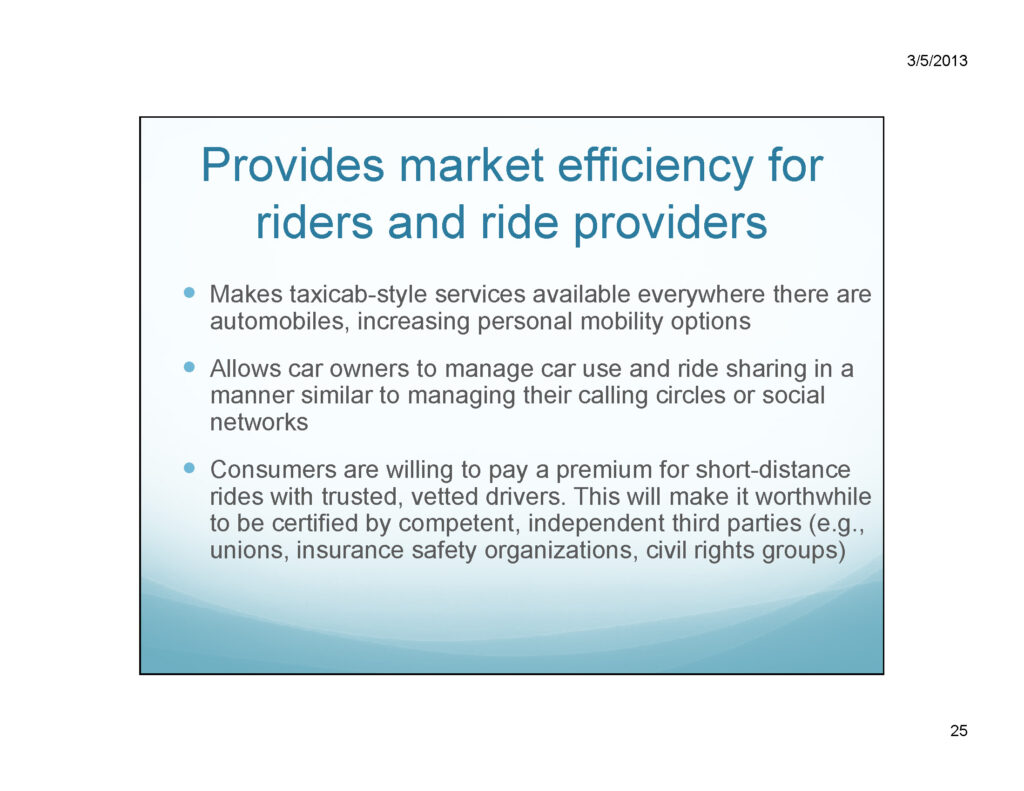
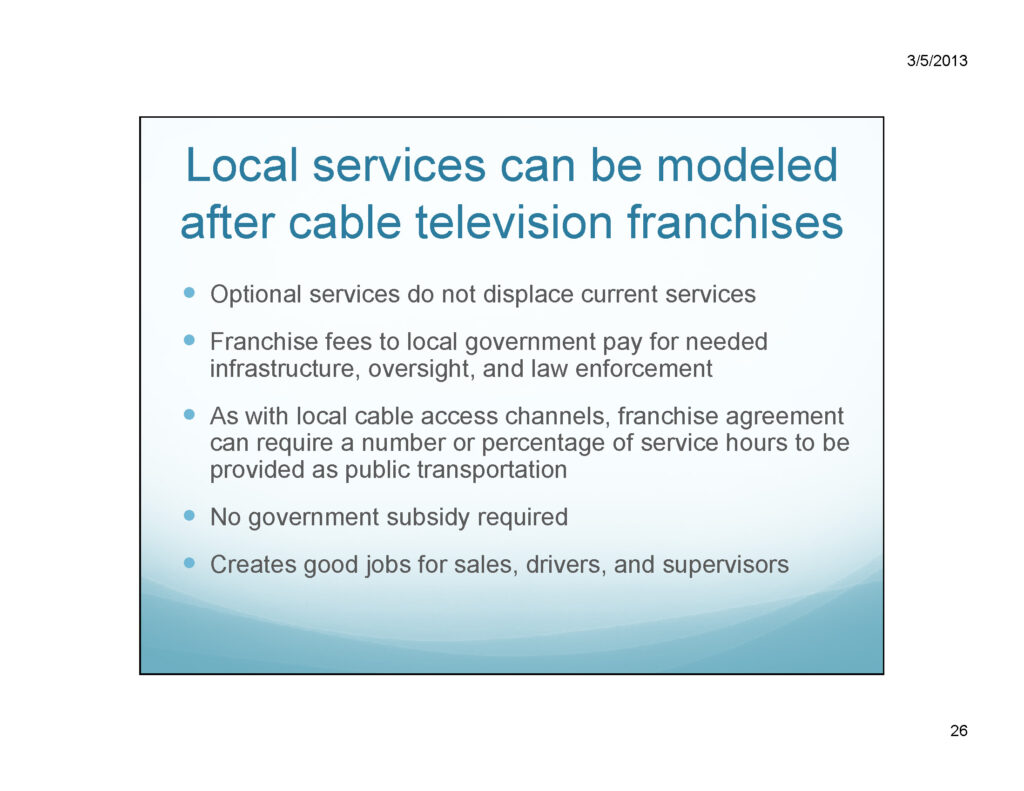
Session Video (above) and Presentation (PDF handout download and slide deck, below) from the American Public Transportation Association (APTA) 2013 Fare Collection Workshop & TransITech Conference, Phoenix, Arizona
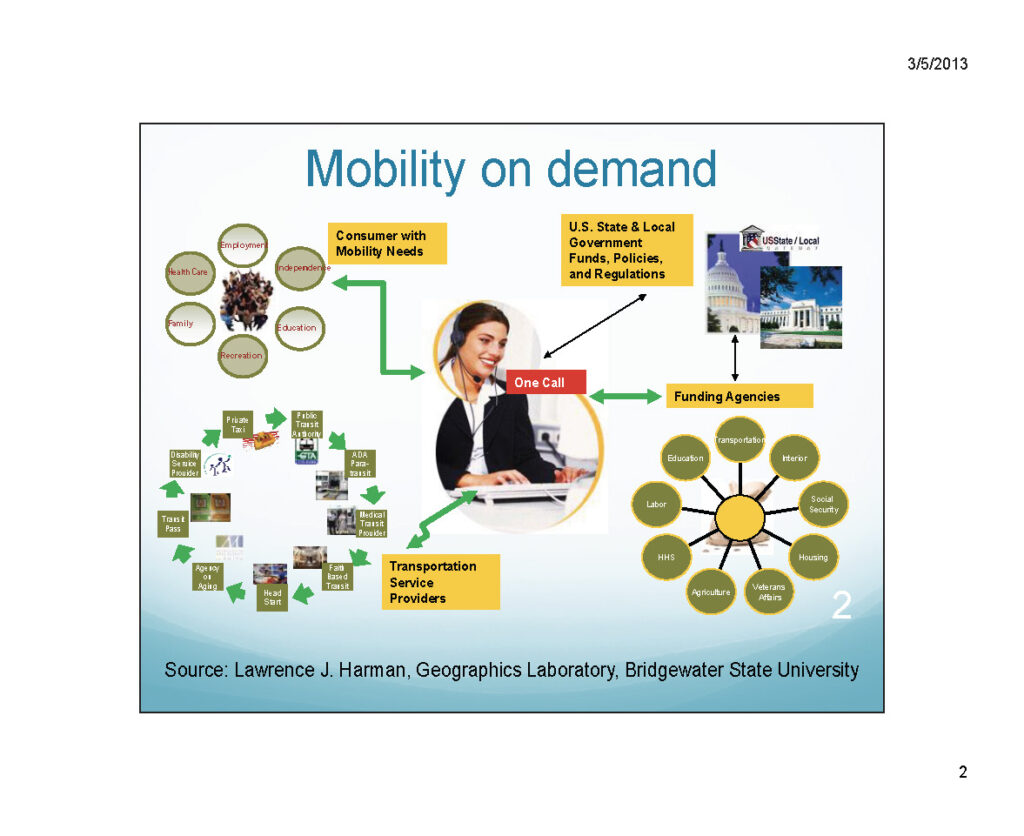
In 2011 I entered a concept paper in the Connected Vehicle Technology Challenge. There were 80 or so entries; my paper balloted third. The top two balloted papers were from university teams.

BetterDrivers for Remote Control Driving (2011)

by Stephan A. Parker

BetterDrivers@me.com

“Better drivers for a better world.”

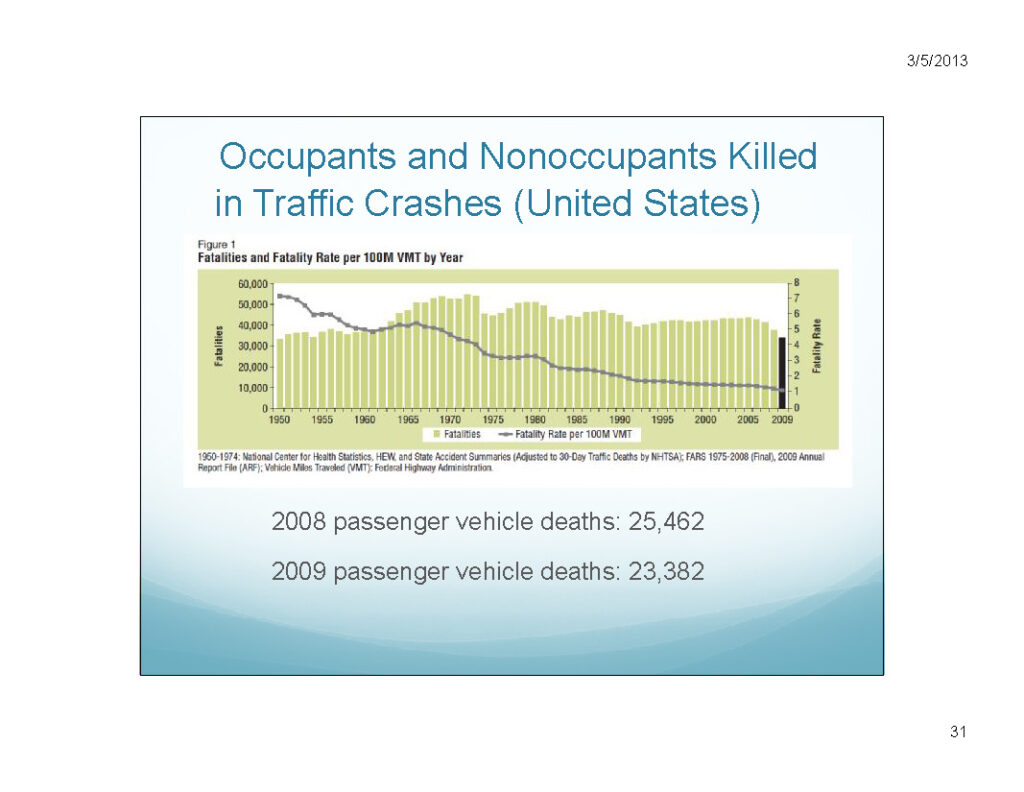
In the United States, mobility is freedom. Today, nearly 100 million Americans do not drive. As the population ages, more will lose the ability to drive themselves safely.  Without mobility, quality of life declines. Yet public transportation of any type is available in less than 60 percent of counties and taxicabs are available in fewer areas—we need better mobility options for non-drivers.

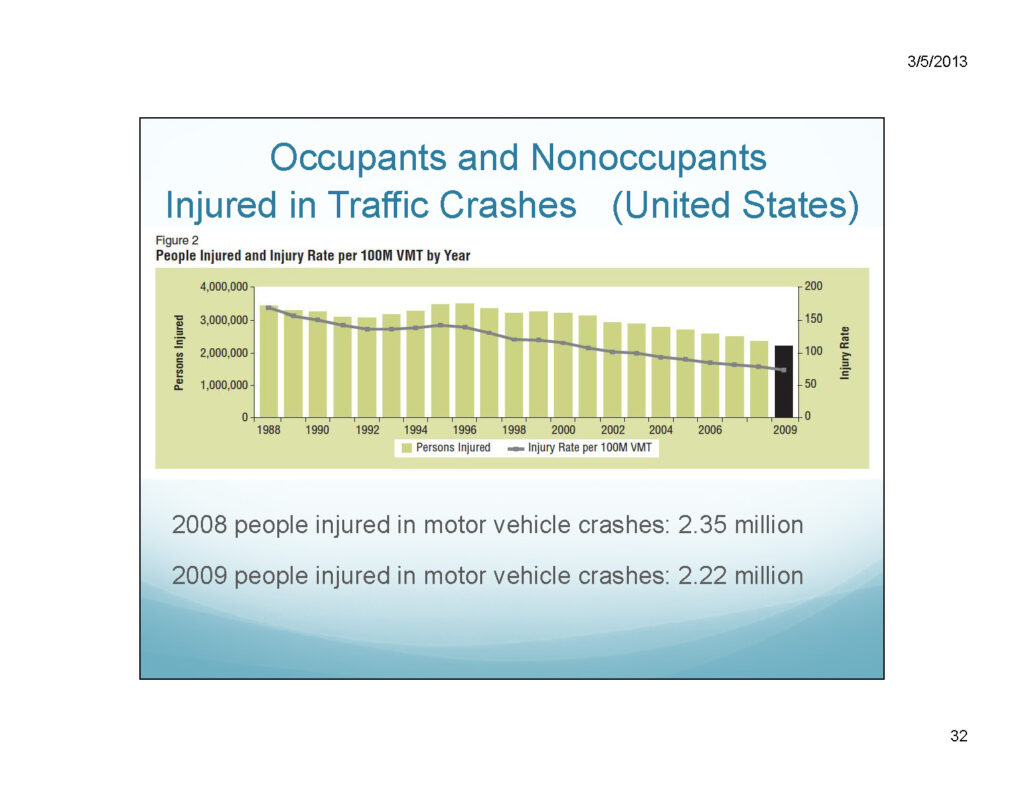
The good news on safety is that injury rates and fatality rates have been lowered through decades of engineering achievements applied to cars and roadways.  Now, just as advanced electronics are able to provide additional information to them, drivers are getting more distracted. Engineering improvements to cars and roadways will not be enough—we need better drivers. 

Making the local neighborhood more available and safer is what BetterDrivers is all about.

  • Mobility is freedom and people are willing to pay for it.
  • Thousands of lives can be saved and millions of injuries prevented every year. 

The technology is available to enable remote operation of private vehicles by qualified remote operators!

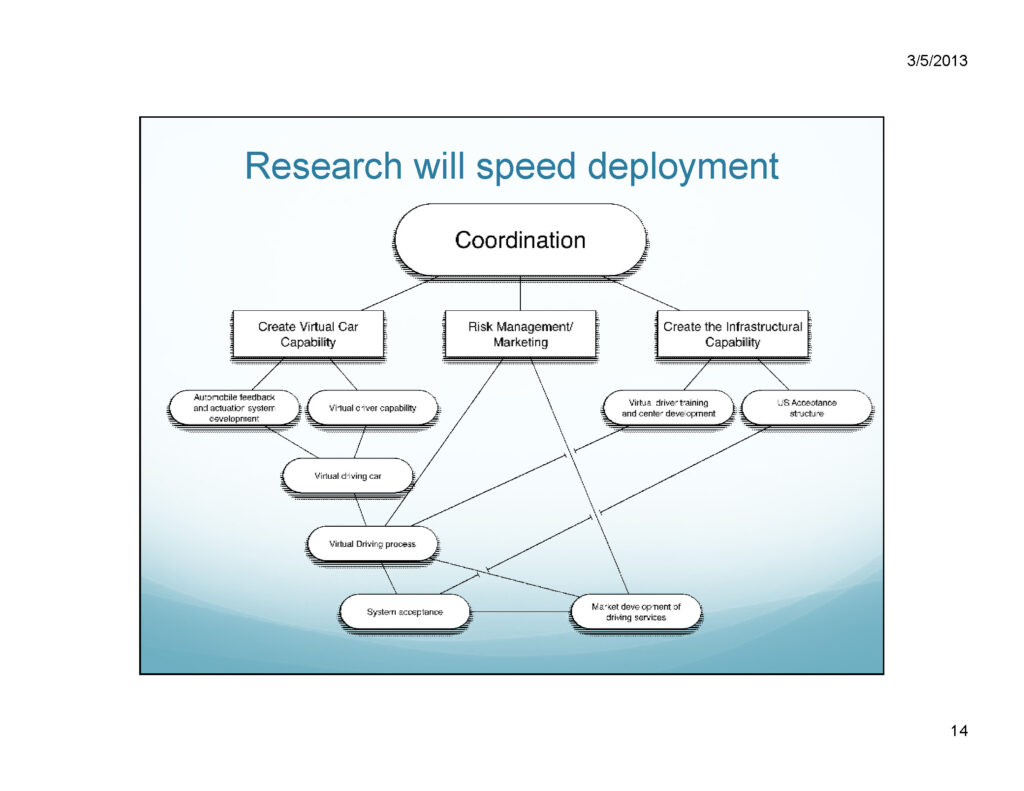
To realize the potential for service delivery, the technology needs to be coordinated with system acceptance and market development of driving services.

Mobility

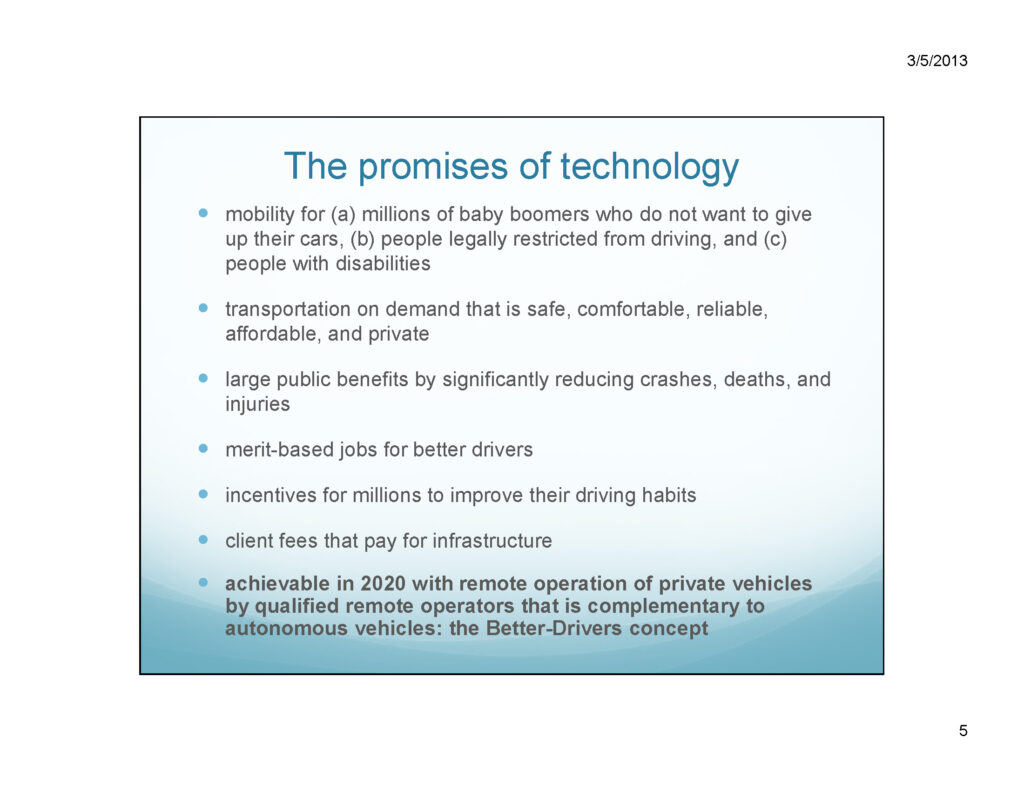
The BetterDrivers concept—driving services delivered by remote control—provides mobility for (a) millions of baby boomers who do not want to give up their cars, (b) people legally restricted from driving, and (c) people with disabilities.  BetterDrivers provides

  • transportation on demand that is safe, comfortable, reliable, affordable, and private
  • large public benefits by significantly reducing crashes, deaths, and injuries
  • merit-based jobs for better drivers
  • incentives for millions to improve their driving habits
  • client fees that pay for infrastructure

Safety

As autonomous vehicle technologies improve, the workload for a driver (in person or remote) is reduced.  Crashes have been reduced 40 percent with current technologies that report fleet drivers for excessive braking, acceleration, or hard turns. Monitoring and controls for remote drivers should yield similar safety results.

Comfort

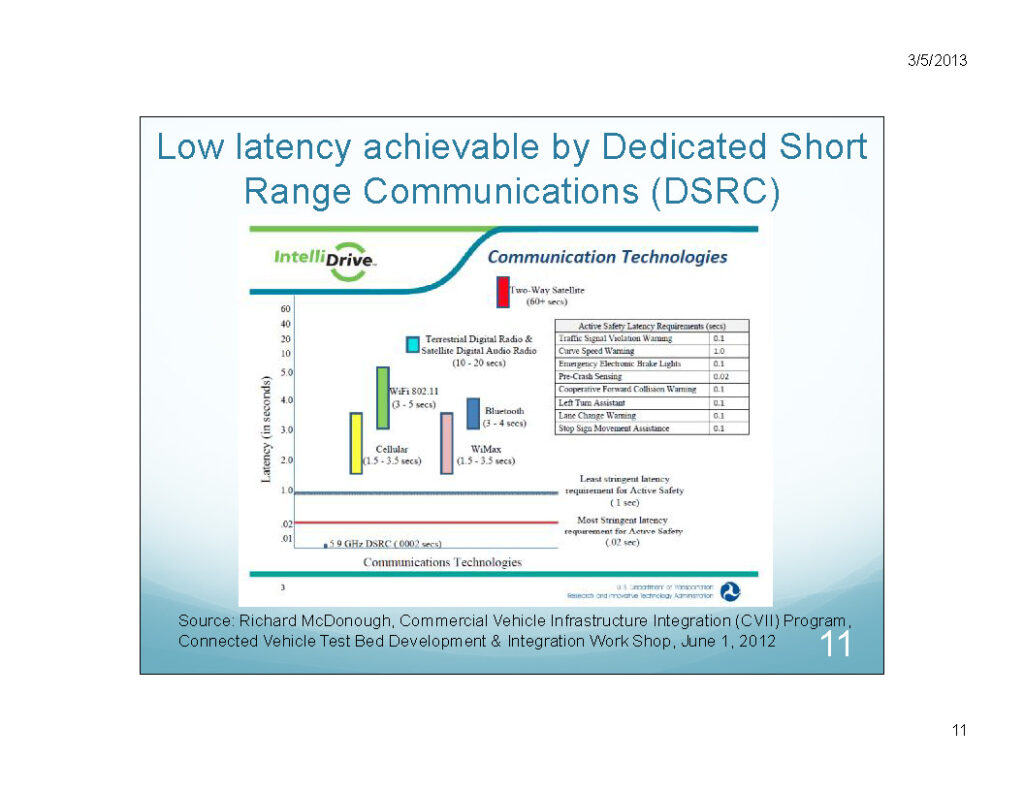
Most people are more comfortable interacting with a person—especially if there is a problem.  BetterDrivers improves autonomous vehicles by providing a certified remote driver.  Autonomous vehicles maintain safe operations if communications are interrupted.  Remote drivers are certified and have fitness for duty testing before each shift, relief breaks, direct supervision, and multiple communications paths so they can speak with clients and drive cars using Low Earth Orbit satellites, land mobile radio, and Dedicated Short-Range Communications (DSRC).

Implementation

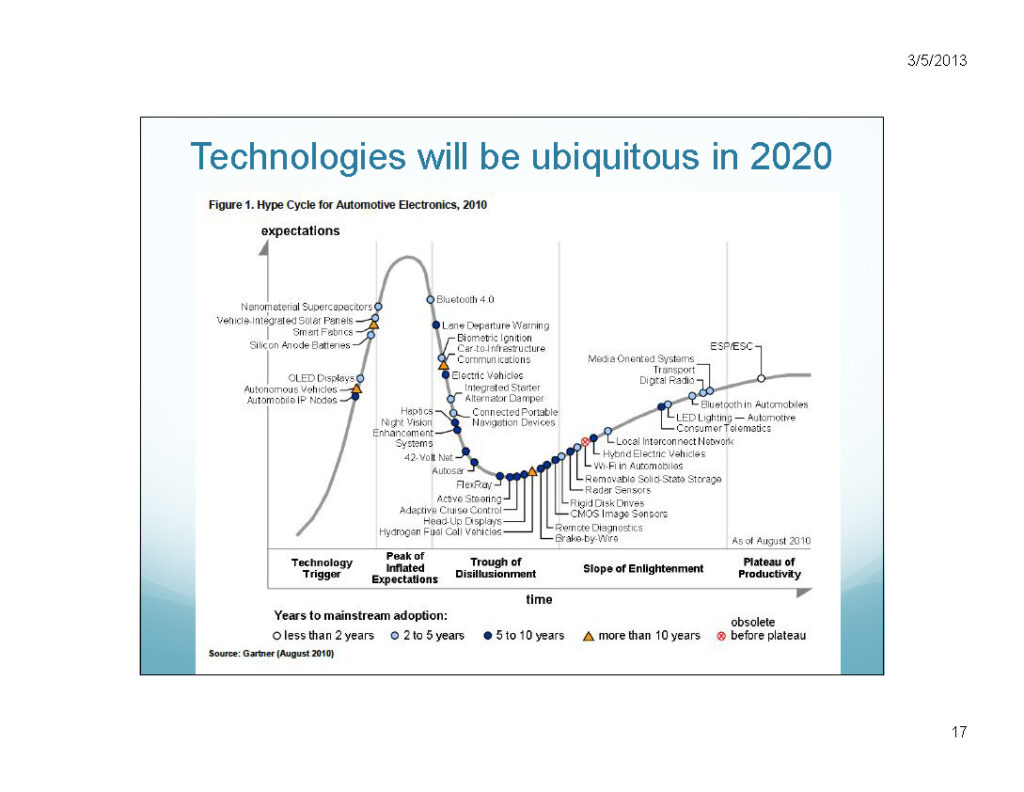
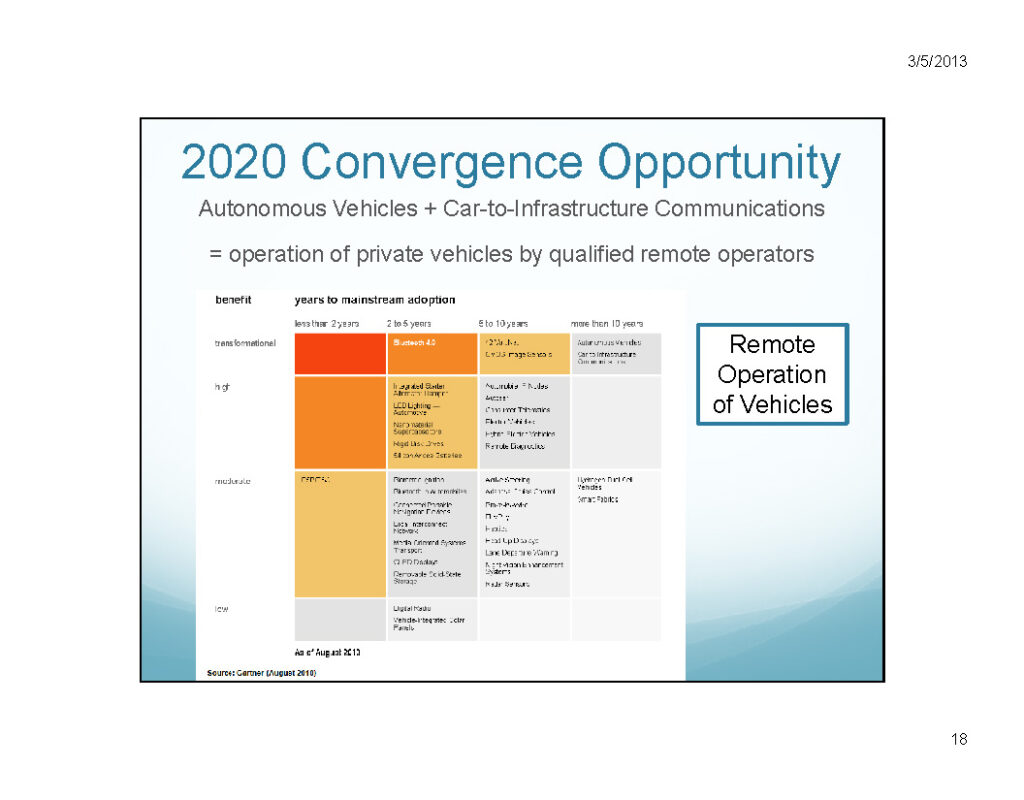
By 2020, baseline technologies for driving by remote control will be mature for (1) autonomous vehicles and (2) vehicle-to-infrastructure communications such as DSRC. Building on research currently underway, such as the Strategic Highway Research Program 2 (SHRP2) Naturalistic Driving Study, companies will develop (a) automobile feedback and actuation systems, (b) the remote control car, (c) remote driver capability, (d) driving metrics, and ultimately (e) the remote control driving process.  

Exhibit 1. The BetterDrivers concept integrates the remote control driving process, system acceptance, and market development of remote driving services.

Innovative agreements will be needed for licensing drivers not in a vehicle, law enforcement, and insurance.  BetterDrivers could co-locate with a traffic operations center with law enforcement officers on-site, paid for with client fees. Near zero-lag-time can be achieved through DSRC with fiber backhaul to the local BetterDrivers center. A smartphone can be used for the client to speak with the remote driver.

Quality of life

People buy computers with upgrade capability even though most never upgrade; many people will pay extra for the option (in future) of remote control operation of a car. No smelly cabs; no waiting for the driver to show up; no wondering if you need to call the dispatcher.  With a remote driver on line, you get to keep your car, keep your stuff and you’re free to come and go as you please.  It’s just like driving yourself! 

Business 

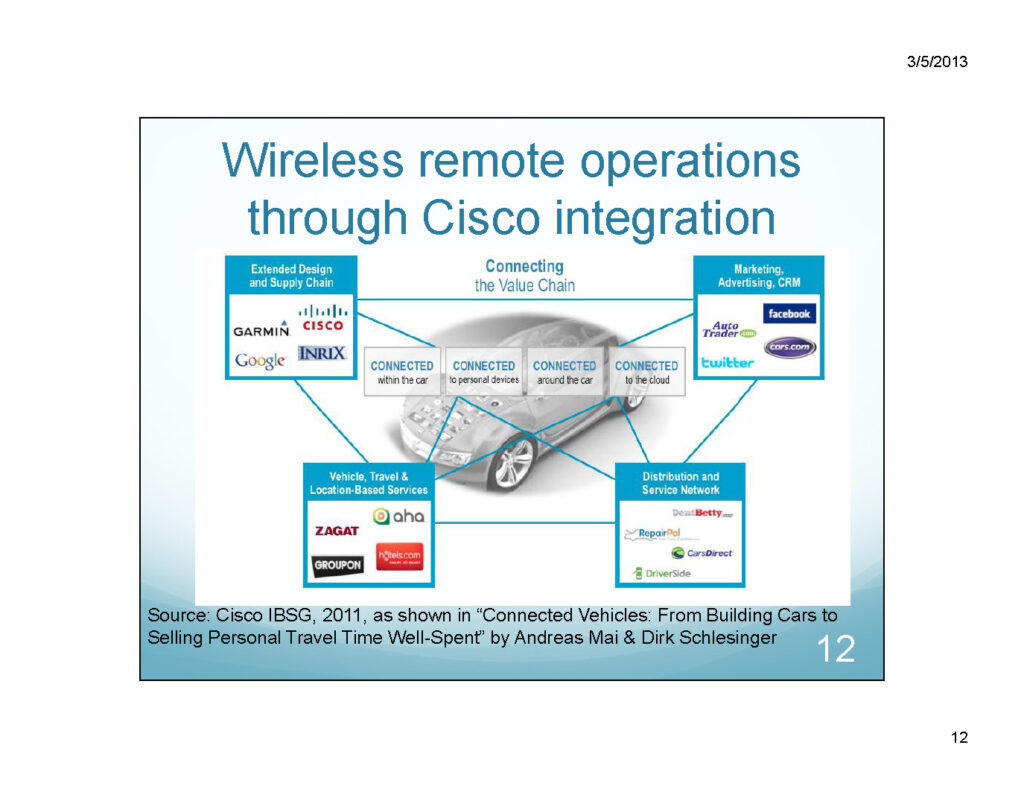
The opportunities for business can be tremendous.  Car companies will enhance their images by offering secure communications, command, and control, whether or not the services are ordered.  With BetterDrivers services in place, companies can sell cars to millions of people who do not drive. The safety and mobility implications are large, making government cooperation likely.  Some car brands already exploit remote operations for marketing. The U.S. market is ready to pay for such technologies.

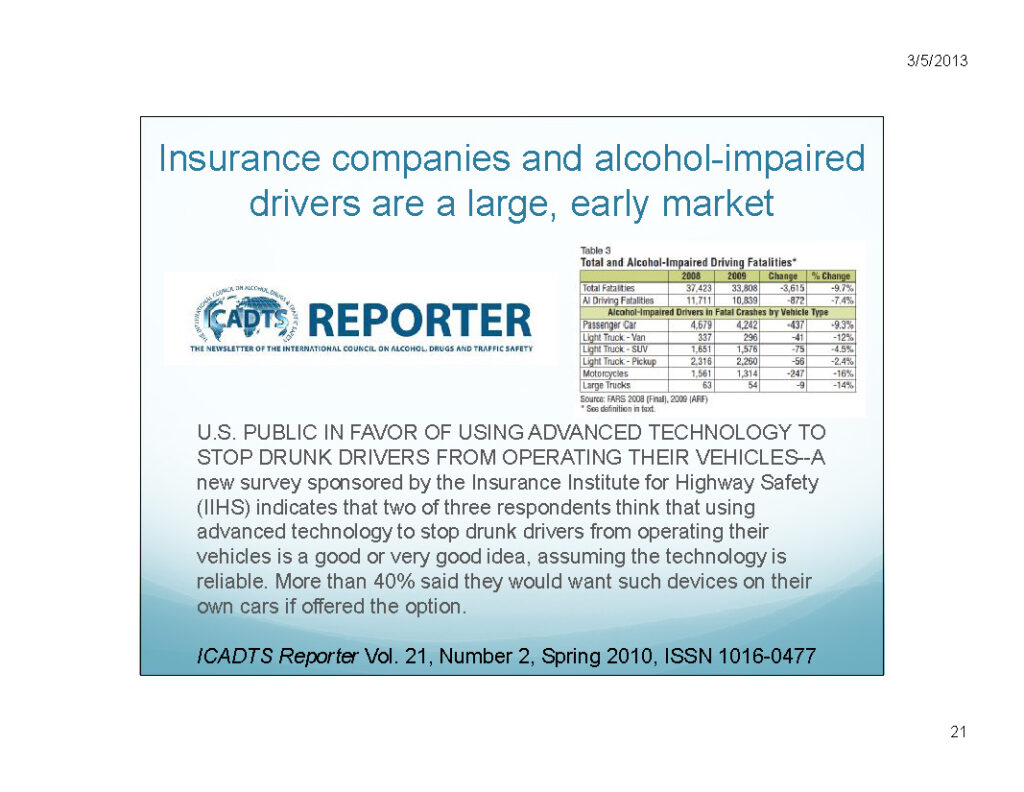
U.S. PUBLIC IN FAVOR OF USING ADVANCED TECHNOLOGY TO STOP DRUNK DRIVERS FROM OPERATING THEIR VEHICLES–A new survey sponsored by the Insurance Institute for Highway Safety (IIHS) indicates that two of three respondents think that using advanced technology to stop drunk drivers from operating their vehicles is a good or very good idea, assuming the technology is reliable. More than 40% said they would want such devices on their own cars if offered the option.

ICADTS Reporter Vol. 21, Number 2, Spring 2010, ISSN 1016-0477

Exhibit 2.  Insurance companies and alcohol-impaired drivers are a large, early market.

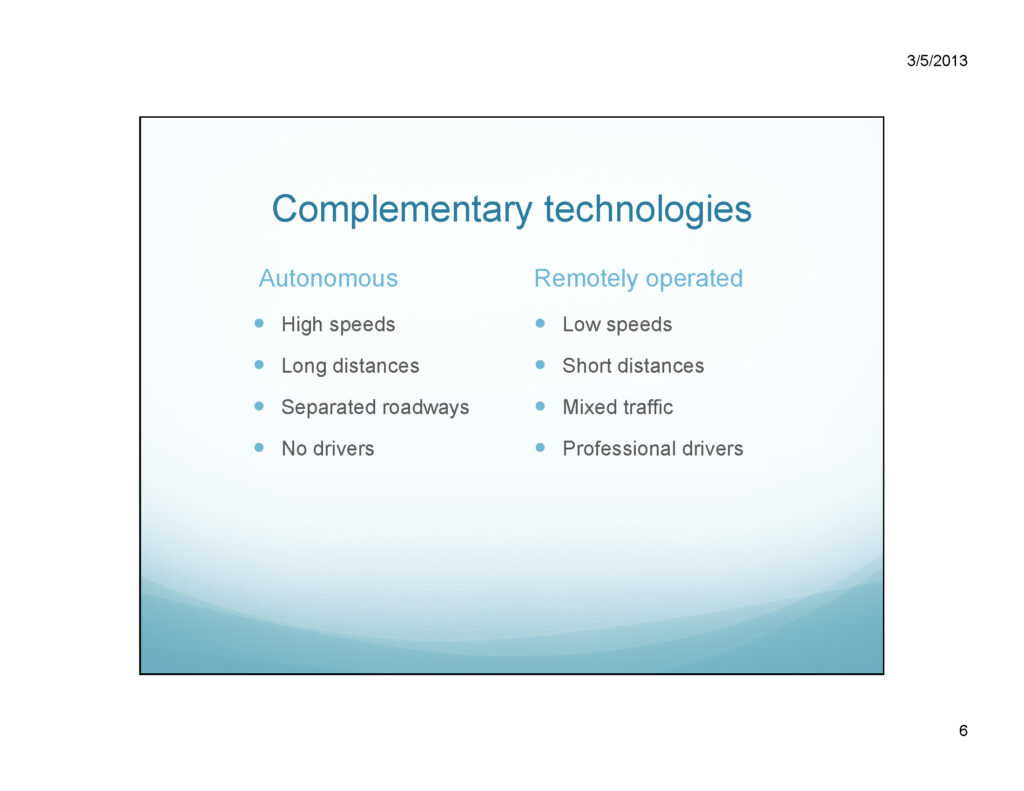
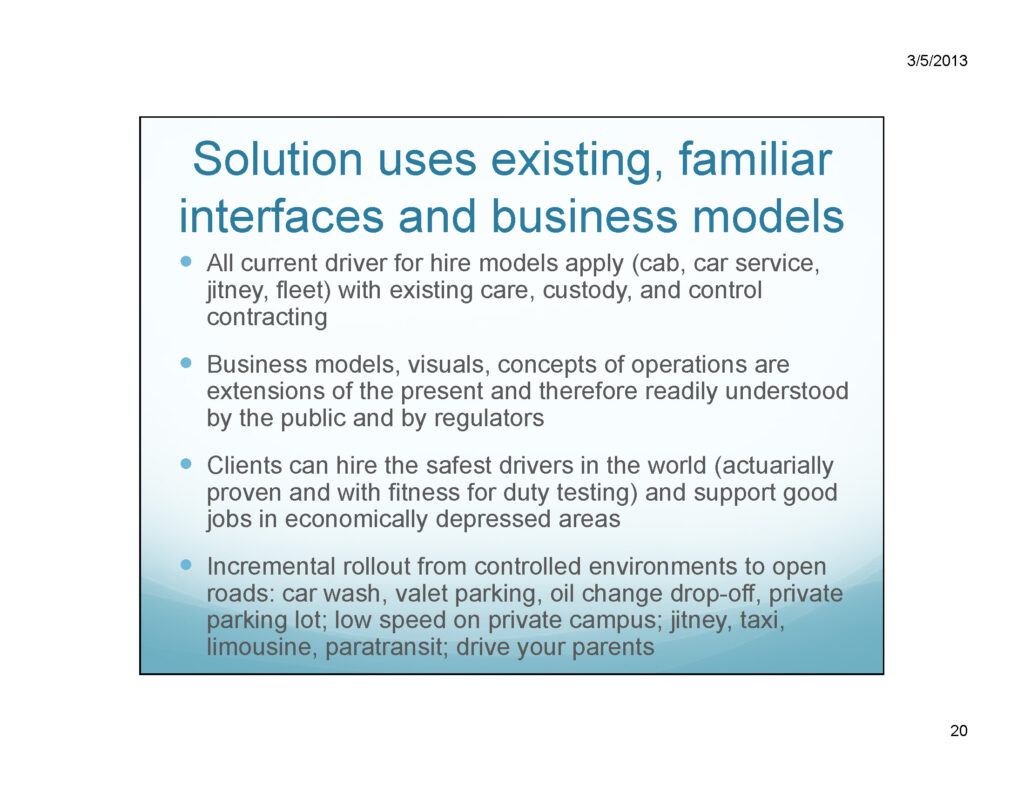
All current driver-for-hire models apply (taxicab, car service, limousine, jitney, paratransit) with existing care, custody, and control contracting. Business models, visuals, and concepts of operations are readily understood by the public and by regulators.  BetterDrivers focuses on the low speed environment, providing mobility near the home. It can be incrementally rolled out from controlled environments to open roads. Eventually, you could use BetterDrivers to drive your parents. 

Infrastructure

Whether driven by remote control or autonomously, cars that are “out there” need to be regularly maintained and inspected for safety.  Hands-on services can be performed by or copied from car rental companies. To remotely validate the safety of on-road vehicles (in addition to on-vehicle health checks) subscribers and law enforcement could take advantage of DSRC to relay information from automated roadside car safety inspection stations.  The inspections could be provided through subscriptions or one-time fees. Remote control and autonomous car safety checks could also be available to manually driven cars, significantly expanding the market. Maintenance and repair shops could support such automated roadside safety inspections and benefit from referrals. A coalition to support the development of such safety infrastructure could be modeled on a current coalition supporting technology and safety initiatives for commercial vehicles (http://www.freightmobility.org/).

Jobs

Online gamers have 10,000 hours of experience by the time they finish high school, according to Dr. Kate McGonigal (http://www.ted.com/talks/view/id/799); she wants to enlist that community to solve big problems (http://www.avantgame.com/).  

Through online simulations and games those individuals with superior remote-control driving skills can be identified, recruited, and trained. BetterDrivers labor recruitment and education activities will cause many people to be better drivers. 

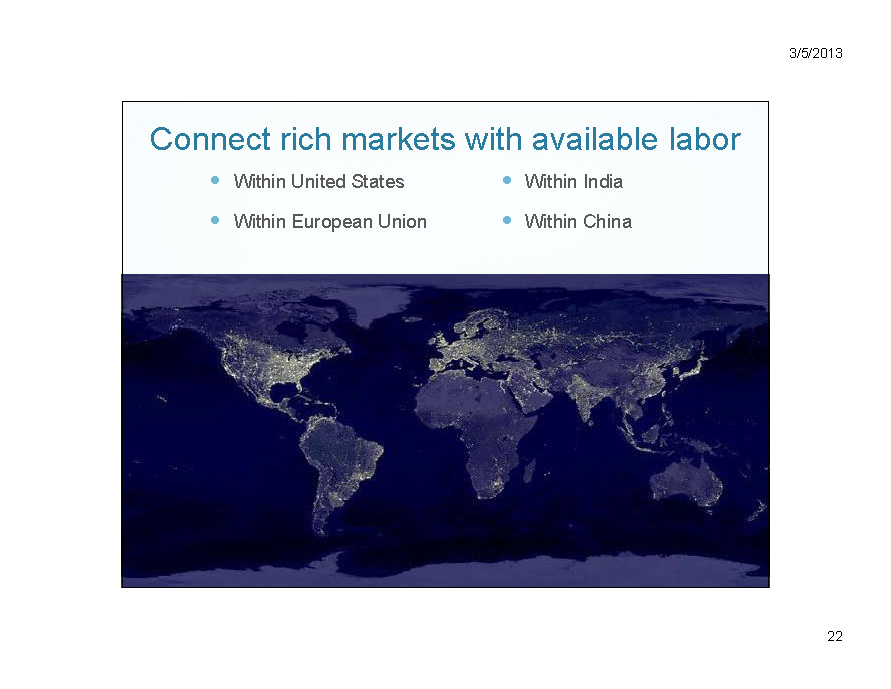
Earth at Night Credit: C. Mayhew & R. Simmon (NASA/GSFC), NOAA/ NGDC, DMSP Digital Archive  Downloaded from http://apod.nasa.gov/apod/ap001127.html 

Exhibit 3. BetterDrivers can link labor with wealthy consumer markets within the European Union, India, China, and the United States.

Conclusion: Acceptance

By 2020, baseline technologies for driving by remote control will be mature. Technologies are necessary but not sufficient: policy, legal, and liability issues need to be addressed in order to make it possible not only to have driverless vehicles, but also to have vehicles driven by remote control. Broad acceptance is necessary for significant market penetration, which is key to realizing safety gains.  Many more people will be willing to ride in autonomous vehicles if they have a person on the line with them, making sure their journey is safe and secure. The BetterDrivers concept—driving services delivered by remote control—provides jobs and mobility by integrating the remote control driving process, system acceptance, and market development of driving services.

Background materials

Remote controls:

2010 Mitsubishi Live Drive  http://www.youtube.com/watch?v=tAeJJQvrcRw 

2011 Chevrolet Cruze | Remote Control  http://www.youtube.com/watch?v=eHruySdTarE 

2012 Ford Focus: Active Park Assist   http://www.youtube.com/watch?v=m8IdUU-3m8A 

Autonomous vehicles:

INRIA-Cybercars and the city of the future http://www.youtube.com/watch?v=Ns896Thb9oY 

CityMobil – Towards Advanced Road Transport for the Urban Environment  http://www.citymobil-project.eu/site/en/Movies%20and%20films.php 

Driving behavior:

FloChat – Introducing Snapshot! http://www.youtube.com/watch?v=ggWY7OPag0s&feature=player_embedded 

Introduction to DriveCam 

http://www.drivecam.com/resource-center/video-center/informational-videos 

A Current Transportation Infrastructure Coalition 

“The Trucking Industry Mobility & Technology Coalition (TIMTC) is jointly managed by the American Transportation Research Institute (ATRI), the Commercial Vehicle Safety Alliance (CVSA), the American Association of State Highway and Transportation Officials (AASHTO), the U.S. Department of Transportation (U.S. DOT) and the American Trucking Associations (ATA).  The TIMTC is sponsored by the U.S. DOT.  Members include motor carriers, commercial drivers, law enforcement, technology providers, equipment manufacturers, transportation planners and policy makers at the local, state and federal levels.”  http://www.freightmobility.org/

More on the SHRP 2 Naturalistic Driving Study (emphasis added)

“SHRP 2 Report S2-S05-RR-1: Design of the In-Vehicle Driving Behavior and Crash Risk Study provides a summary of the key aspects of the planning effort supporting the SHRP 2 Naturalistic Driving Study (NDS). SHRP 2 Safety Project S05: Design of the In-Vehicle Driving Behavior and Crash Risk Study (Study Design) designed the SHRP 2 NDS, which will collect data—on the order of 1 petabyte (1,000 terabytes)—on “naturalistic,” or real-world, driving behavior over a 2-year period beginning in fall 2010. The resulting data will provide a wealth of information regarding driving behavior, lane departures, and intersection activities, which is anticipated to be of interest to transportation safety researchers and others for at least 20 years. The report is available online as an Adobe PDF document and in hardcopy through the TRB bookstore.”

“The objective of the SHRP 2 NDS is to reduce traffic injuries and fatalities by finding ways to prevent collisions and reduce their severity. Every 1% reduction in crashes will prevent 330 deaths and about $2 billion annually in medical expenses and other losses from these crashes. Moreover, crashes are a leading cause of nonrecurring congestion. Collision prevention has added benefits in terms of reduced delay, fuel consumption, and emissions. The focus of the NDS is to provide objective information on the role of driver behavior and performance in traffic collisions and the interrelationship of the driver with vehicle, roadway, and environmental factors…Using a sophisticated recording package installed in vehicles, it will collect information on the day-to-day driving of about 3,100 volunteer drivers for up to 2 years.” http://books.trbbookstore.org/s2s05.aspx 

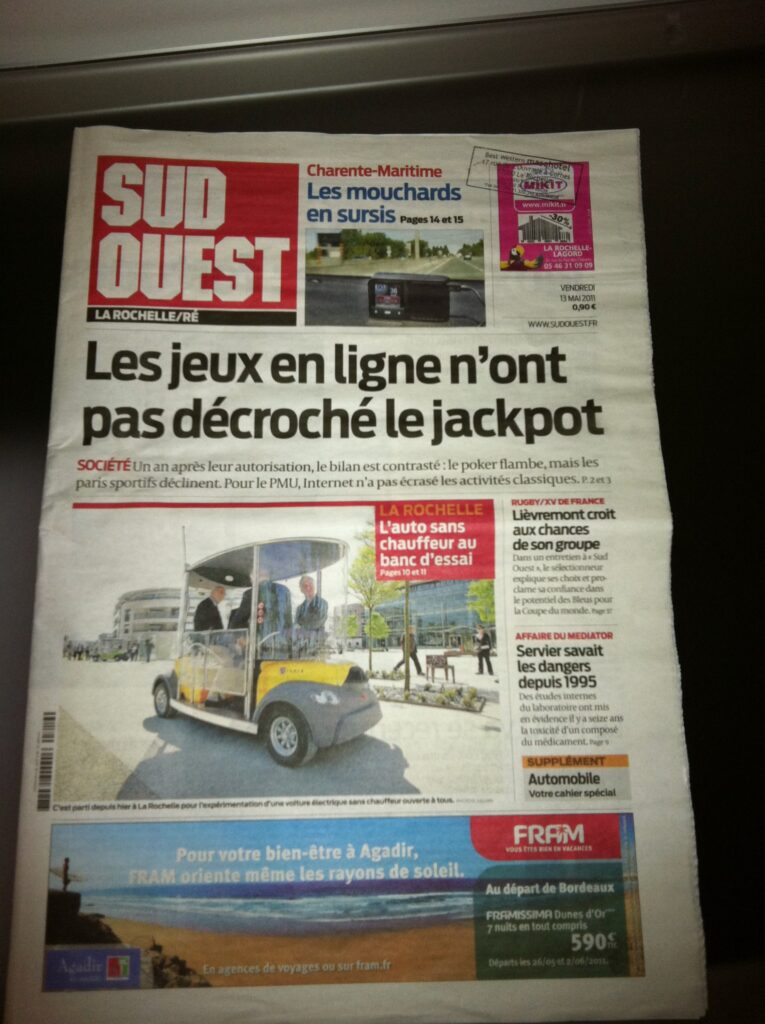
CITYMOBIL, La Rochelle, France (2011)
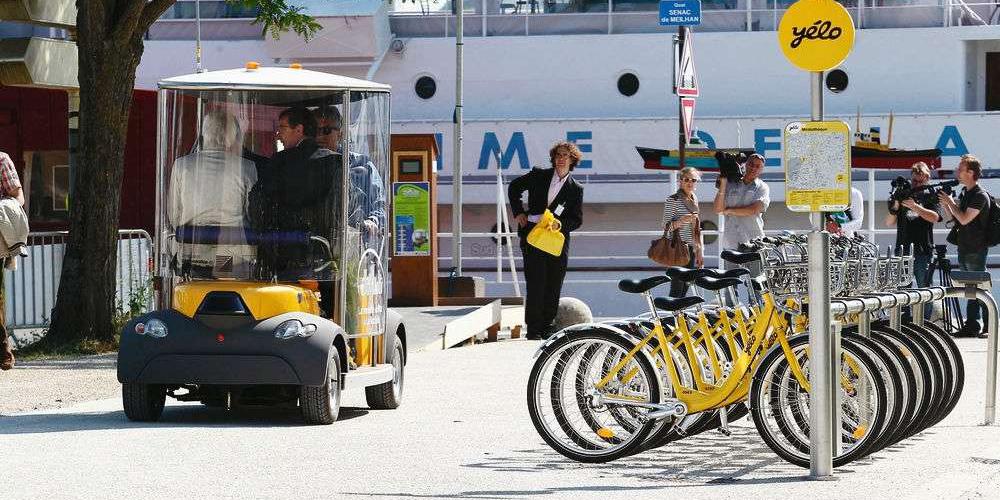
I hand-carried copies of my “Better-Drivers for Remote Control Driving” paper to the wrap-up conference for the CITYMOBIL research program. Program participants told me the Better-Drivers concept was sound, but no one would be willing to bet on it until they could see a demonstration project.

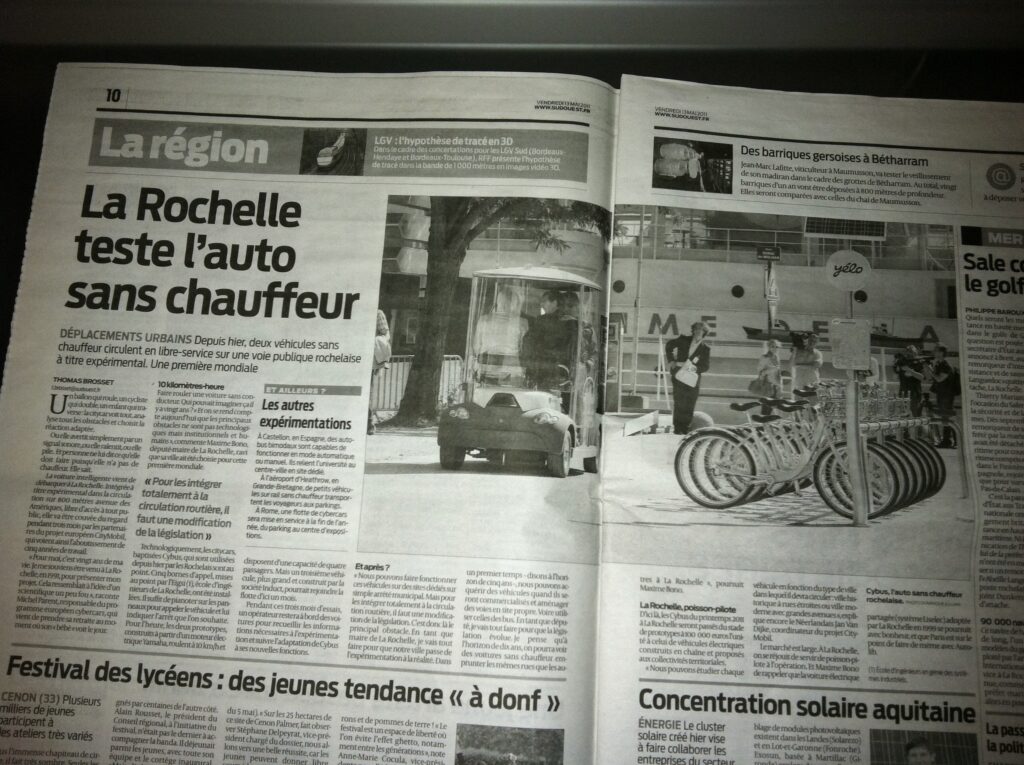
In La Rochelle I had the privilege of riding in the first automated vehicle to operate in mixed traffic. See photo above, from the local paper.

https://www.sudouest.fr/economie/transports/la-rochelle-teste-l-auto-sans-chauffeur-9657451.php
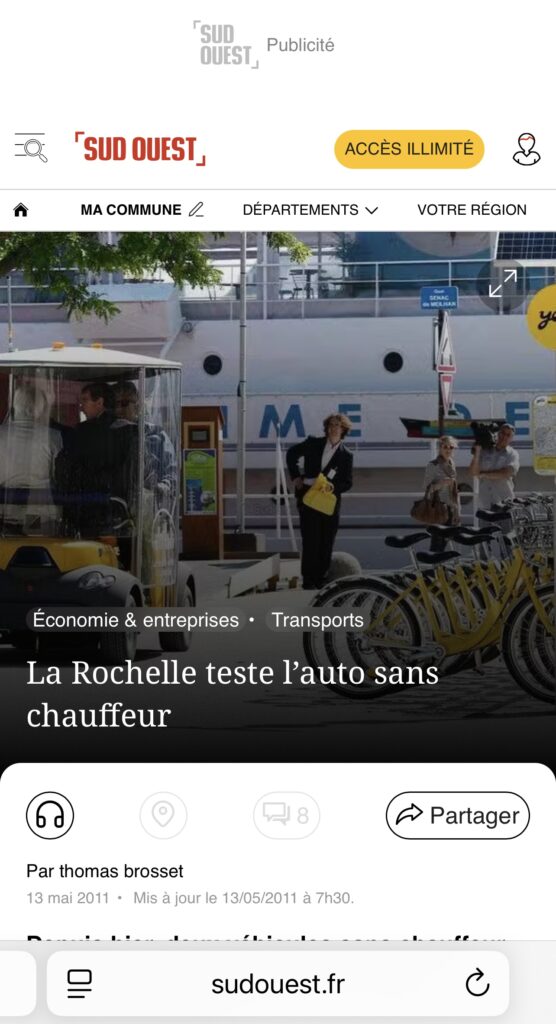
Screenshot

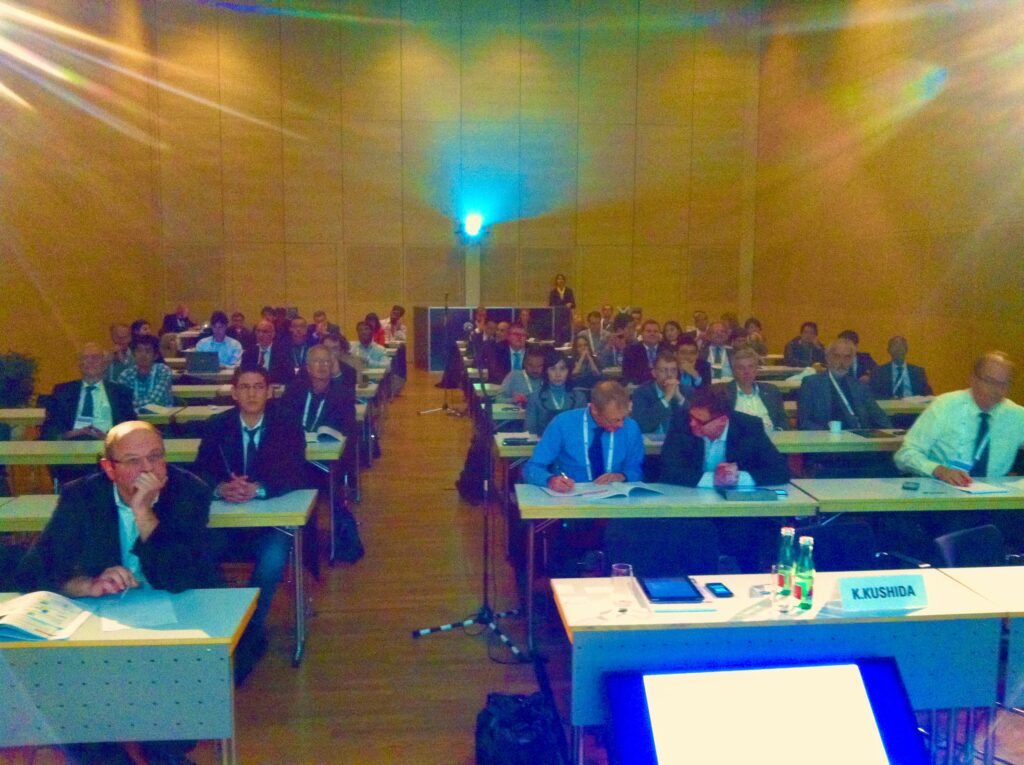
2012 Intelligent Transportation Systems World Congress, Vienna, Austria

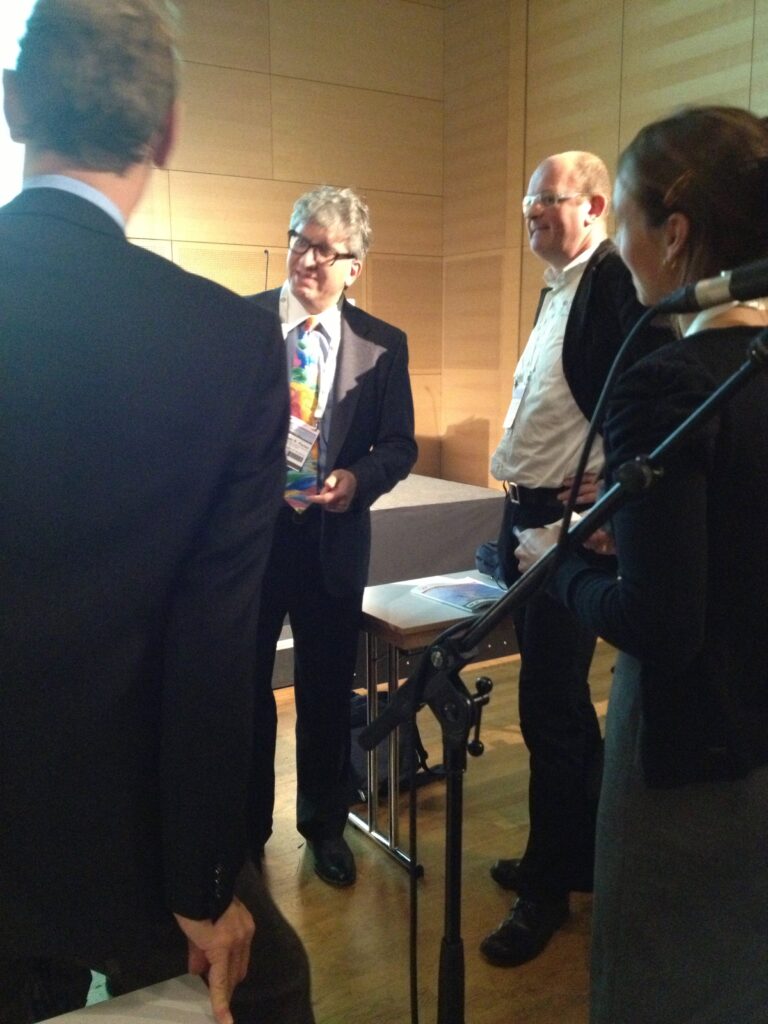
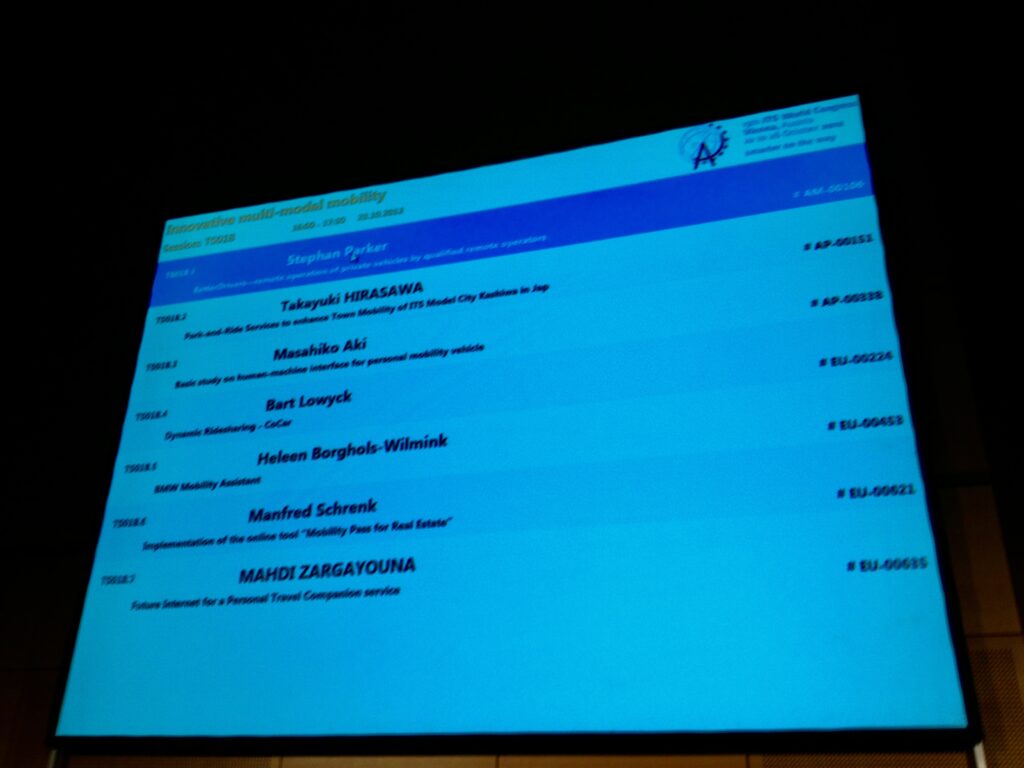
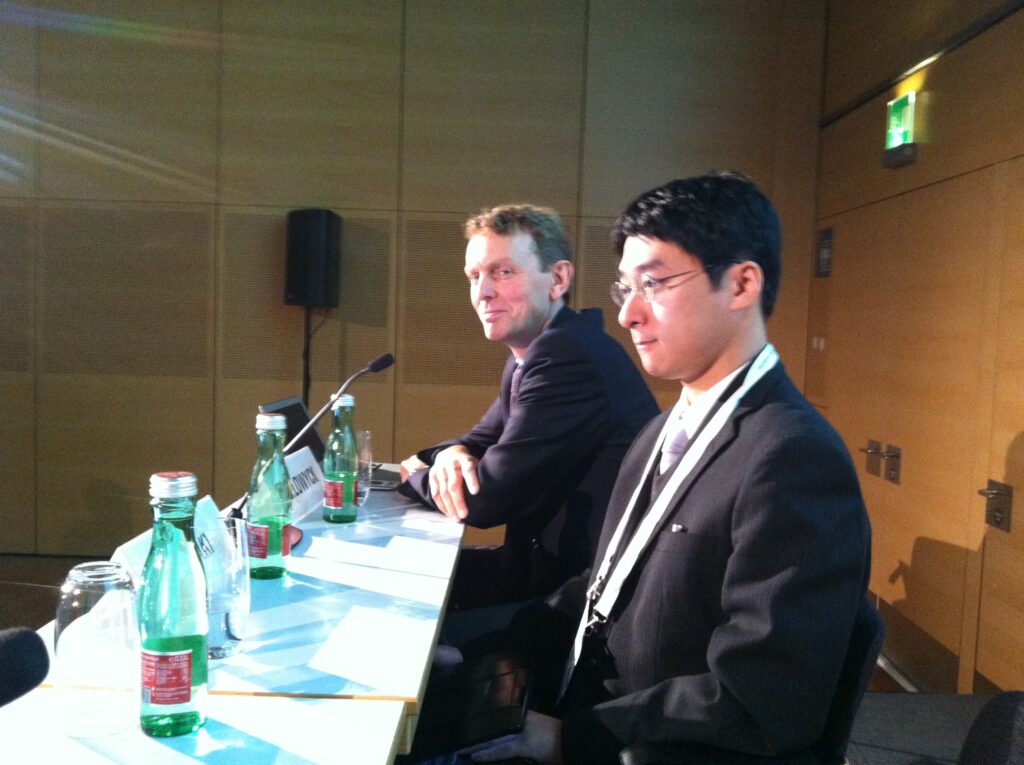
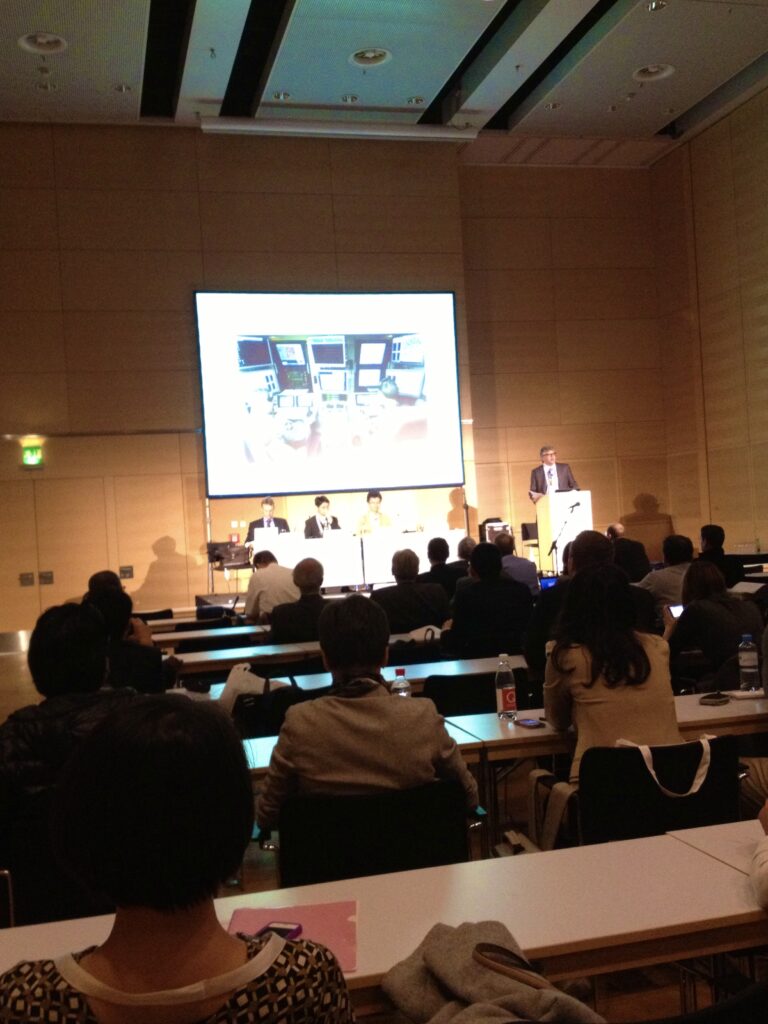
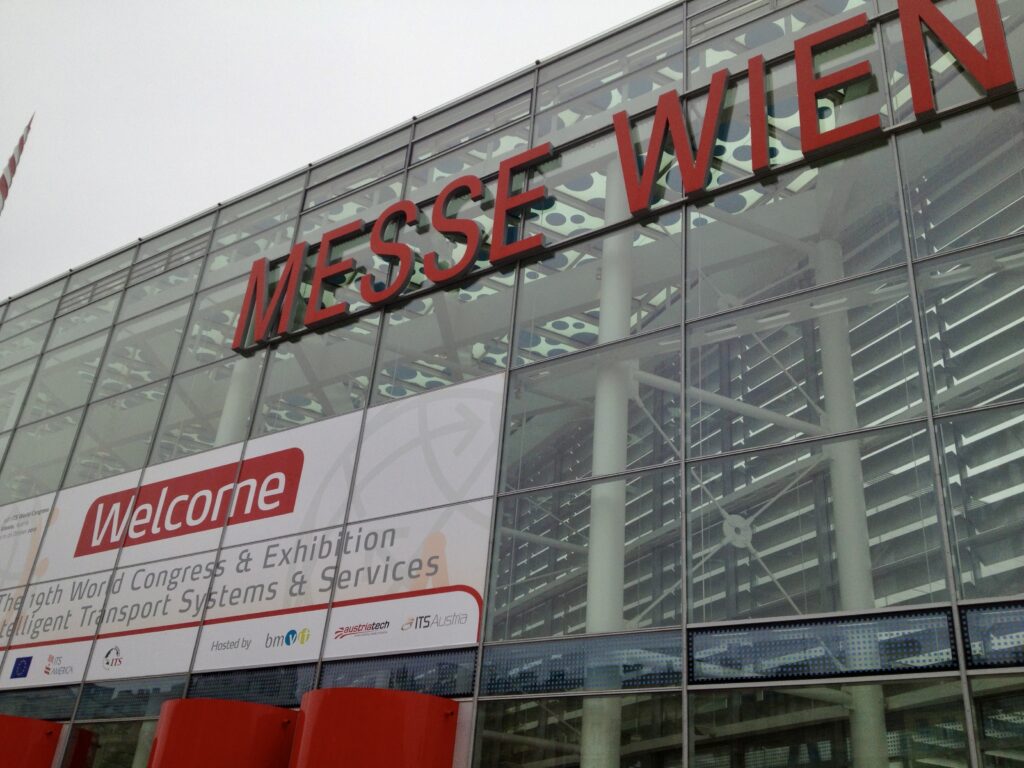
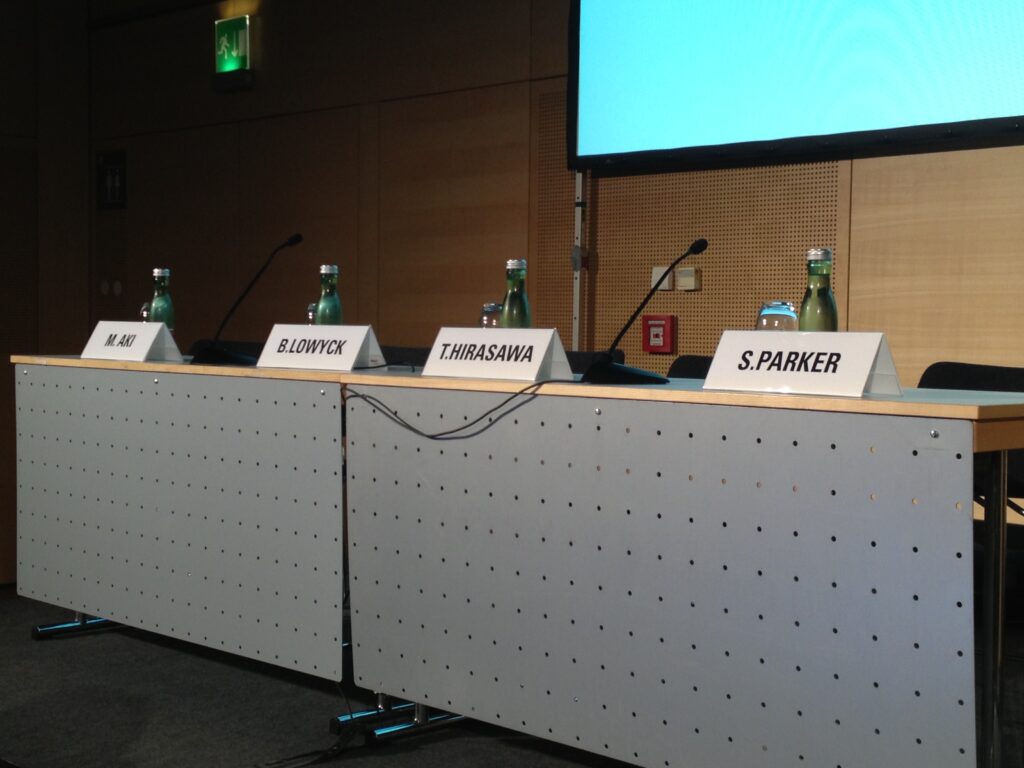
My bosses at the Transportation Research Board (TRB) authorized me to present at the 2012 ITS World Congress. They even paid my registration fee! I was thrilled to be the first speaker at the session “Innovative Multi-modal Mobility.”
2013 Intelligent Transportation Systems World Congress, Tokyo, Japan (paper withdrawn after acceptance)

My bosses at the Transportation Research Board (TRB) did not authorize me to present at the 2013 ITS World Congress. As my co-authors could not travel to present, either, we had to withdraw the paper. The draft is below.

The Future of Transit is Here: Rides on Demand Can Be Better Than (and Almost as Fast as)  Driving Yourself

Stephan A. Parker
Senior Program Officer, Transportation Research Board of the National Academies
500 Fifth Street NW, Washington, DC 20001 USA
TEL 202-334-2554, FAX 202-334-2006  saparker@nas.edu; BetterDrivers@icloud.com

Lawrence J. Harman

Co-Director, GeoGraphics Laboratory,
Conant Science and Mathematic Center
Bridgewater State University
Bridgewater, MA, 02325 TEL 508-531-6144   larry@geographicslab.org 

Nanda Srinivasan
Senior Program Officer, Transportation Research Board of the National Academies
500 Fifth Street NW, Washington, DC 20001 USA
TEL 202-334-1896, FAX 202-334-2006  nsrinivasan@nas.edu

ABSTRACT

For years, people in public transportation have focused on how to get people out of their cars in order to make transit efficient.  Changes in people’s attitudes and available technologies have recently begun to make markets respond to the enormous latent demand for mobility. Here is the future of transit: expanding mobility through entrepreneurial services that blend the best aspects of public and private transportation services. New service models, new vehicles, and new infrastructure are now in place to allow revolutionary improvements in productivity. An innovative research and demonstration project sponsored by the Cape Cod Commission and the Cape Cod Regional Transit Authority is integrating service models, technologies, communications infrastructure, and qualified operators to provide rides by remote control, a concept called Better-Drivers. The expected result: better mobility and many new jobs.

Keywords: autonomous vehicles, car sharing, transit on demand, remote operation, jobs

1. INTRODUCTION

For years, people in public transportation have focused on how to get people out of their cars in order to create demand densities that will make transit efficient.  With recent changes in people’s attitudes and available technologies, markets are responding in innovative ways to satisfice the latent demand for mobility. Here is the future of transit: expanding mobility through entrepreneurial services that blend the best aspects of public and private transportation services. New service models, new vehicles, and new infrastructure allow revolutionary improvements in transit productivity by effectively eliminating deadheading. Rather than resulting in fewer jobs, moreover, the ability to provide rides on demand without waiting time for a driver to physically get to your location is expected to create thousands of good jobs—in the locales that will allow the remote driving control technologies to be installed. There is a need for independent research to inform the policy makers so as to foster and reward innovation. To some extent, this will require swimming against the tide of open systems, as—for the sake of both operational security and technology investment amortization—it will be more efficient and effective to support proprietary systems that permit open data exchange (ODE). 

1.1 Vehicles

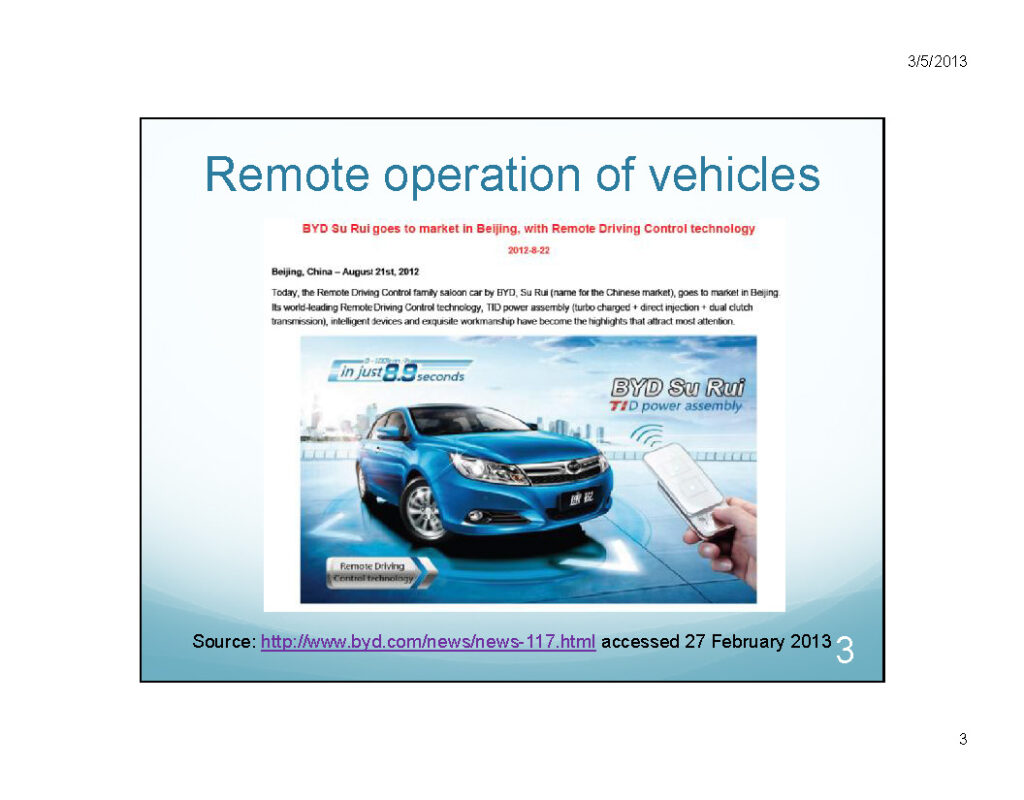
Recently, new vehicles and manufacturers have introduced advances in control technologies and marketing specifically to people with mobility challenges. In August 2012, the Chinese firm BYD put the Su Rui model on the market in Beijing, the first commercially available passenger vehicle with Remote Driving Control technology. The media were quick to realize that it is only a matter of time before the remote controls are hacked to remove the speed and range limiters (the remote control is intended to cap the speed at 2 kilometers per hour and the range at 20 meters in order to limit use of the technology to parking where there is not room to open the driver’s door). http://www.byd.com/news/news-117.html

January 2013 brought announcements by Toyota and Audi. As noted in Toyota’s news release:

While key components of these research efforts could lead to a fully autonomous car in the future, the vision is not necessarily a car that drives itself. Instead, Toyota and Lexus envision technologies that enhance the skills of the driver, believing a more skillful driver is a safer driver.
 
“In our pursuit of developing more advanced automated technologies, we believe the driver must be fully engaged,” said Mark Templin, Toyota group vice president and general manager of the Lexus Division. “For Toyota and Lexus, a driverless car is just a part of the story. Our vision is a car equipped with an intelligent, always-attentive co-pilot whose skills contribute to safer driving.”
 
The Lexus advanced active safety research vehicle is equipped with an array of sensors and automated control systems to observe, process and respond to the vehicle’s surroundings. These include GPS, stereo cameras, radar and Light Detection and Ranging (LIDAR) laser tracking.

Similarly, Audi’s news release also stops short of fully autonomous operation: 

Today, Audi defines autonomous driving capabilities in terms of piloted parking and piloted driving. The term “piloted” is used advisedly, as Audi envisions motorists enjoying the convenience of allowing the car to handle mundane stop-and-go driving conditions, for example, while still being able to take control of the car when needed. In this way, the technology is similar to auto-pilot systems found on jetliners. Likewise, autonomous, or piloted parking, would let future Audi models park safely without a driver at the wheel in tight parking spaces.

As the technologies that support a driver get more robust and require less driver attention, the temptation for the driver to pay less attention to the driving task and more attention to, say, entertainment and communications technology, could potentially confound the safety advances that these driver assistance technologies present. There is a solution for that.

1.2 Services

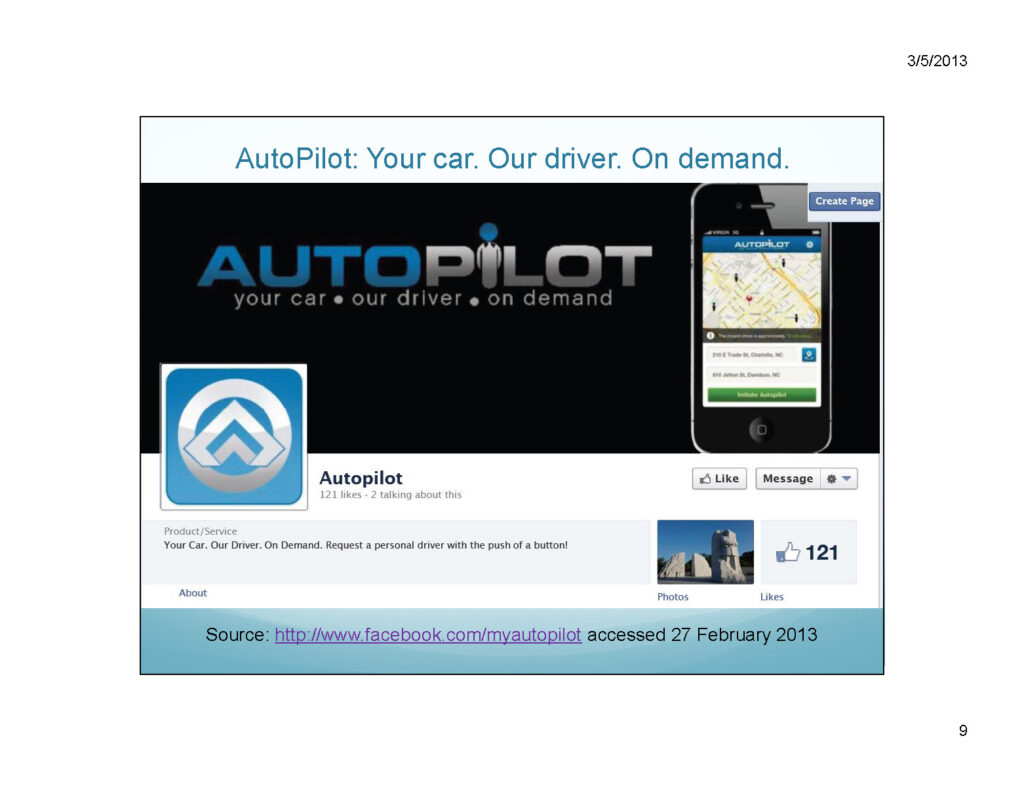
Car-sharing services have spread widely, but mobility for the entire mobile population requires more than just vehicles; drivers are needed, too. Examples of these innovations spreading from concepts to implementation can be found in the marketplace already. For example: 

AutoPilot, whose slogan is “Your car. Our driver. On demand.” http://www.myautopilot.co/pages/join

Lyft, which is marketed with the slogan “Your friend with a car, on demand.” http://lyft.me/safety 

The first of these services depends on having drivers in close enough proximity to the demand, which implies density requirements; the latter requires overlapping density of drivers and demand. Both are innovative and market-responsive. There is, however, a gap in the market that can be filled using these types of service models in a mash-up with demand-responsive public transportation.  

1.3 High-speed communications technology

It is possible to get the necessary low-latency today by employing DSRC with fiber backhaul. It is anticipated that sufficiently low latency can also be achieved using 4G LTE, which is likely to leverage the security and back-office billing infrastructure of traditional wireless telecommunications companies. 

4G LTE capabilities include:

  • Downlink peak data rates up to 326 Mbps with 20 MHz bandwidth
  • Uplink peak data rates up to 86.4 Mbps with 20 MHz bandwidth
  • Operation in both TDD and FDD modes
  • Scalable bandwidth up to 20 MHz, covering 1.4 MHz, 3 MHz, 5 MHz, 10 MHz, 15 MHz, and 20 MHz in the study phase
  • Increased spectral efficiency over Release 6 HSPA by two to four times
  • Reduced latency, up to 10 milliseconds (ms) round-trip times between user equipment and the base station, and to less than 100 ms transition times from inactive to active 

http://www.4gamericas.org/index.cfm?fuseaction=page&sectionid=249 

1.4 Integrated service models leverage communications technologies to remotely pilot vehicles

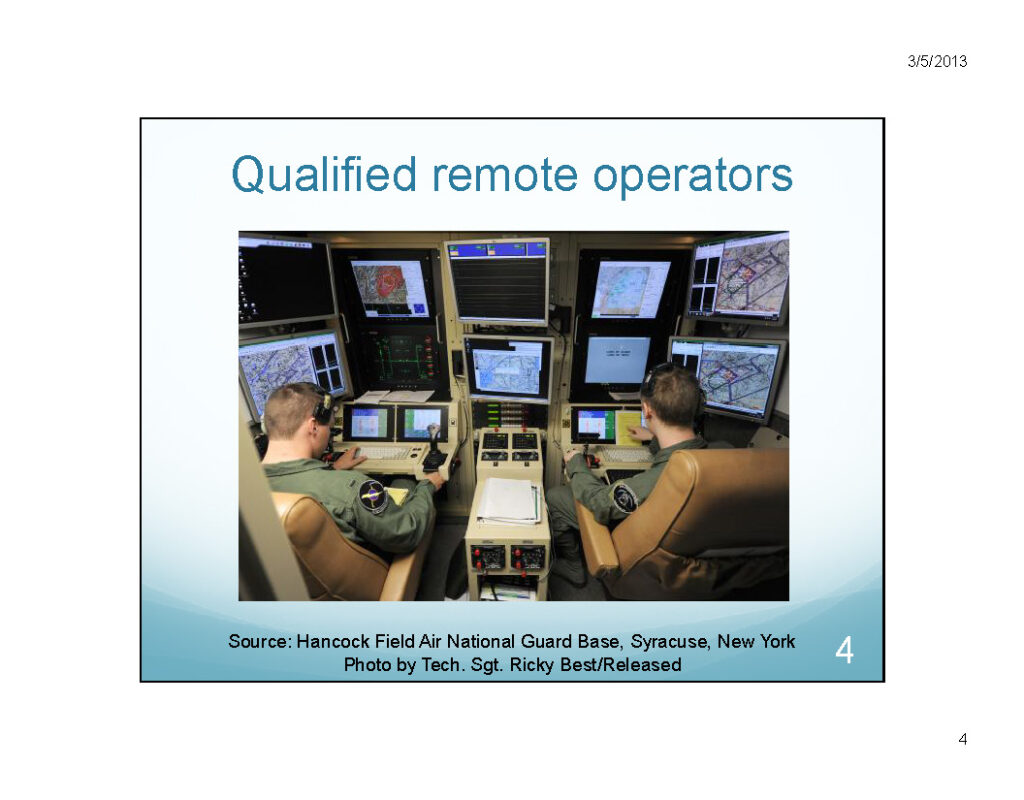
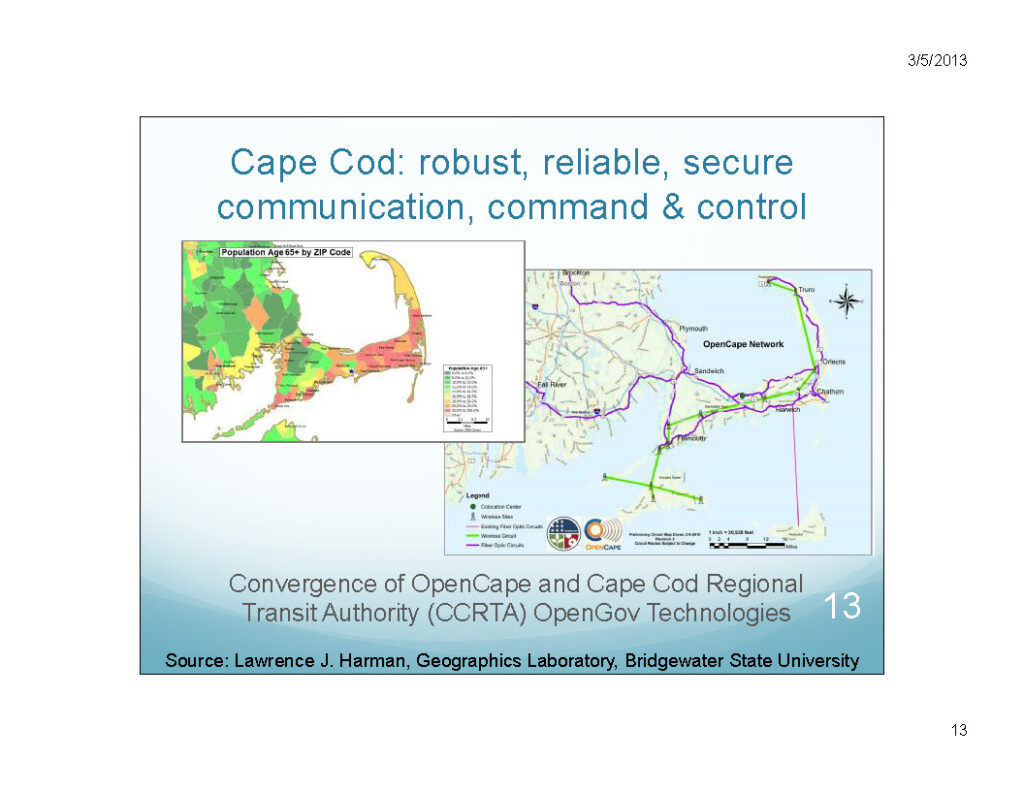
The Cape Cod Commission and the Cape Cod Regional Transit Authority are leveraging high-bandwidth fiber and dedicated high-bandwidth radio infrastructure installed for the OpenCape Broadband initiative to test the feasibility of remotely driving cars, a concept known as Better-Drivers. Using the model of drone pilots, who remotely pilot planes, and low-latency telecommunications through either (a) dedicated short-range communications (DSRC) with fiber backhaul or (b) 4G long term evolution (LTE) cell technology, qualified drivers in a call center can provide instant driving services to persons wishing such assistance. This will make the service delivery as seamless to riders as the one-call, one-click service request concept.

2. ACKNOWLEDGMENTS

The American Public Transportation Association and its Research and Technology Committee provided early vetting of the concepts in this paper. The Cape Cod Commission and the Cape Cod Regional Transit Authority are funding Bridgewater State University’s current research and development of systems engineering to test the feasibility of using remote drivers to provide rides on demand on the lower Cape.
 

About

From 2000 to 2023, Stephan A. Parker managed public transportation, pedestrian, and bicyclist projects as well as projects in the surface transportation resilience-, security-, emergency management-, and critical infrastructure protection-related research efforts in the Cooperative Research Programs at the Transportation Research Board (TRB) of The National Academies, coordinating technical panels and contractors to produce dozens of reports.

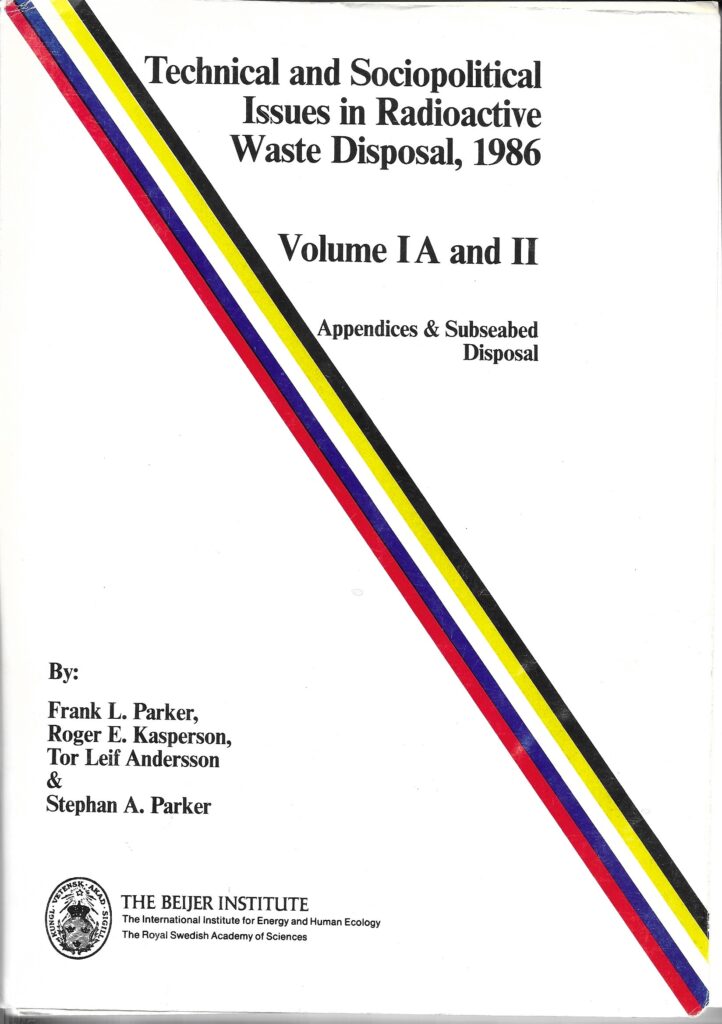
Prior to joining TRB in 2000, Mr. Parker developed Intelligent Transportation Systems courses and ran the NTI Fellows program for the Advanced Technologies and Innovative Practices section at the National Transit Institute at Rutgers, The State University of New Jersey. He earned a BS in Speech from Northwestern University and an MS in Interdisciplinary Studies: Civil Engineering and Management of Technology from Vanderbilt University. Mr. Parker is author of An Assessment of U.S. Hazardous Materials Emergency Response Preparedness (MS thesis, Vanderbilt University, 1994) and co-author of Technical and Sociopolitical Issues in Radioactive Waste Disposal, 1986 (The Royal Swedish Academy of Sciences, 1987). He served as Scholar Associate for a Review of the Department of Homeland Security’s Approach to Risk Analysis (National Academy of Sciences, 2010).

Mr. Parker began his transportation career as a bus driver. As the Administrator for the Joint Powers Transportation Board of the Town of Jackson and Teton County, he served as the general manager for the START Bus transit system in Jackson Hole, Wyoming, and was founding vice-president of WYTRANS, the Wyoming Public Transit Association.

In 2010, Mr. Parker began developing the business case for Better-Drivers–remote piloting of vehicles by qualified operators. Relevant presentations: (1) 2013 National Rural Intelligent Transportation Systems Conference, St. Cloud, Minnesota; (2) 2013 American Public Transportation Association’s TransITech Conference, Phoenix, Arizona; (3) 2012 Intelligent Transportation Systems World Congress, Vienna, Austria.

Steph produced comedy revues in Jackson Hole from 1988 to 1992 for the Roadkill on a Stick Frozen Foods Theatre Company. He co-produced a studio album – A Roadkill Opera – in 2013. In 2016, he produced four fully staged performances with a chamber orchestra and two fully staged performances with the Symphony Orchestra of Northern Virginia.

October 2024 saw the release of a two-disc 180-gram vinyl gatefold LP.

Roadkill!!! Greatest Hits! A Roadkill Opera Movie was released on YouTube in August 2025.
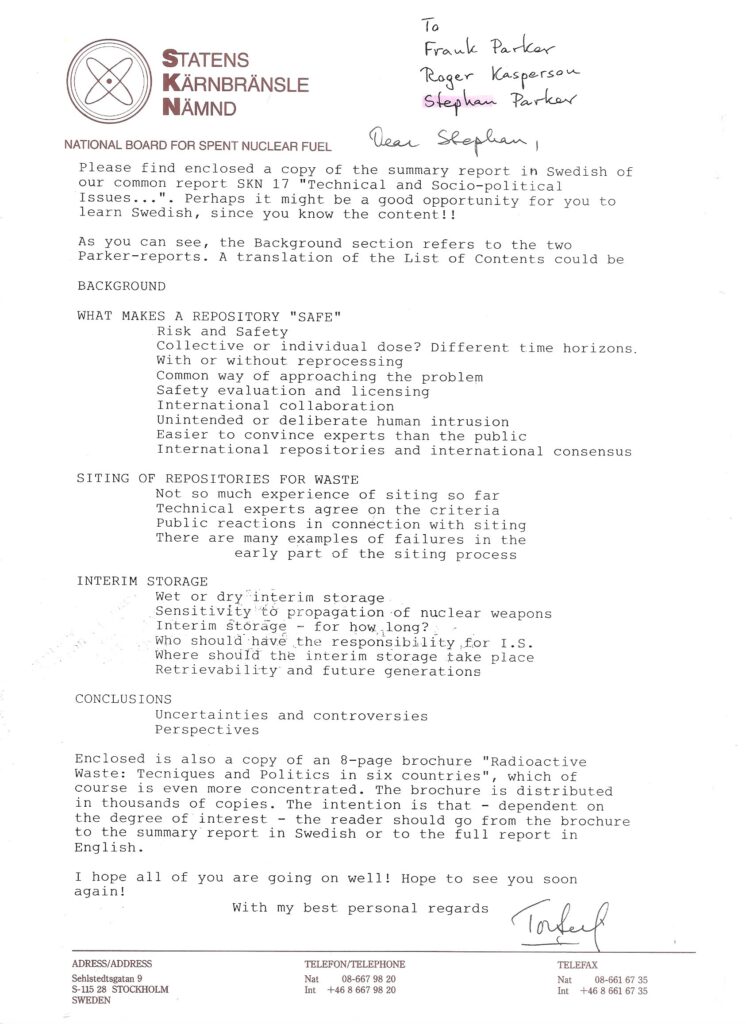
Technical and Sociopolitical Issues in Radioactive Waste Disposal, 1986

With the resumption of interest in opening nuclear power plants in the United States, it seems prudent to make this report more visible to interested parties. I would particularly call attention to a key question addressed in this report that remains most relevant: what constitutes “safe” disposal?

April 26, 2026, is the 40th anniversary of the 1986 Chernobyl disaster. It took place as a small research team assembled by the Beijer Institute was preparing for the first of two sets of visits with persons and organizations in the Federal Republic of Germany, France, Great Britain, Sweden, and Switzerland as well as international organizations headquartered in Belgium. 

As stated in the Foreword to Technical and Sociopolitical Issues in Radioactive Waste Disposal, 1986, by Gordon T. Goodman, Executive Director, and Lars Kristoferson, Vice Executive Director of the Beijer Institute:

“We are extremely grateful to the Research Team for the highly competent and penetrating way in which they have prepared the material for this report. Not only is the topic an inherently difficult and complex one from the scientific point of view, but a series of extra complications were added by the Chernobyl accident which happened during the course of the Study. This made several drastic revisions of the original workplan necessary. Finally, the whole issue of radioactive waste management is so highly politicized that serious social controversies are the order of the day. We are sure that readers will be able to appreciate the team’s efforts in analyzing, assessing and presenting the issues and problems in a fair and comprehensive way.”

The work was ordered and funded by Statens Kärnbränslenämnd, SKN (The Swedish National Board for Spent Nuclear Fuel) and organized by The Beijer Institute. The report is now nearly 40 years old; much has happened in many of the countries described, even if these processes generally are very slow.

As stated in Chapter 1’s Initial Considerations section of Technical and Sociopolitical Issues in Radioactive Waste Disposal, 1986:

“…there is no single ‘correct’ answer to any of these questions any more than there is to what constitutes a ‘good life.’ In the succeeding chapters we shall detail how the commonalities as well as the differences affect the solutions reached in each of the countries. 

“To make our understanding of the problems within the individual countries more complete, we visited not only the producers of nuclear waste, (which, depending upon the country, are state-owned, privately-owned, or some combination thereof) but also the agencies which regulate the disposal of nuclear waste(which, again, depending upon each country, may be the federal government, or be highly dependent upon local governments). In some countries, even though there is no legal requirement for the local political unit to make a decision, in fact, because of the power or influence of those units, it would be very difficult for the central government to establish a repository without the concurrence or at least the tolerance of the local government unit.

”In addition, we interviewed members of the environmental and ecological movements and/or political opposition or proponents in each of the countries.”

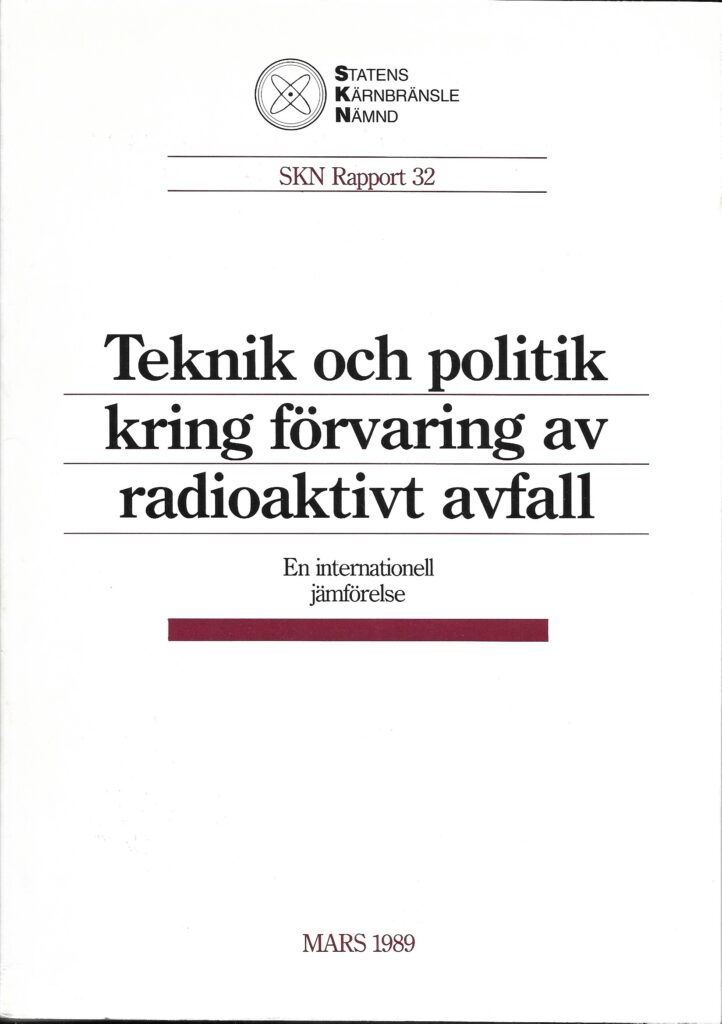
One of the members of the small research team assembled by the Beijer Institute was Tor Leif Andersson, Tellus Energi AB. SKN Report 17 was published in English; Tor Leif Andersson subsequently prepared a very popular, short version of SKN Report 17 in Swedish, issued as SKN Rapport 32.

Andersson, T. L. Teknik och politik kring förvaring av radioaktivt avfall. En internationell jämförelse. Stockholm: Statens Kärnbränslenämnd, 1989.

Tor Leif Andersson described our research team in his 1989 report’s Bakgrund (in part):

——————

Författarna

Frank Parker är professor i Environmental and Water Resources Engineering vid Vanderbilt University, Nashville, Tenn, USA. Han är även ordförande i Styrelsen för hantering av radioaktivt avfall (Chairman of the the Board of Radioactive Waste Management) nom USA:s vetenskapsakademi (US National Academy of Science).

Roger Kasperson är professor i geografi vid Clark University, Worcester, Mass, USA. Han har särskilt intresserat sig för hur allmänheten agerar i samband med olika stora projekt som i hög grad kan beröra större eller mindre grupper av befolkningen, såsom anläggning av storflygplatser, hamnar etc. Han har bl a skrivit boken “Equity Issues in Radioactive Waste Management” (Rättvisefrågor i samband med hantering av radioaktiv avfall).

Tor Leif Andersson är docent i fysik och verksam som energikonsult i Sverige.

Stephan Parker är forskningsassistent och redaktör. Sammanfattningen av materialet har gjorts av Tor Leif Anderson.

——————

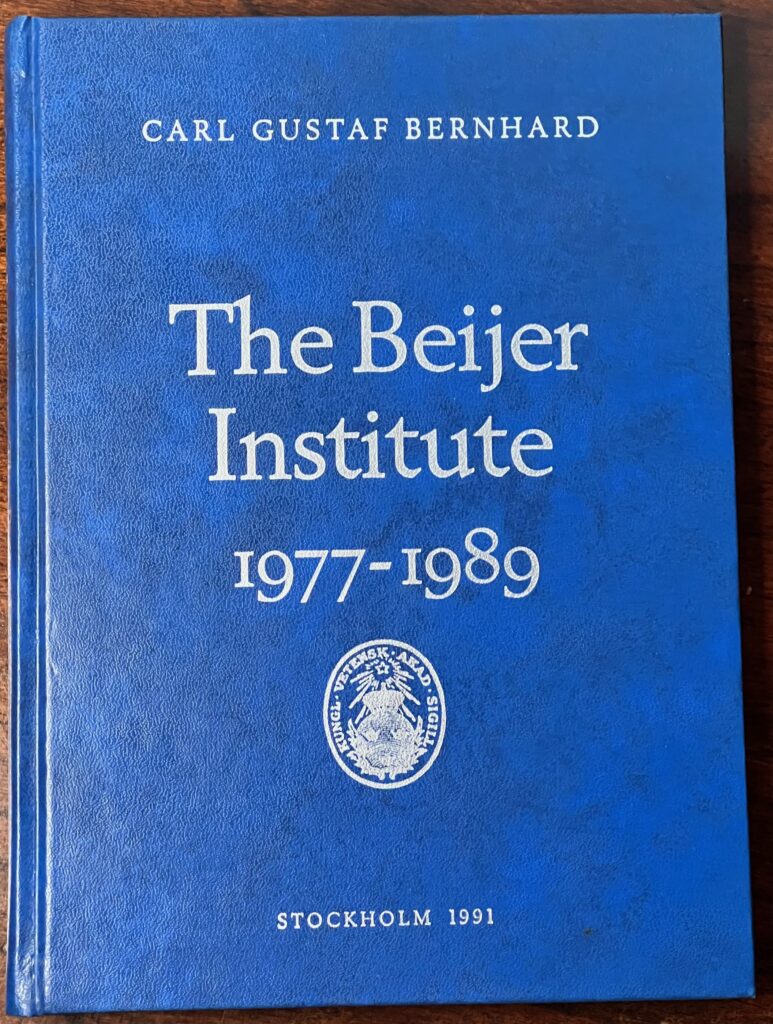
The work was summed up in the section titled Radioactive Waste in Carl Gustaf Bernhard’s 1991 book, The Beijer Institute 1977-1989 [English translation by Roger Tanner].

One of the most difficult problems of the energy sector concerns the long-term consequences of energy policy. Climatological effects of the use of fossil fuels later came to be dealt with under one of the Institute’s main programmes (see below), while questions relating to the long-term deposition of radioactive waste were broached early on. Thus a series of studies was undertaken in collaboration with the National Nuclear Fuels Board (SKN) and other agencies, to see how Sweden and other advanced industrialised countries were dealing with these questions. The countries investigated were those with fully-fledged nuclear energy programmes, viz Belgium, Canada, West Germany, France, Japan, Switzerland and the USA.

The results were published, as work proceeded, in a series of reports from the Beijer Institute: “The Disposal of High-Level Radioactive Waste” (1984, Vols. I and II), by Frank L. Parker, Robert E. Broshears and Janos Pastor and

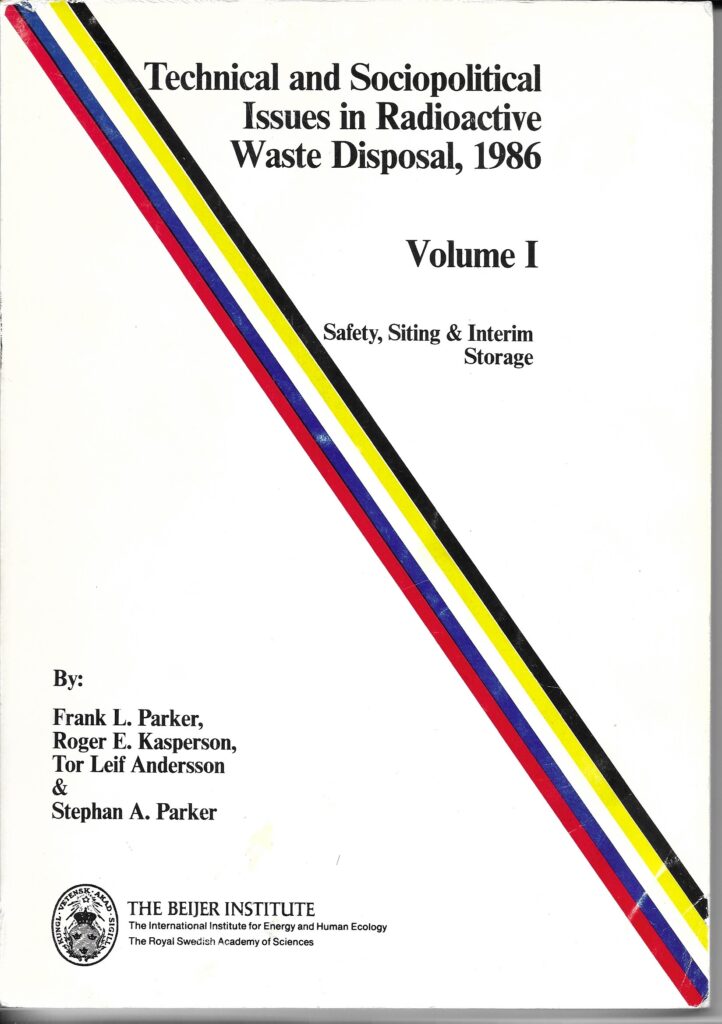
“Technical and Sociopolitical Issues in Radioactive Waste Disposal” (1986, Vols. I, IA and II) by Frank L. Parker, Roger E. Kasperson, Tor Leif Anderson and Stephan A. Parker.

These studies revealed, firstly, concurrence between the countries concerned on many of the technical issues but, secondly, considerable differences of attitude both politically and technically speaking. Public standpoints generally did a great deal to influence political decisions, while having little effect on technical decisions and risk appreciation. The politicisation of programmes for the deposition of radioactive waste appeared on the whole still to be increasing and to stand in the way of planning work.

All the above mentioned countries were resorting to intermediate storage, some of them close to the reactors, others in remote spots. Whereas West Germany and the USA were demanding terminal disposal of highly radioactive waste within the near future, Britain intended to continue with intermediate storage for at least a few more decades. In most countries, the problem was not finding a suitable place for deposition but rather gaining the public support needed for developing and using potential areas. In the case of small countries lacking suitable geological conditions for the purpose or having only limited nuclear programmes, international deposition, e.g. under the sea bed, seemed to be a desirable proposition. Deposition arrangements of this kind, however, have not been found acceptable either nationally or internationally, even though technically speaking they are a possible solution.

The palpable opposition occurring in many countries frequently has an ecological and philosophical background. To this are added international agreements which have obstructed the use of such forms of deposition. It should be added here that the research group was at pains to stress that it had found no cause for assuming that deep geological deposition of radioactive waste would lead to problems of catastrophic proportions.

The results were published in a series of monographs, and an evaluation of the current studies was made in 1985.
The work on risk-assessment and perception showed that these issues were so pervasive in the energy-environment field that it came to be integrated into the main fabric of all of its activities instead of, as previously, being conducted under a separate programme.
——————

Roger Kasperson was a member of the National Academy of Sciences and in 1999 was elected Director of the Stockholm Environment Institute, a post he held through 2004. He served on the Human Dimensions of Global Change Committee and the Committee on Strategic Advice for the Climate Change Program of the U.S. National Research Council, was co-chair of the scientific advisory committee of the Potsdam Institute for Climate Change, and was on the Executive Steering Committee of the START Programme of the IGBH. He was Research Professor and Distinguished Scientist at Clark University. He was the Executive Director of the Stockholm Environment Institute from 2000 to 2004. He passed away in April 2021.

Frank Parker was elected to the National Academy of Engineering (part of the National Academies) in 1988, the year after our report was published. He celebrated his 95th birthday in March 2021 and passed away in August 2022. He is also my father. On a 2021 visit with him, Frank mentioned that the report that he, Roger Kasperson, Tor Leif Andersson, and I authored is cited in the seminal work of the sustainability movement.

United Nations World Commission on Environment and Development, ed. Report of the World Commission on Environment and Development: Our Common Future. Oxford: Oxford University Press, 1987. http://www.un-documents.net/our-common-future.pdf 

“The UN’s World Commission for Environment and Development, chaired by former Norwegian Prime Minister Gro Harlem Brundtland and thus referred to as the Brundtland Commission, published the report “Our Common Future,” also known as the “Brundtland Report,” in 1987. Influenced by the 1980 “World Conservation Strategy” of the International Union for Conservation of Nature (IUCN) the report defined the principle of sustainable development as “development that meets the needs of the present without compromising the ability of future generations to meet their own needs.” The publication of the report is considered a milestone in triggering international awareness and discourse on the importance of global sustainable development.” – Source: The Rachel Carson Center’s Environment & Society Portal http://www.environmentandsociety.org/mml/un-world-commission-environment-and-development-ed-report-world-commission-environment-and 

The relevant section of Our Common Future is:

2.4 Radioactive Waste Disposal

52. Civil nuclear energy programmes worldwide have already generated many thousands of tons of spent fuel and high-level waste. Many governments have embarked on large-scale programmes to develop ways of isolating these from the biosphere for the many hundreds of thousands of years that they will remain hazardously radioactive.

53. But the problem of nuclear waste disposal remains unsolved. Nuclear waste technology has reached an advanced level of sophistication./50

Our Common Future footnote, on page 170:

50/ F.L. Parker et al., The Disposal of High Level Radioactive Waste – 1984, Vols. 1 & 2 (Stockholm: The Beijer Institute, 1984); F.L. Parker and R.E. Kasperson, International Radwaste Policies (Stockholm: The Beijer Institute, in press).

There are two Beijer Institute reports cited; the latter, cited while in press, was eventually published as

Parker, F., R.E. Kasperson, T. Anderson, and S. Parker. 1987. Technical and socio-political issues in radioactive waste disposal. Vol. I: Safety, siting, and interim storage. Vol. II: Subseabed disposal. Stockholm: The Beijer Institute. Also published in three volumes under the same title by Statens Kärnbränsle Nämnd (National Board of Spent Fuel) of Sweden, SKN Report 17, Stockholm: 1987.

As the Beijer Institute’s publication is not findable online, I have scanned and posted the covers and the Foreword. Those appear to be the only differences between the versions published by the two institutions.

Full text PDFs of Technical and Sociopolitical Issues in Radioactive Waste Disposal, 1986, are available for free download:

Volume I: Safety, Siting and Interim Storage. Statens Kärnbränsle Nämnd (National Board of Spent Fuel) of Sweden, SKN Report 17, Stockholm: 1987. https://inis.iaea.org/collection/NCLCollectionStore/_Public/19/059/19059761.pdf?r=1 

Vol. IA: Safety, Siting and Interim Storage. Statens Kärnbränsle Nämnd (National Board of Spent Fuel) of Sweden, SKN Report 17, Stockholm: 1987.  https://inis.iaea.org/collection/NCLCollectionStore/_Public/19/059/19059665.pdf

Volume II: Subseabed Disposal. Statens Kärnbränsle Nämnd (National Board of Spent Fuel) of Sweden, SKN Report 17, Stockholm: 1987. https://inis.iaea.org/collection/NCLCollectionStore/_Public/19/059/19059762.pdf?r=1&r=1

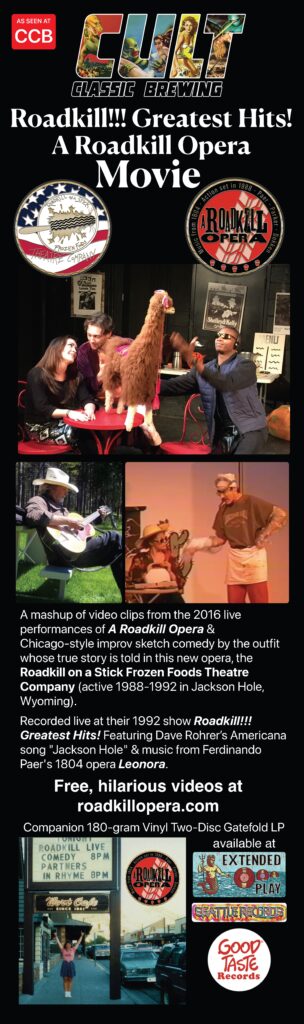
FREE! on YouTube: Roadkill!!! Greatest Hits! A Roadkill Opera MOVIE

After a successful in-person premiere at Cult Classic Brewing in June 2025, the full 73-minute movie had a FREE YouTube streaming premiere Sunday, August 31, 2025

Stream it now!

Extras: Trailers, out-takes, etc. for Roadkill!!! Greatest Hits! A Roadkill Opera Movie

About the Movie

Roadkill!!! Greatest Hits! A Roadkill Opera Movie is a mashup of a backstage, screwball comedy set in 1988 Wyoming with music from Ferdinando Paer’s 1804 opera Leonora. It tells the true story of the the hour before the lights go up on the first professional gig for an amateur sketch comedy improv troupe–the Roadkill on a Stick Frozen Foods Theatre Company–at the legendary Silver Dollar Bar in the Wort Hotel in Jackson Hole. During that hour, they find out their showroom will be torn down after their run. Hilarity ensues.

This movie is essentially a demo to encourage live performances of music from Ferdinando Paer’s 1804 opera Leonora. And to tell the story of a small-time comedy troupe along the way.

It is made from live performances in October 2016, January 2016, June 2012, March 1992, and August 1988, along with tracks from the 2013 studio recording of A Roadkill Opera.

The opera itself is a lightly fictionalized telling of the story of the 1988 comedy troupe.

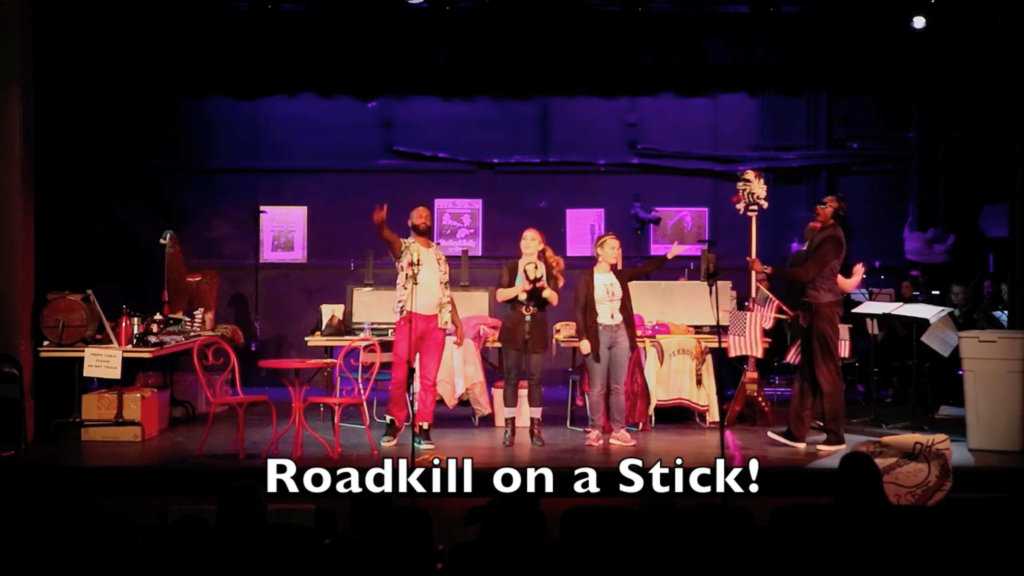
Photo of the cast (left to right): Larry Boggs, baritone, as Eddie; Laura Wehrmeyer, soprano, as Holly; Kelly Curtin, soprano, as Debbie; Christopher Dews as Marv; and conductor/music director/stage director Jeffrey Dokken onstage in the finale of the Symphony Orchestra of Northern Virginia's (SONOVA's) two free, fully staged performances of A Roadkill Opera at the James Lee Community Theater in Falls Church, Virginia on October 21, 2016. Subtitle: "Roadkill on a Stick!"
The cast (left to right): Larry Boggs, baritone, as Eddie; Laura Wehrmeyer, soprano, as Holly; Kelly Curtin, soprano, as Debby; Christopher Dews as Marv; and conductor/music director/stage director Jeffrey Dokken, tenor, as Dave (behind Christopher Dews) onstage in the finale of the Symphony Orchestra of Northern Virginia‘s (SONOVA’s) two free, fully staged performances of A Roadkill Opera at the James Lee Community Theater in Falls Church, Virginia on October 21, 2016. Footage shot at that show makes up the bulk of Roadkill!! Greatest Hits! A Roadkill Opera Movie.

Specifically, the movie combines footage from A Roadkill Opera‘s 2016 live shows at the James Lee Community Theater in Falls Church, Virginia; the Mead Theatre Lab at Flashpoint in Washington, DC; a brief segment from an Artomatic 2012 workshop in Crystal City, Virginia; and sketches video-recorded live at the Jackson Hole comedy revues by the Roadkill On A Stick Frozen Foods Theatre Company (active 1988-1992), principally at their final 1992 show Roadkill!!! Greatest Hits!

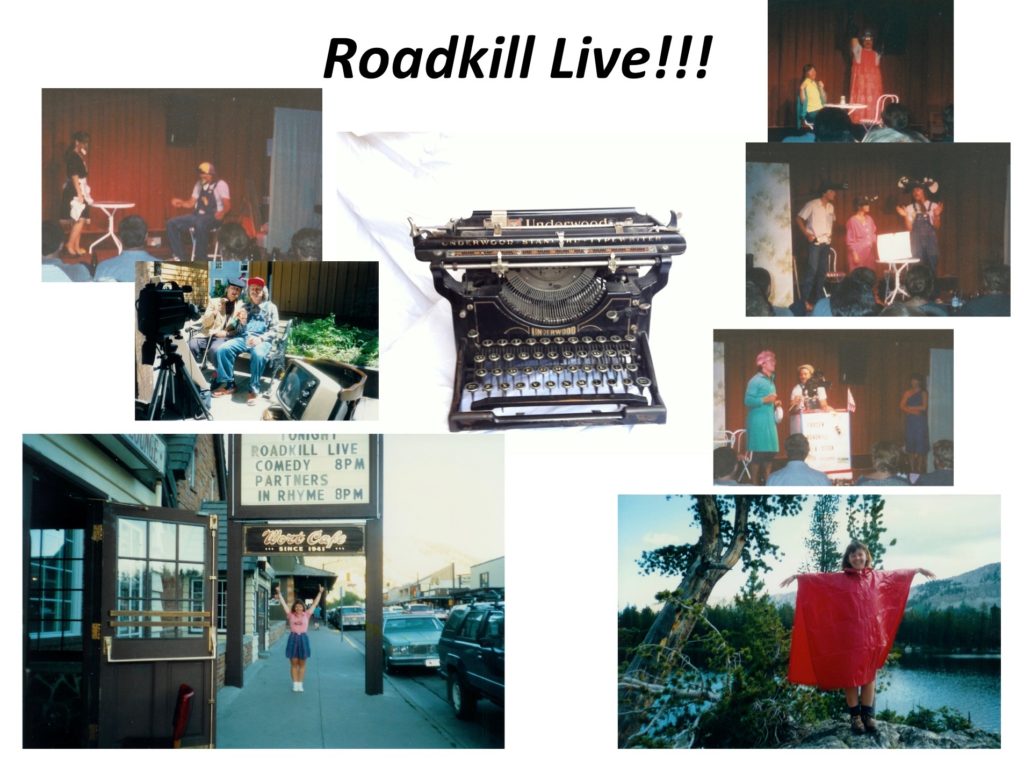
Photo collage showing scenes from Roadkill Live!!! surrounding a photo of an Underwood Standard 1912 manual typewriter. The collage includes scenes of two old men on a bench, three players with animal masks, two players at a cart that says Frozen Roadkills on a Stick, and a woman posed like a cheerleader under the marquis at the Wort Hotel where the sign includes the text Roadkill Livev Comedy 8 pm.
Roadkill!!! Live! ran for 8 weeks at the Wort Hotel’s Silver Dollar Bar Showroom in 1988. The story of the hour before the first professional gig for the improv comedy sketch troupe is the basis for A Roadkill Opera. Shown clockwise from the top right, from left to right in each photo: Holly Danner and Ed Bachtel in “Cod Piece Dining Room”; Stephan Parker and Ed Bachtel in “Frozen Roadkills on a Stick”; Deb “DJ” Choupin stunningly beautiful in a red poncho, posing pre-show at Phelps Lake in Grand Teton National Park; box office manager Deb “DJ” Choupin standing under the marquis outside the Wort Cafe cheering us on opening night; Stephan Parker and Ed Bachtel filming a promo as characters from “Old Men”, which was improved each night at the top of the show; Holly Tanner and Ed Bachtel in “Leave It to Beaverzilla”.

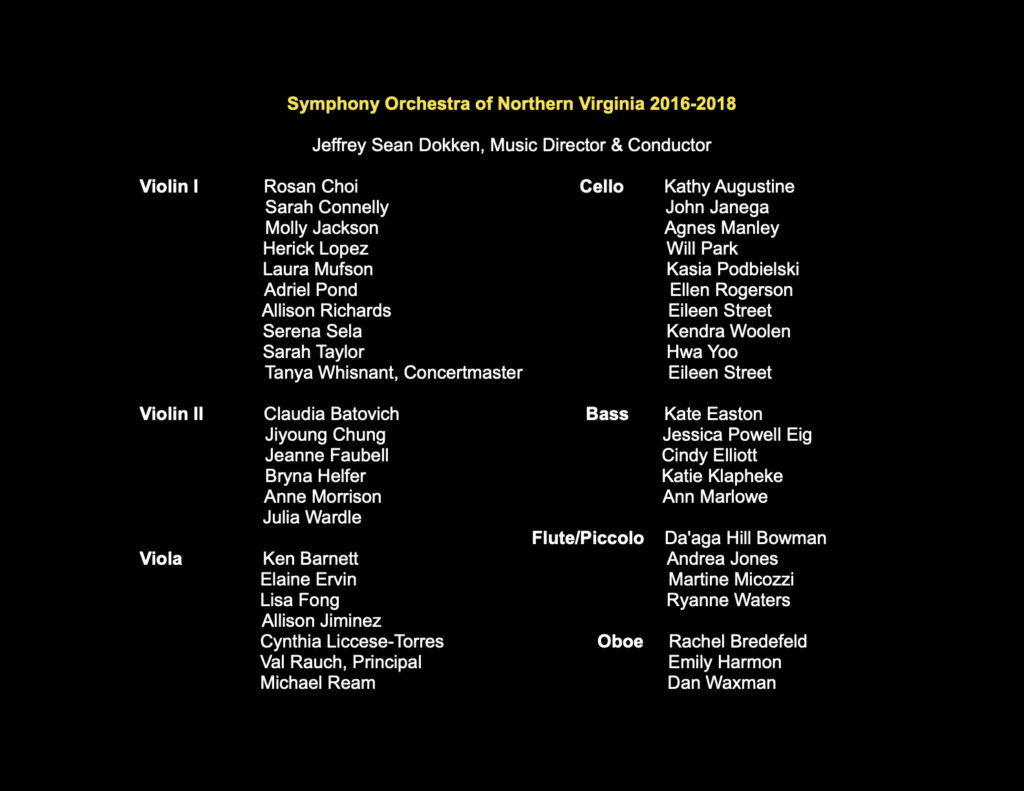
Included in the movie are live and studio performances of Dave Rohrer’s Americana song Jackson Hole and music from Ferdinando Paer’s 1804 opera Leonora performed by the Symphony Orchestra of Northern Virginia under the music direction of Maestro Jeffrey Dokken (currently the Music Director for the National Football League’s Washington Commanders; Music Director and Conductor of The American Contemporary Classical Orchestra in Washington, DC; and Music Director and Conductor of The Rome Symphony Orchestra in Rome, Georgia).

Jackson Hole” is an Americana song written and performed by Dave Rohrer, first at the 1988 Roadkill!!! Live! shows at the Silver Dollar Bar’s Showroom at the Wort Hotel in Jackson, Wyoming. Dave also played all the instruments on the studio recording of that song, which he also engineered, mixed, and mastered.

Classic sketches from the 1988 and 1992 comedy revues in the movie include “Frozen Roadkills on a Stick” and “Cod Piece Dining Room,” both written by Ed Bachtel. Ed, Stephan Parker, and Louise Gignoux (who was in the 1992 cast) appear in the movie’s sketches. Holly Danner (who was in the 1988 cast) is seen as the cast takes a bow.

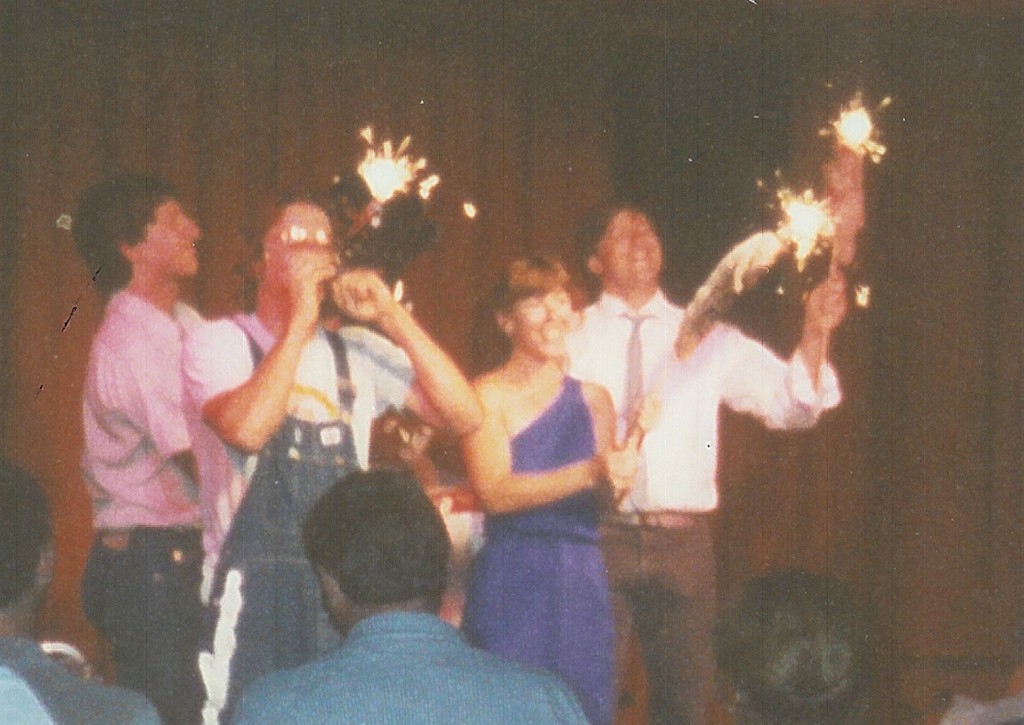
Photo: Ed Bachtel performs the national anthem as Stephan Alexander Parker, Holly Danner, and Dave Rohrer hold roadkills on a stick with sparklers to a standing ovation at the sold-out final 1988 performance of Roadkill Live!!!
Ed Bachtel performs the national anthem as Stephan Alexander Parker, Holly Danner, and Dave Rohrer hold roadkills on a stick with sparklers to a standing ovation at the sold-out final 1988 performance of Roadkill!!! Live!

With action set in the 1980s, this over-the-top production employs presentational and naturalistic theatrics; borrows tropes from Sherlock Holmes, the Marx Brothers, vaudeville, silent movies, and Monty Python’s Flying Circus; and nods to King Kong, Marie Antoinette, and the Dead End Kids/Bowery Boys. Works by Weird Al Yankovic and PDQ Bach belong on the same playlist as the soundtrack to Roadkill!!! Greatest Hits! A Roadkill Opera Movie.

Live Audience Premiere at Cult Classic Brewing on June 3, 2025

Between Roadkill!!! Greatest Hits! A Roadkill Opera Movie and Cult’s Talent Tuesday we filled the venue. Thank you, Cult Classic Brewing and all the friends, performers, fans, and simply curious people who showed up!

Background

Stephan Alexander Parker published the sheet music and commercially released a CD of A Roadkill Opera in 2013. The music from A Roadkill Opera, originally composed for Ferdinando Paer’s 1804 opera Leonora, has received a resurgence of interest since Parker began promoting it at the GRAMMYs in 2015.

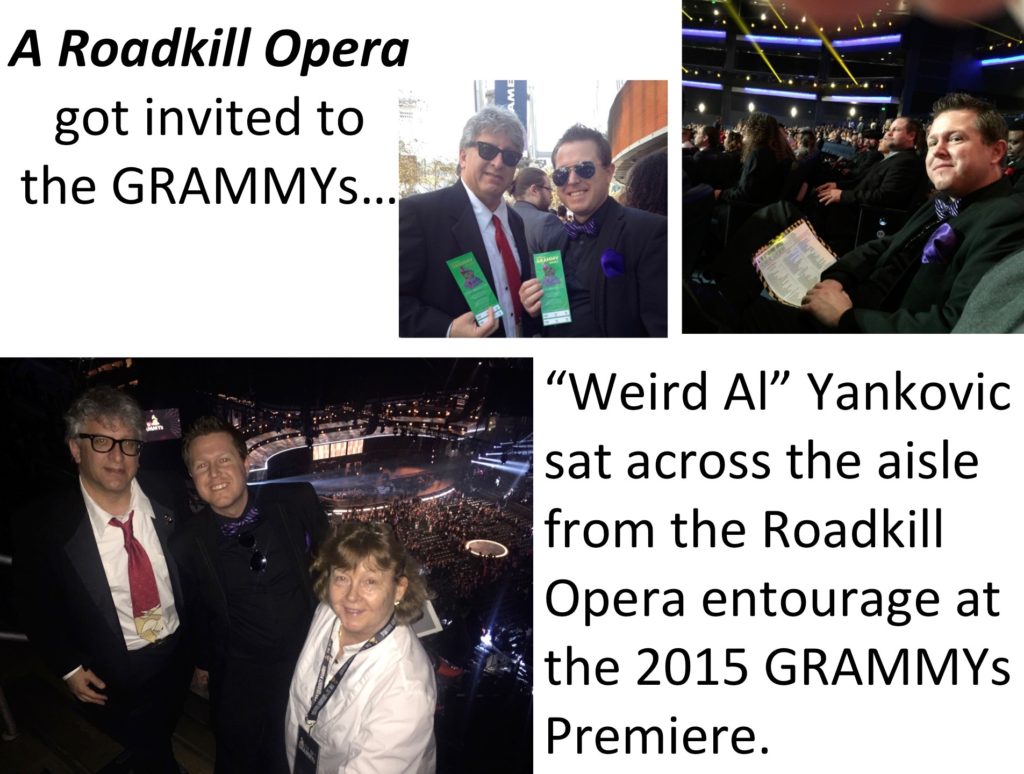
Photos clockwise from top: librettist/co-producer Stephan Alexander Parker and conductor/tenor/timpanist/co-producer Jeffrey Dokken with their GRAMMY tickets; Dokken (and the rest of the Roadkill Opera entourage, out of frame) sitting across the aisle from "Weird Al" Yankovic at the GRAMMY Premiere (which had festival seating--Yankovic sat near us!) moments before Yankovic won Best Comedy Album for Mandatory Fun; Parker, Dokken, and publisher/photographer/merchandising director DJ Choupin at our assigned seats for the broadcast of the 57th GRAMMYs in February 2015.
Because it had been commercially released and the commercial and artistic staff of Roadkill On A Stick Frozen Foods Publishing had joined ASCAP and the National Academy of Recording Arts and Sciences, A Roadkill Opera got invited to the GRAMMYs, which we attended in February 2015. Photos clockwise from top: librettist/co-producer Stephan Alexander Parker and conductor/tenor/timpanist/co-producer Jeffrey Dokken with their GRAMMY tickets; Dokken (and the rest of the Roadkill Opera entourage, out of frame) sitting across the aisle from “Weird Al” Yankovic at the GRAMMY Premiere (which had festival seating–Yankovic sat near us!) moments before Yankovic won Best Comedy Album for Mandatory Fun; Parker, Dokken, and publisher/photographer/merchandising director DJ Choupin at our assigned seats for the broadcast of the 57th GRAMMYs in February 2015.

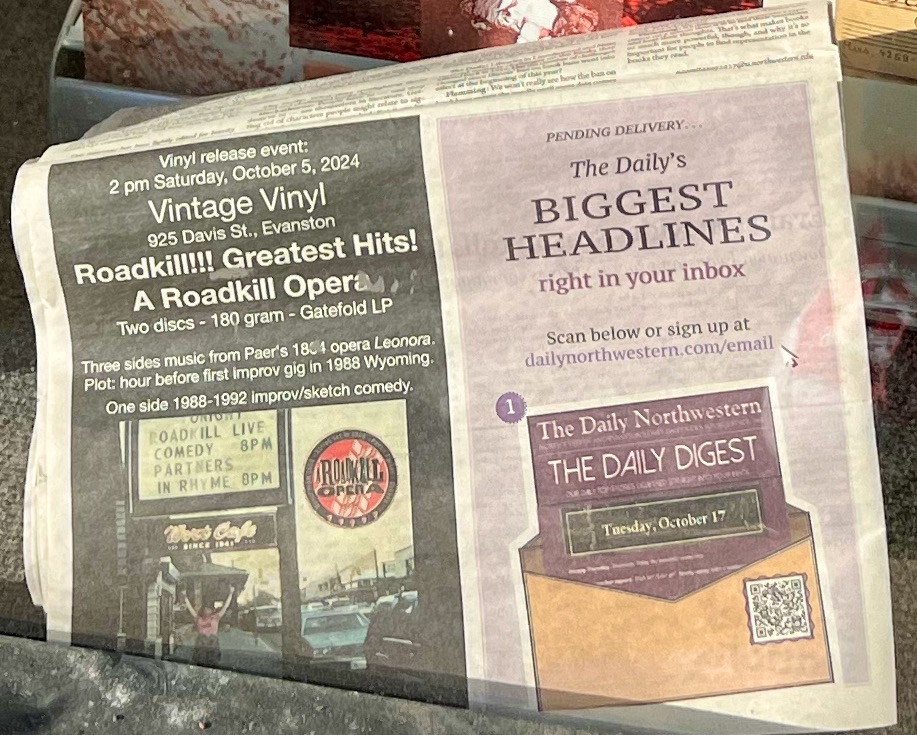
To commemorate the Chicago Opera Theater‘s 2024 North American premiere of Leonora, Parker prepared the first vinyl release of the 2-disc, 180-gram, gatefold album Roadkill!!! Greatest Hits! A Roadkill Opera. The Direct Metal Mastered double LP has the complete 2013 studio recording of A Roadkill Opera on three sides, with the fourth side carrying comedy highlights from the outfit whose true story is told in A Roadkill Opera, the Roadkill On A Stick Frozen Foods Theatre Company (active in Jackson Hole, Wyoming, 1988-1992).

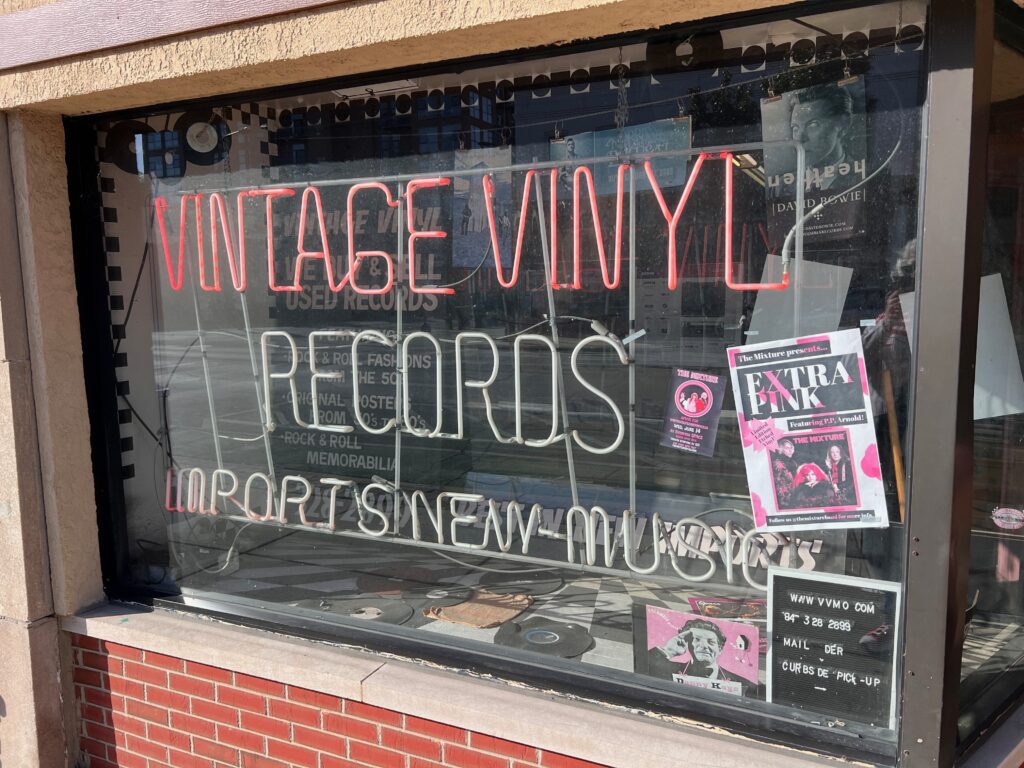
Vinyl release celebration Saturday, October 5, 2024 at Vintage Vinyl in Evanston, Illinois. Roadkill!!! Greatest Hits! A Roadkill Opera is a two-disc, 180-gram, gatefold LP that was Direct Metal Mastered in the Czech Republic and pressed and packaged in Canada. Vintage Vinyl is the iconic record store immortalized in the classic Stephen Frears movie High Fidelity starring John Cusack, Jack Black, and Iben Hjejle. (FYI no photography is allowed inside the venue.)

Roadkill!!! Greatest Hits! A Roadkill Opera Movie is a mash-up of live performance highlights by the comedy troupe in 1988 and 1992 with live performances of the opera in 2016 and the 2013 studio recordings of the songs from A Roadkill Opera. Also included are live and studio recordings of the Americana song Jackson Hole, written and performed by Dave Rohrer.

The movie and album have two companion books:

A Roadkill Opera: Silver Dollar Showroom Edition is the libretto or script for the opera. It includes bios from the 2013 world premiere cast for A Roadkill Opera, lyrics to the opera’s songs, and the script for the improv comedy sketch Frozen Roadkills on a Stick.

Hungry Men Don’t Swerve tells how a cold spell in Jackson Hole led to A Roadkill Opera, the underground opera sensation. The deluxe full-color interior takes the reader on a ride from 50-below-zero temperatures in Jackson Hole, Wyoming, to Chicago, Vienna, Minneapolis, London, Washington DC, Nashville, Gaithersburg, Los Angeles, and ultimately, back to Chicago for the North American premiere of Leonora in 2024.

Hungry Men Don’t Swerve also includes the lyrics to Dave Rohrer’s song Jackson Hole and the script for the improv comedy sketch Cod Piece Dining Room.

The movie has mostly live performances where the LP has mostly studio performances. The movie also has additional documentary information about the comedy troupe.

Roadkill!!! Greatest Hits! A Roadkill Opera Movie had its premiere screened before a live audience on June 3, 2025, at Cult Classic Brewing.

73 minutes.

English, with English supertitles.

————— The Score’s Backstory ————-

There was a 1798 two-act comic opera, Leonora, ou L’Amour conjugal. It had a French libretto by Jean-Nicolas Bouilly, with the action set in sixteenth-century Spain—what is referred to in the opera world as an escape drama. The Bouilly libretto was set to music by Pierre Gaveaux.

Marie Therese, grand-daughter of Empress Maria Theresa, grew up in musical Milan and, when she wed her Austrian cousin and herself became Empress of Austria, brought her passion for music with her. She loved music; made copies, swapped copies, played, sang, and produced public concerts two or three times a year; and, three to ten times a month she would stage private concerts for her own amusement, amassing an ensemble of 12 to 16 musicians and singers to play for two or three hours. In her private concerts, Marie Therese would sing. And she would tell anyone who would listen that her favorite libretto of all time was Bouilly’s Leonora, and she wished someone would set it to new music for her. Within two years, there were not one, not two, but three new settings for her.

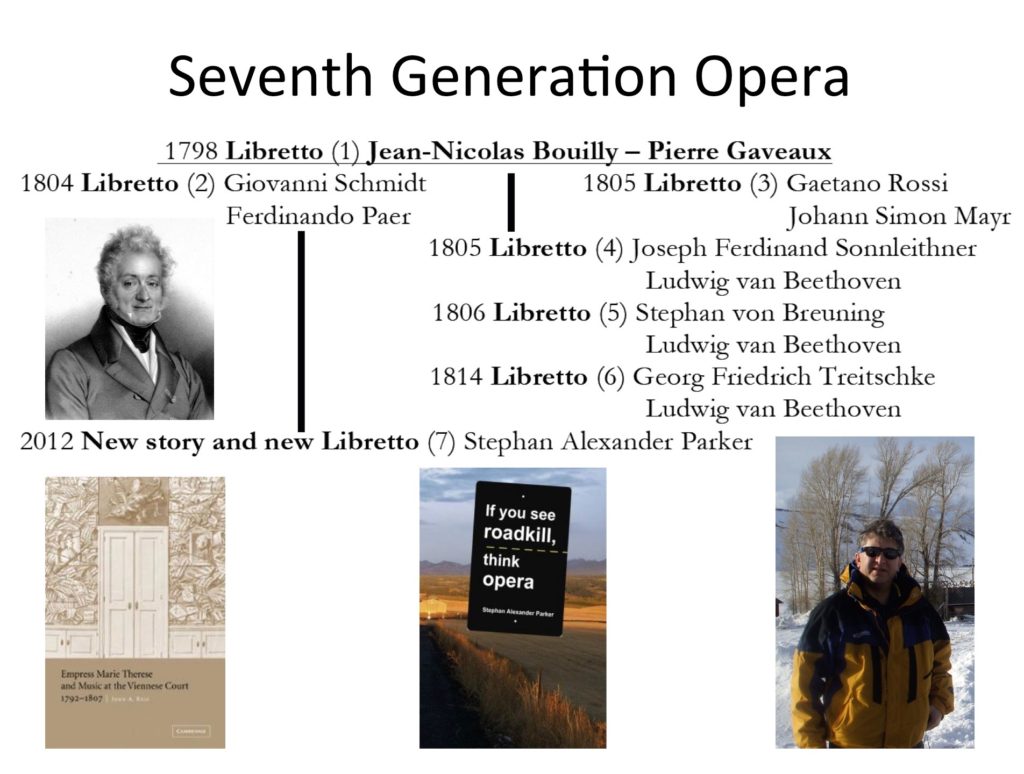
Photo titled Seventh Generation Opera shows a family tree and photos of composure Ferdinando Paer, librettist Stephan Alexander Parker, and covers of two books: Parker's If you see roadkill, think opera, and Empress Marie Therese and Music at the Viennese Court 1792-1807 by John A. Rice
A Roadkill Opera is the Seventh Generation Opera descended from Jean-Nicolas Bouilly and Pierre Gaveaux’s 1798 Leonore.

Paer and Mayr and Beethoven all worked in Vienna, and were all well-aware of the Empress’s generosity towards those who supplied her with new music. Ferdinando Paer, the Parma-born music director at the Kärntnertortheater in Vienna and a regular performer in Marie Therese’s private concerts, moved to another court in Dresden while Austria was at war with Napoleon. It was in Dresden that Paer finished his Leonora for the Empress in 1804. The overture and first act of Paer’s Leonora are the musical basis for A Roadkill Opera. After Napoleon defeated the Austrians, Paer moved to Paris where he eventually headed up the Opéra-Italien, to be succeeded by Rossini. When Paer died in 1839, his Leonora was forgotten.

Forgotten, that is, until another musical denizen, intrigued by Beethoven’s high praise for Paer’s music, recovered Paer’s Leonora. Peter Maag found Paer’s Leonora while artistic director of the Teatro Regio di Parma in Paer’s home town. Maag was so taken with it that he mounted a radio production in 1976 and followed up with a 3-disc boxed set on London Records in 1978. After 140 years of neglect, Paer’s Leonora was back.

Praise

“… a very, very, cool thing… exceptionally well done…”
Paul Barrosse, writer/performer, Mee-Ow Show,
Practical Theatre Company, and Saturday Night Live

“Songs like ‘Impress Them,’ ‘Cod Piece Dining,’ ‘Jello,’ and [Gonna buy my old granddad a] ‘Geo’ pair offbeat humor with beautiful vocals and music.”
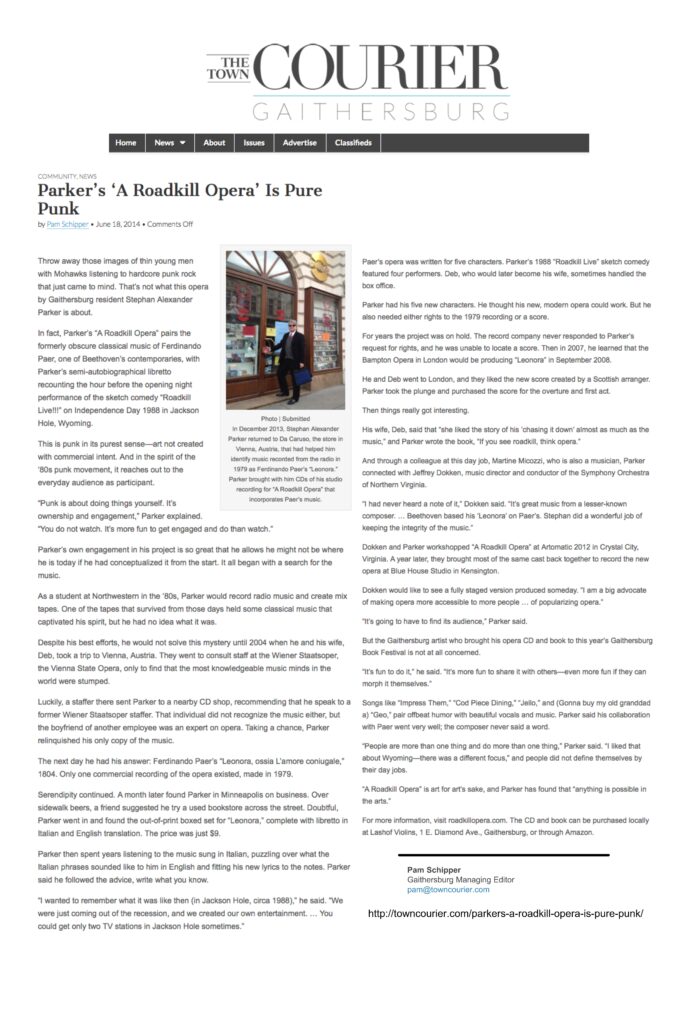
Pam Schipper, Gaithersburg News Courier

“An inspired, imaginative work, technically worthy of the highest praise… the orchestration is faultless and complements the vocal parts beautifully.”
Peter Maag writes about Paer’s Leonora

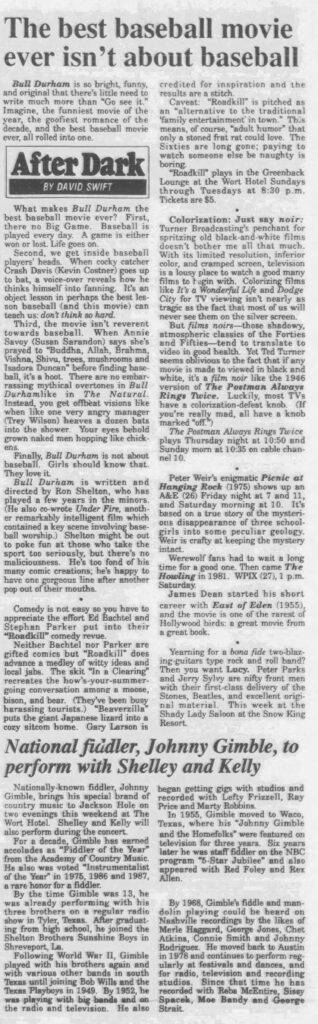
“Roadkill… advances a medley of witty ideas and local jabs. The results are a stitch.”
David Swift, Jackson Hole News, writes about Roadkill!!! Comedy Revue

This image has an empty alt attribute; its file name is 24x80-popup-5-MB-Roadkill-Greatest-Hits-A-Roadkill-Opera-Movie-304x1024.jpeg

Vinyl

Roadkill!!! Greatest Hits! A Roadkill Opera is a two-disc, 180-gram, gatefold LP that was Direct Metal Mastered in the Czech Republic and pressed and packaged in Canada.

The three opera sides were produced for the 2013 CD by Stephan Alexander Parker, Jeffrey Dokken, and Jeff Gruber.

The 2013 CD was recorded, mixed, and mastered at Maryland’s Blue House Productions by Audio Engineer Jeff Gruber.

The 2024 vinyl release was produced by Stephan Alexander Parker, who edited in live recordings from the 1988 and 1992 comedy shows in Wyoming with bits from live 2016 opera recordings in Virginia and Washington DC to develop the fourth side.

The 2024 vinyl release has a 2024 companion book: Hungry Men Don’t Swerve. That book details how Parker’s randomly recording  Leonora off a WFMT broadcast in 1979-1980 led to a 24-year search to identify the recording; a 2012 workshop and 2013 studio recording of Parker’s new opera; attending the 2015 GRAMMYs; and six fully staged performances of A Roadkill Opera in 2016, two with the full Symphony Orchestra of Northern Virginia.

This image has an empty alt attribute; its file name is Roadkill-Greatest-Hits-LP-cover-1024x1024.png

Roadkill!!! Greatest Hits! A Roadkill Opera was officially released Tuesday, October 1, 2024, to commemorate the North American premiere that evening of Ferdinando Paer’s 1804 opera Leonora at Chicago Opera Theater. It is exclusively available as a Direct Metal Mastered, two-disc, 180 gram, gatefold LP.

Roadkill!!! Greatest Hits! A Roadkill Opera

Label: Roadkill on a Stick Frozen Foods Publishing
Genres: Classical, Comedy
UPC: 195269314361
Availability: October 2024
Category: 180 Gram Vinyl Record
No. of Discs: 2

Buy the LP at these fine establishments in Maryland, Delaware, Massachusetts, and Washington State!

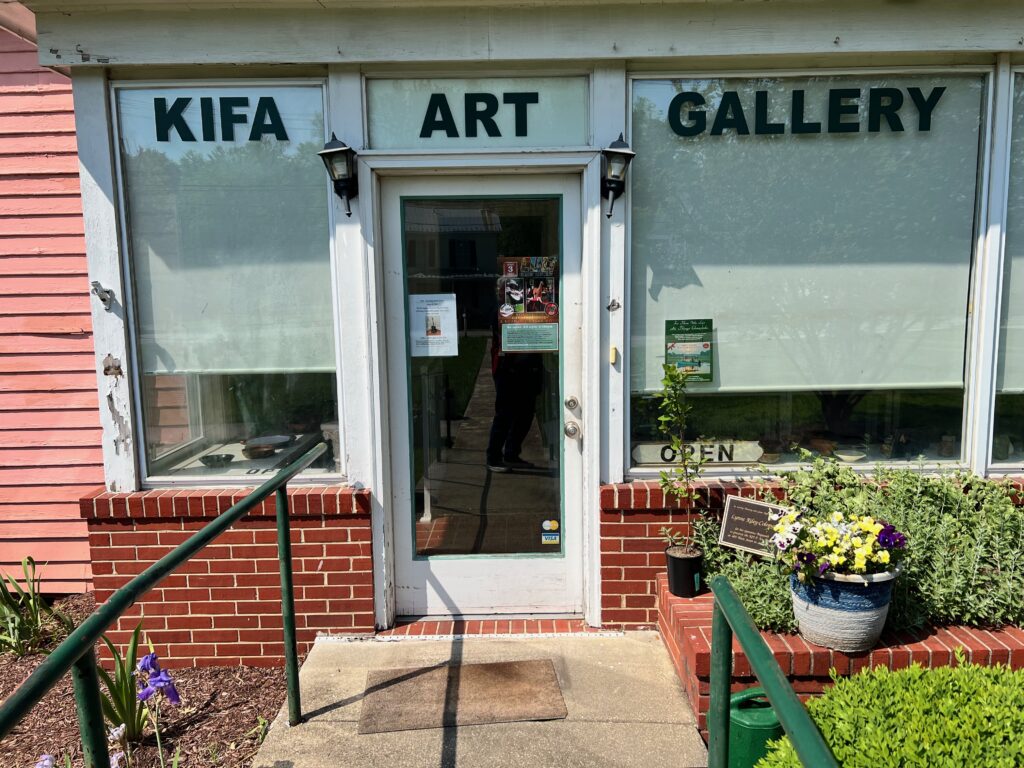
Kent Island Federation of Arts, Inc.

405 Main Street, Stevensville, MD 21666

410-643-7424 | arthousekifa@gmail.com | www.kifa.us​​​

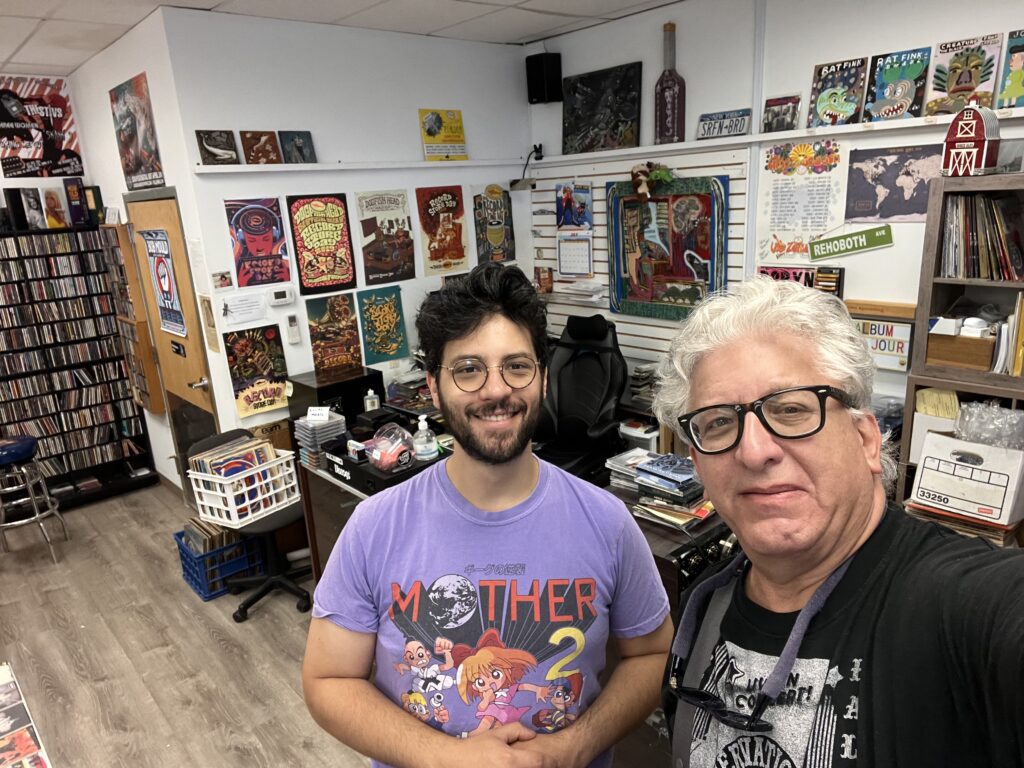
Extended Play
149 Rehoboth Ave
Rehoboth Beach, DE 19971

We’re a brick-and-mortar shop located in coastal Delaware that’s been selling vinyl for years. Owned by Steve Fallon, former owner of Maxwell’s in Hoboken, NJ.

GENRE: Alternative, Jazz, Punk, Rock, Soundtracks
FORMATS: Cassette, CD, Vinyl

OPERATIONS: Buying, Selling, Trading
tel: 302-226-8469
EMAIL: extendedplayrehoboth@gmail.com

GOOD TASTE Records is an independent record store based in Boston, MA’s historic North End neighborhood with a focus on a curated selection of new and used vinyl records for anyone interested in adding GOOD TASTE to their vinyl collection. Whether it’s for your DJ crates, your grails shelf, or just good music to listen to, let The Taste Makers help you find what you’re looking for.

4 Thacher Street
Boston Massachusetts
02113 United States

www.instagram.com/goodtasterecord
goodtasterecords.com

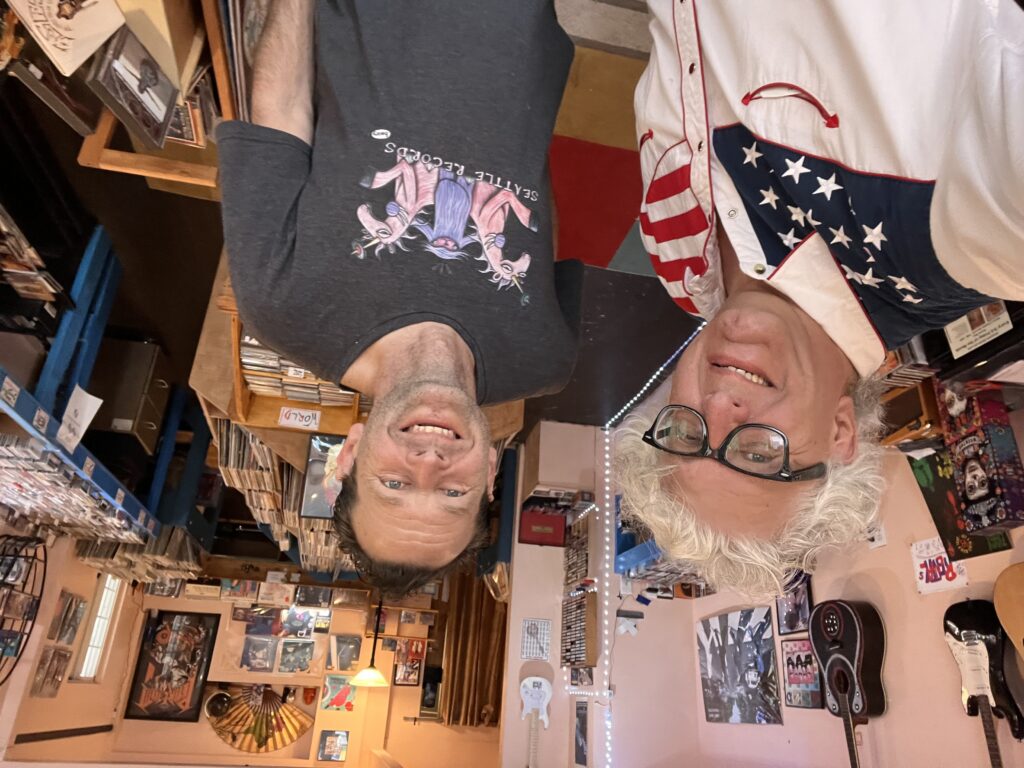
Seattle Records
Shopping & retail
the coolest christmas gifts!

5521 University Way NE
Seattle WA 98105

seattlerecordsinfo@gmail.com
Instagram: seattle_records
www.seattlerecords.net

And by mail order from:

Vintage Vinyl
925 Davis Street
Evanston, Illinois

Mail order: www.vvmo.com

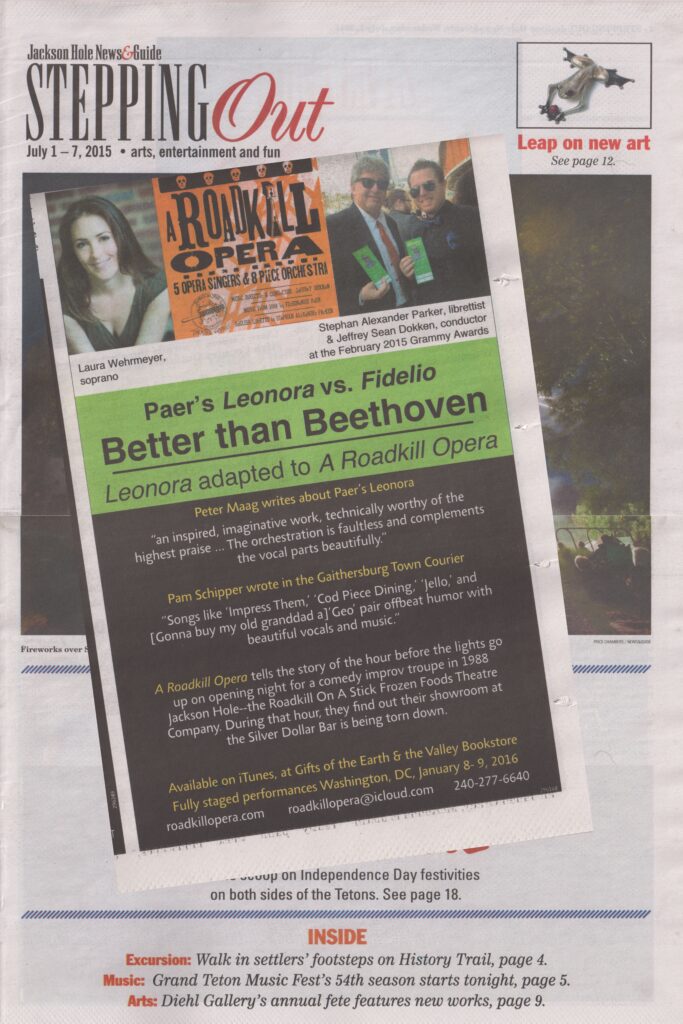
A Roadkill Opera tells the story of the hour before the lights go up on opening night for a comedy improv troupe in Jackson Hole, Wyoming—the Roadkill On A Stick Frozen Foods Theatre Company. Based (loosely) on a true story from a fast-developing tourist town, this original English libretto by Parker is set to music by Ferdinando Paer (a direct competitor of Beethoven and Napoleon’s maître de chapelle).

In June 2012 A Roadkill Opera was workshopped in Crystal City, Virginia, by Jeffrey Dokken at Artomatic, the Washington DC area’s largest free creative arts event. Dokken, currently the music director for the National Football League’s Washington Commanders, served as music director and conductor of the Symphony Orchestra of Northern Virginia from 2010 to 2023. Maestro Dokken reassembled most of the 2012 workshop’s chamber orchestra and singers in 2013 for a series of recording sessions in Maryland.

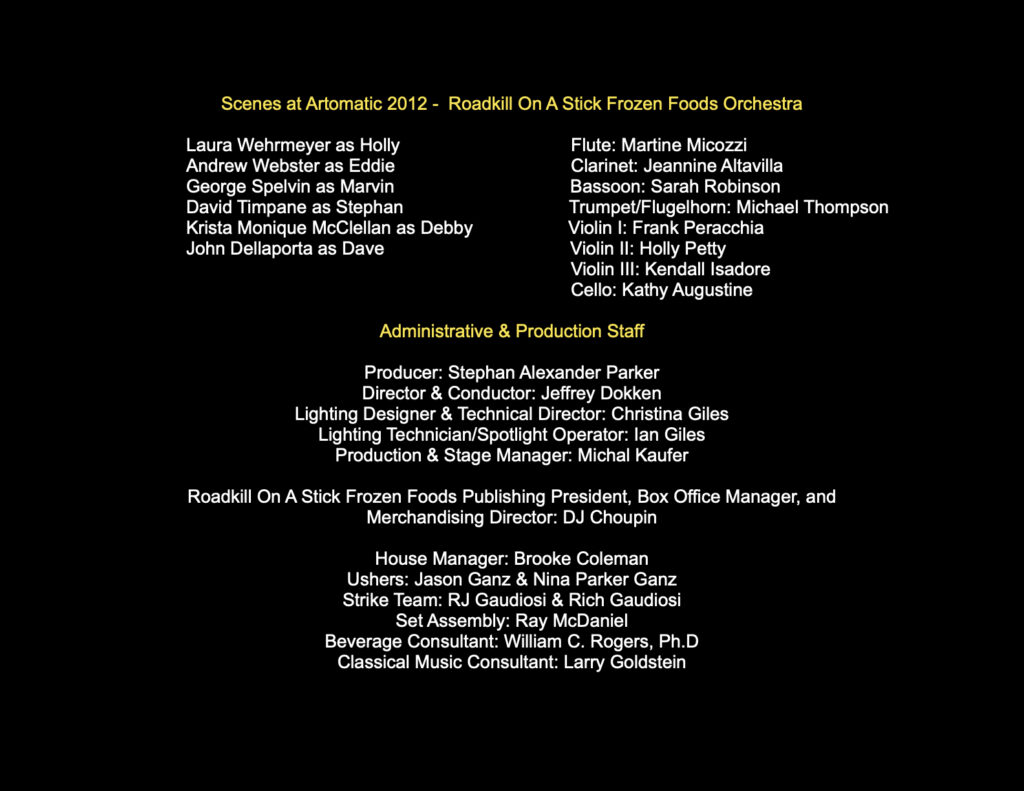
The cast for the studio opera recording includes Laura Wehrmeyer (Holly), soprano; Andrew Webster (Eddie), baritone; David Timpane (Stephan), baritone; Krista Monique McClellan (Debby), soprano; and Jeffrey Dokken (Dave), tenor.

The chamber orchestra for the opera recording includes Martine Micozzi, flute; Jeannine Altavilla, clarinet; Sarah Robinson, bassoon; Michael Thompson, trumpet; Jeffrey Dokken, timpani; Frank Peracchia, violin I; Ian Ross, violin II; Val Rauch, viola; Kathy Augustine and Natalie Spehar, cello; and Stephan Alexander Parker on hammer, 2×4, and cymbal.

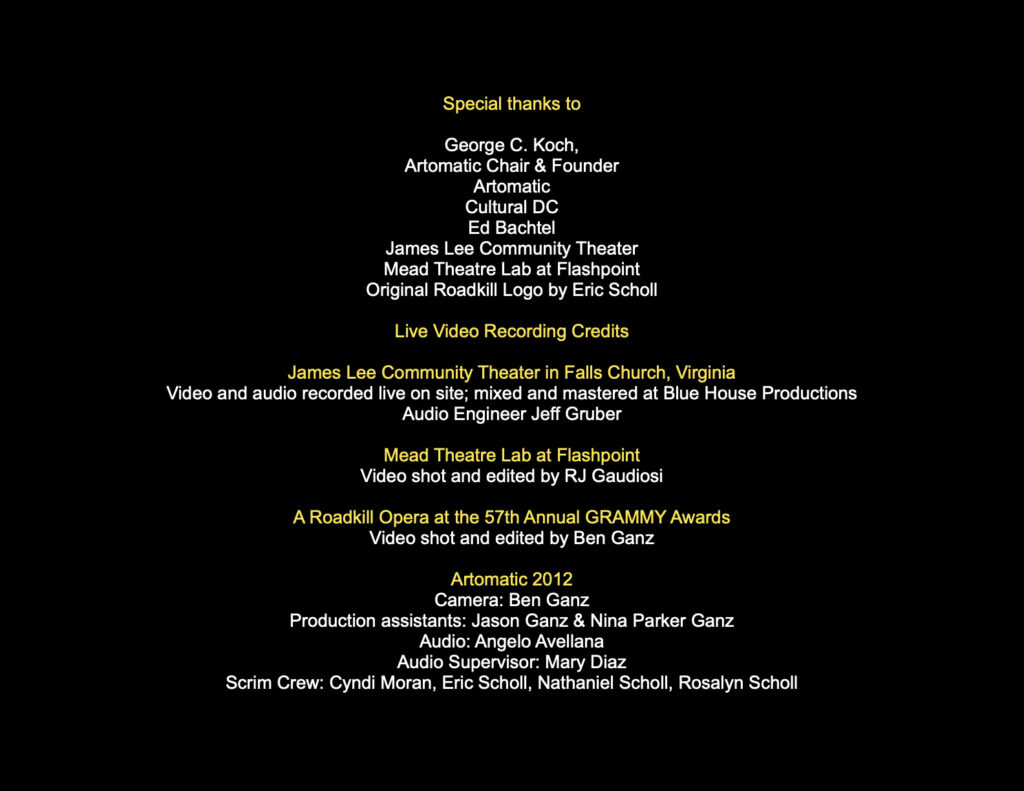
A Roadkill Opera was recorded, mixed, and mastered at Blue House Productions by Jeff Gruber.

The cast for the live improv/comedy recording Roadkill!!! Greatest Hits! includes Christopher Dews (2016); Ed Bachtel (1988, 1992); Stephan Alexander Parker (1988, 1992); Louise Gignoux (1992); and Dave Rohrer (1988, 1992). Rohrer is also responsible for writing and performing the newly released studio recording “Jackson Hole,” which is the first track on the side Roadkill!!! Greatest Hits!

Ferdinando Paer (Composer) was active in Vienna, Dresden, and Paris. He was a regular participant in the thrice-monthly private concerts put on by (and for the personal amusement of) Marie Therese at the royal court of Vienna, Austria. The Empress would assemble talented amateur and professional singers and musicians (similar in size and make-up to the group that recorded A Roadkill Opera) to play mixed concerts of sacred and secular music from her vast collection of scores and parts. 

Paer wrote dozens of operas. Leonora, the first act from which the score for A Roadkill Opera was derived, was his 40th opera. It is the same story as Beethoven’s first and only opera, Fidelio.

Sheet Music & Books

In addition to the 2024 gatefold double LP and companion book, the opera libretto and books of sheet music for the singers and orchestra are also available for order through your favorite bookseller or online:

A Roadkill Opera: Silver Dollar Showroom Edition

A Roadkill Opera: Piano/Vocal

A Roadkill Opera: Conductor’s Score

A Roadkill Opera: Parts for Wind Instruments

A Roadkill Opera: Parts for Timpani and String Instruments

A Roadkill Opera Overture: Conductor’s Score & Parts

Roadkill!!! Greatest Hits!
180 Gram Vinyl Record – Two Discs – Gatefold Cover
Three sides studio-recorded music from Paer’s Leonora. One side improv/sketch comedy recorded live.
“Jackson Hole” written & performed by Dave Rohrer.
Companion books with lyrics and backstory include Hungry Men Don’t Swerve and A Roadkill Opera: Silver Dollar Showroom Edition, as well as sheet music for A Roadkill Opera published in 8.5 x 11 inch scores and tear-out parts.

Press

This image has an empty alt attribute; its file name is SONOVA-October-2016-A-Roadkill-Opera-Washington-Post-ad-1024x106.png
This image has an empty alt attribute; its file name is SchipperGaithersburg-AROpunk2014-683x1024.jpeg
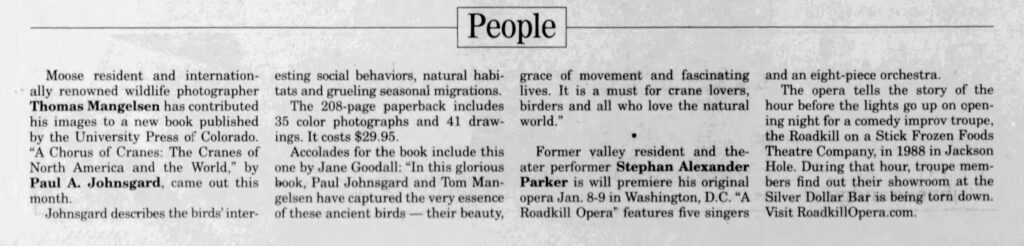
This image has an empty alt attribute; its file name is People_A_Roadkill_Opera_premiere_Jan_8_9_in_Washington_DC-1024x246.jpg
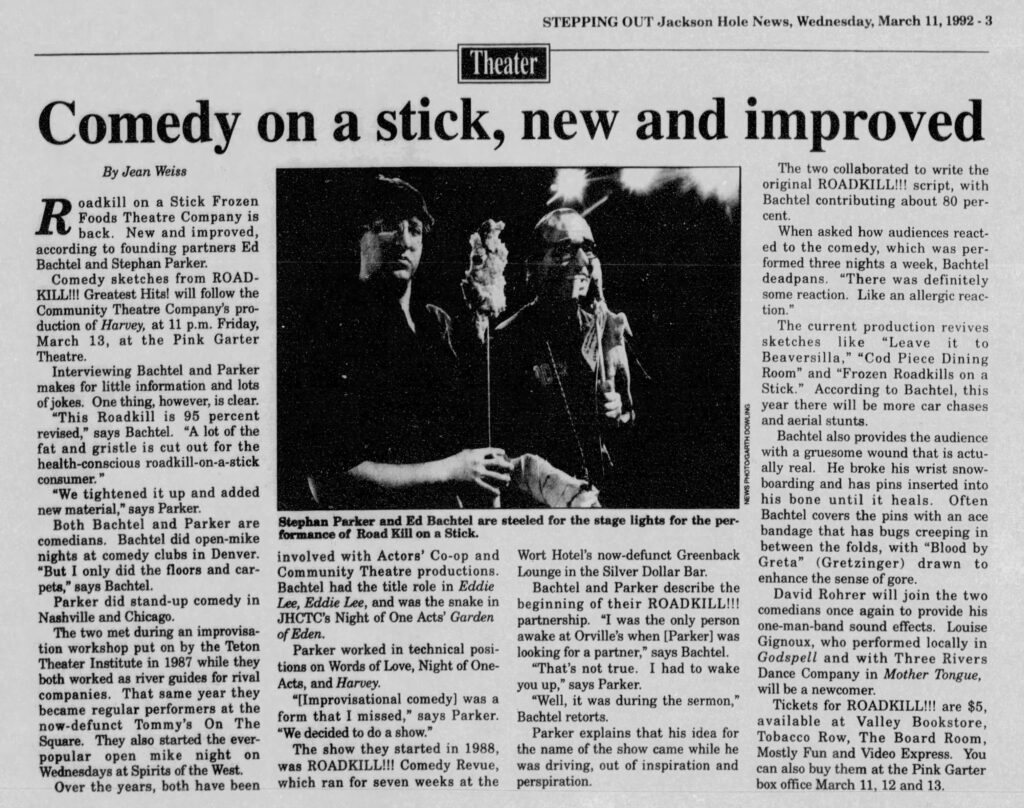
This image has an empty alt attribute; its file name is Comedy_on_a_stick_new_and_improved-1024x808.jpg
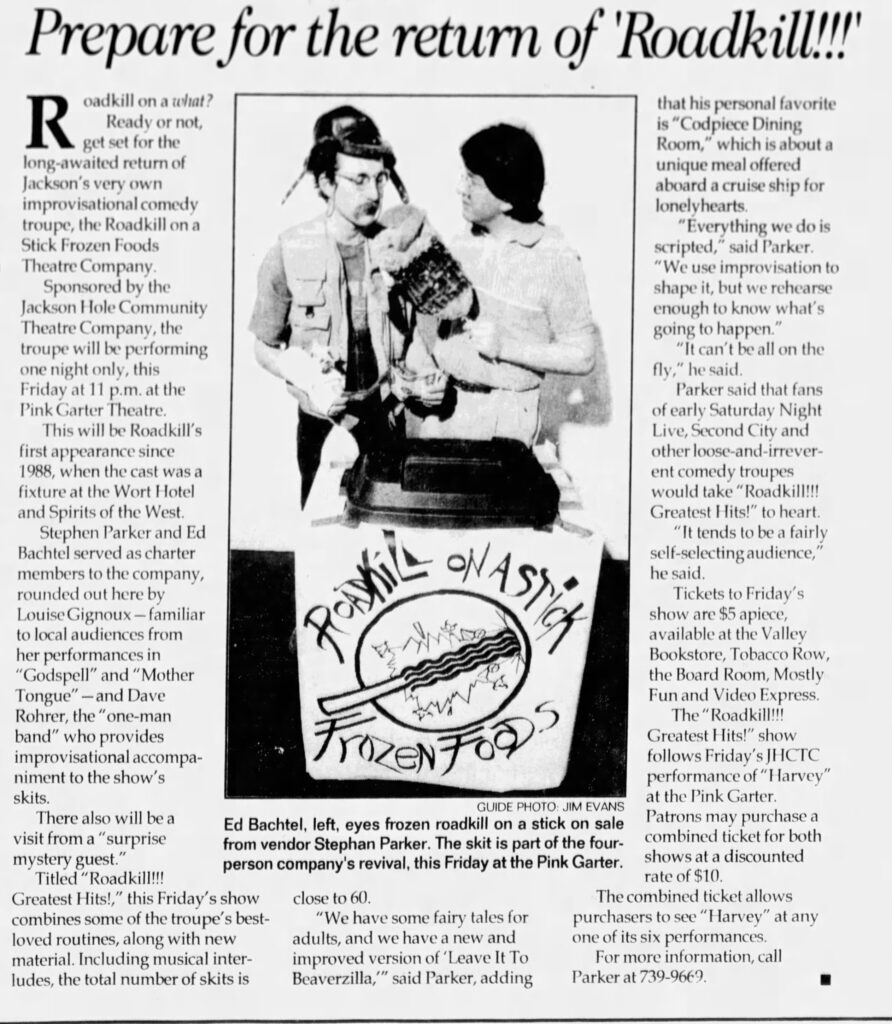
This image has an empty alt attribute; its file name is Prepare_for_the_return_of_Roadkill-892x1024.jpg
This image has an empty alt attribute; its file name is h_Shelley_and_Kelly-318x1024.jpg
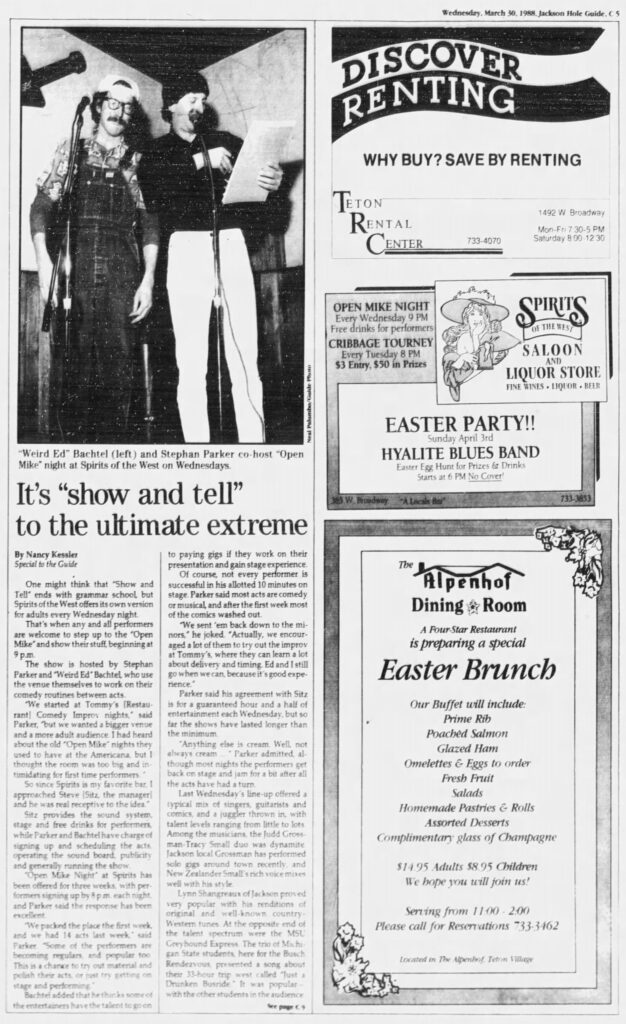
This image has an empty alt attribute; its file name is Bachtel_and_Parker_co_host_Open_Mike_night_at_Spirits_of_the_West_on_Wednesdays-626x1024.jpg
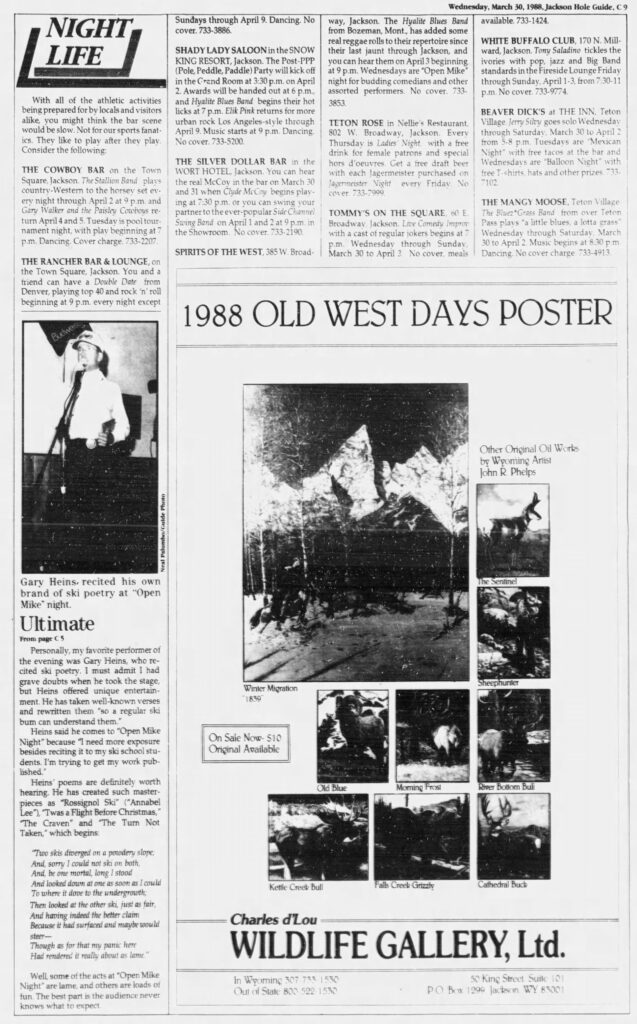
This image has an empty alt attribute; its file name is Open_Mike_Night_p_C9_with_Tommy_s_on_the_Square_Live_Comedy_Improv-637x1024.jpg
This image has an empty alt attribute; its file name is Open_Mike_Night_every_Wednesday_night_starting_tonight_ad-1024x812.jpg
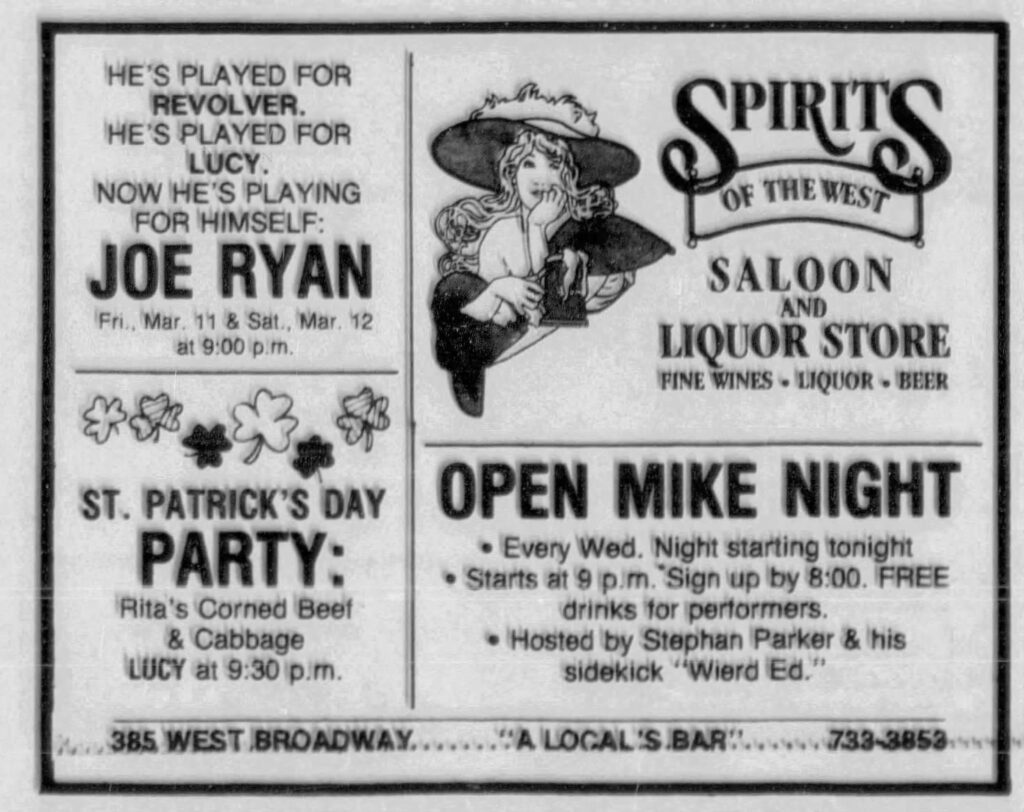
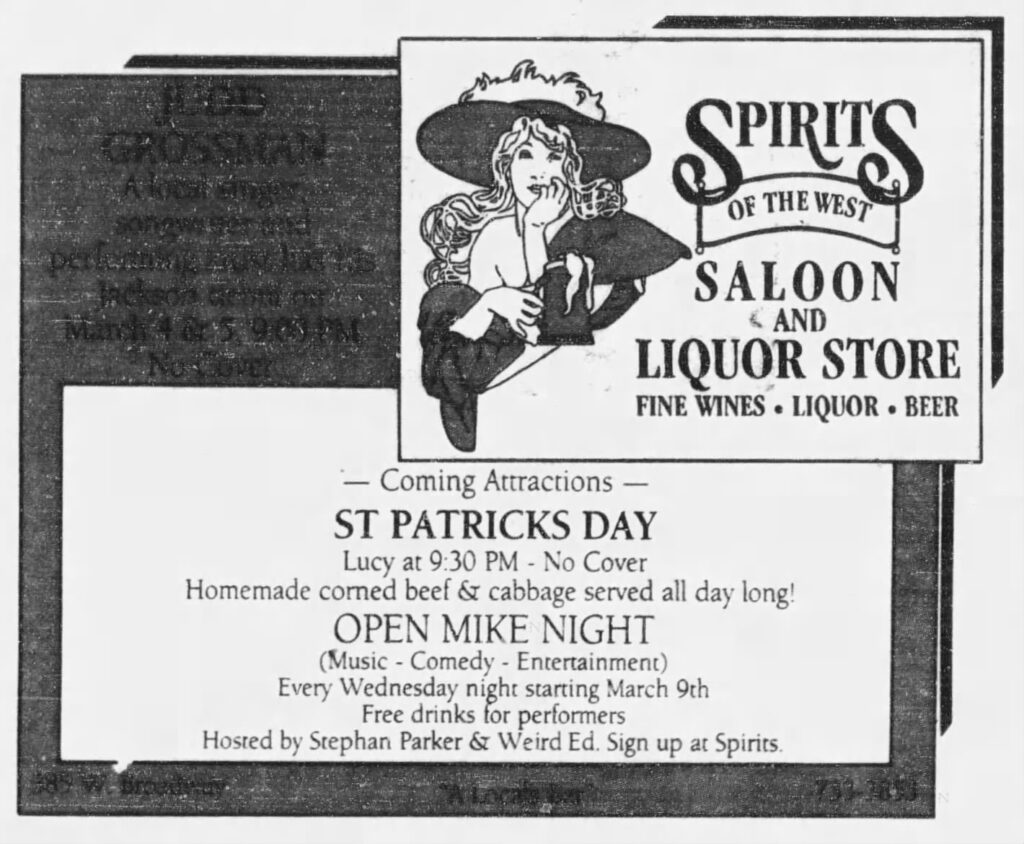
This image has an empty alt attribute; its file name is Open_Mike_Night_hosted_by_Stephan_Parker_Weird_Ed_at_Spirits_of_the_West_Saloon_ad-1024x844.jpg
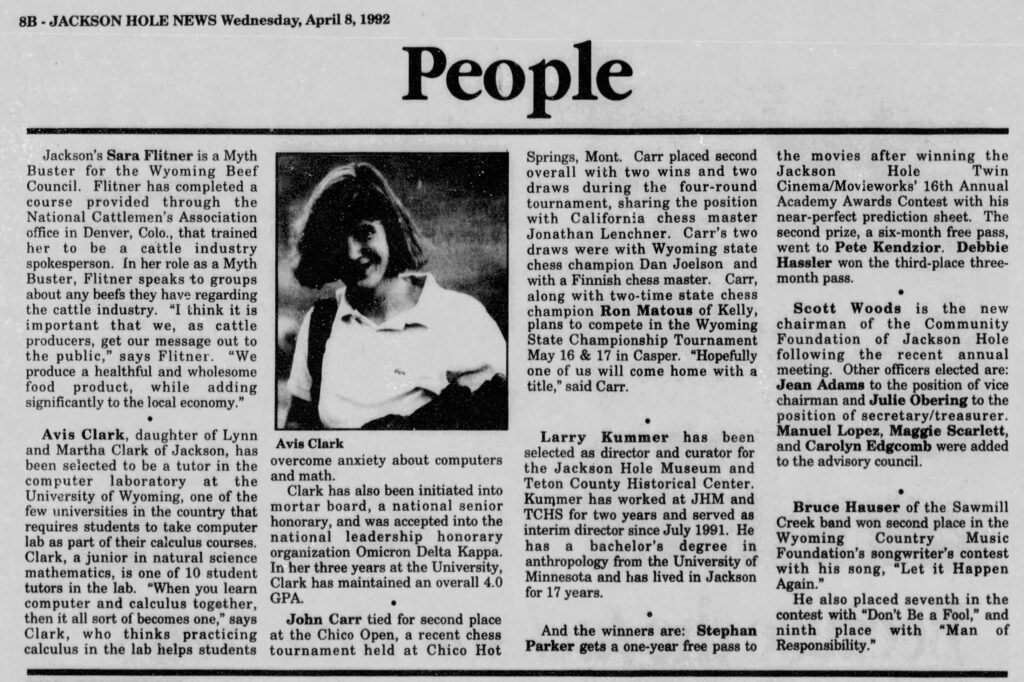
This image has an empty alt attribute; its file name is Parker_wins_Academy_Awards_contest_with_near_perfect_prediction_sheet-1024x682.jpg

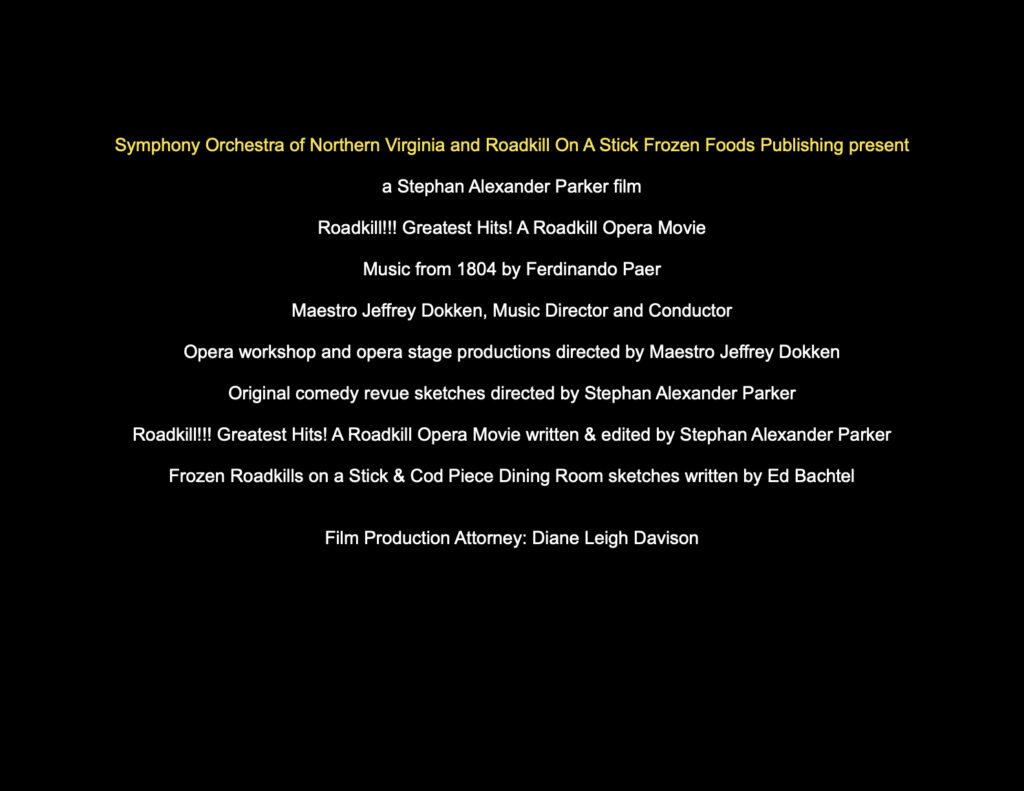
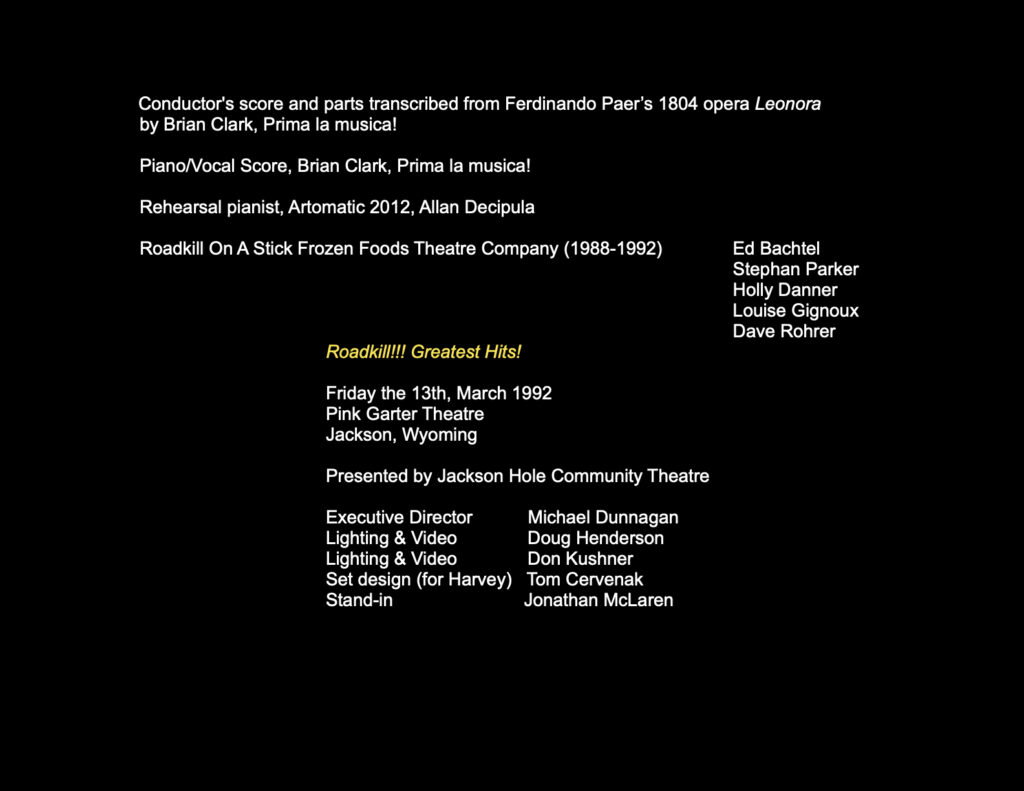
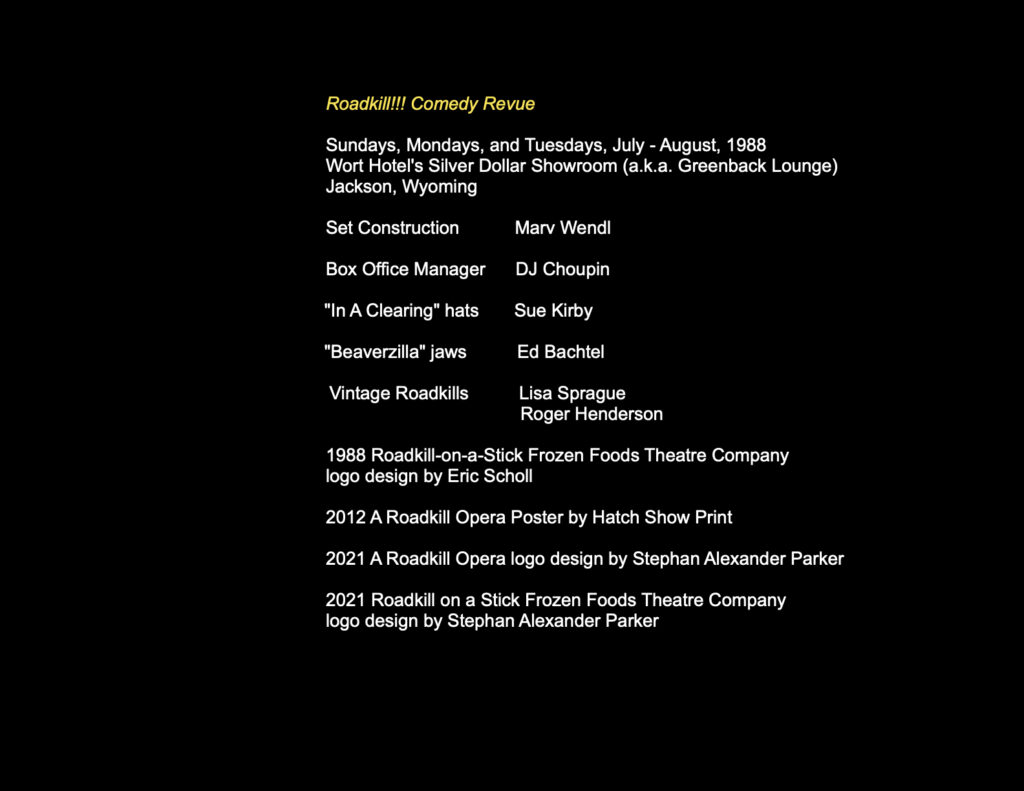
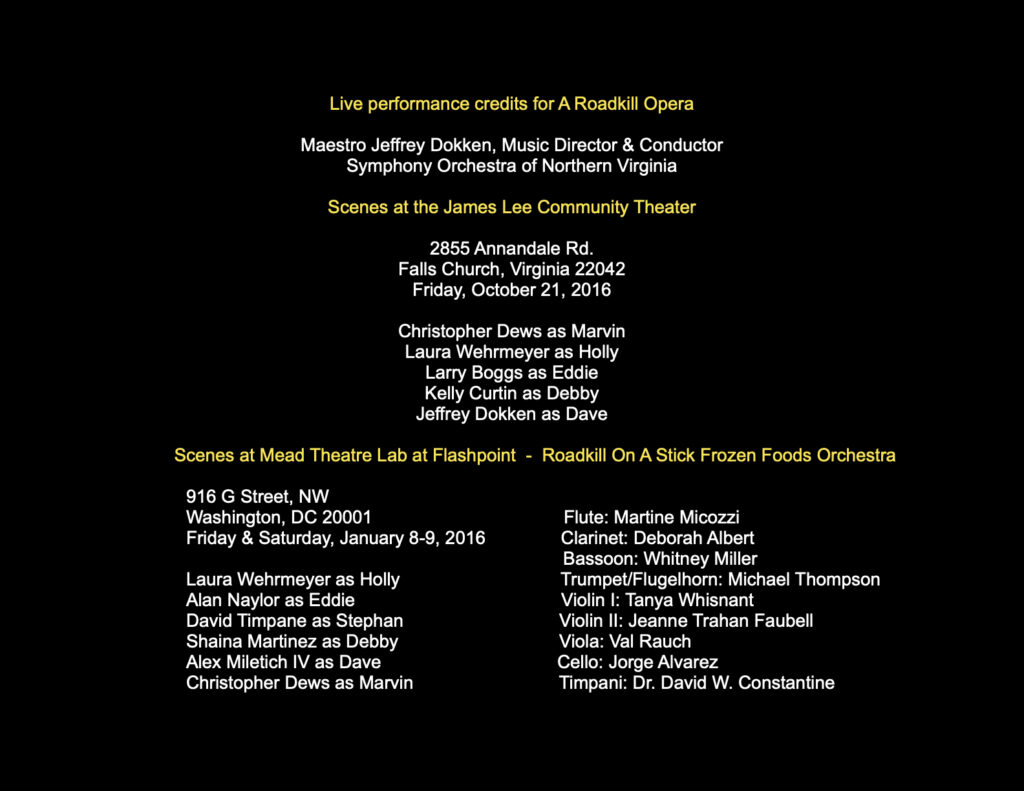
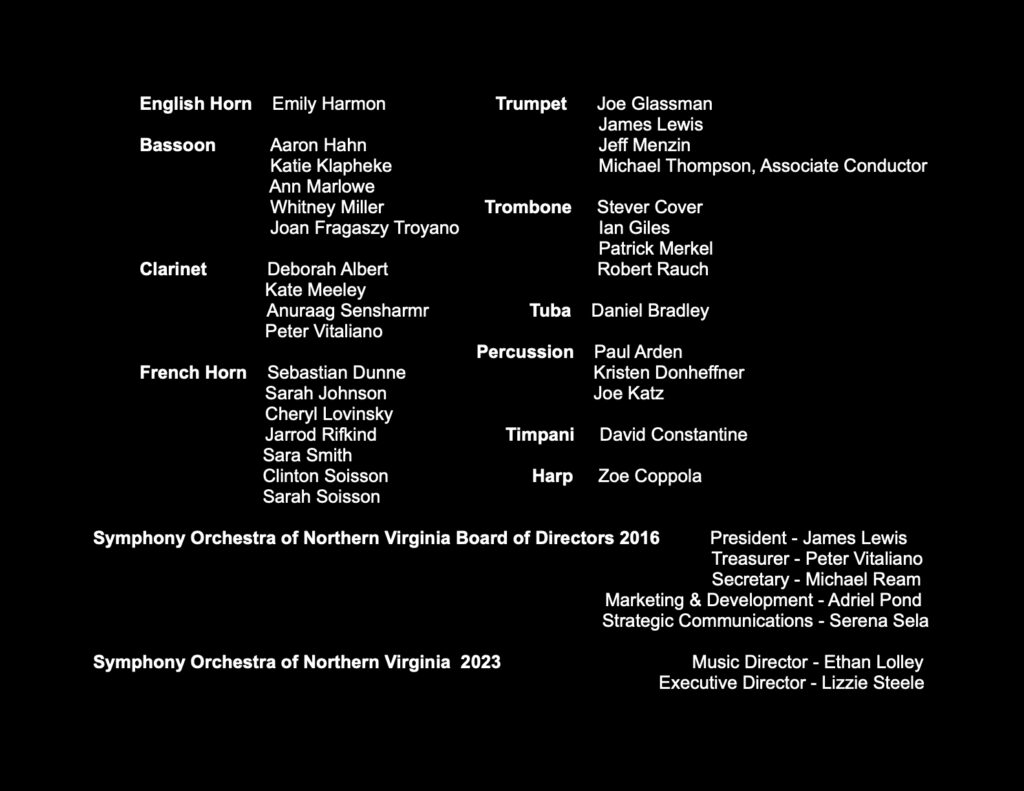
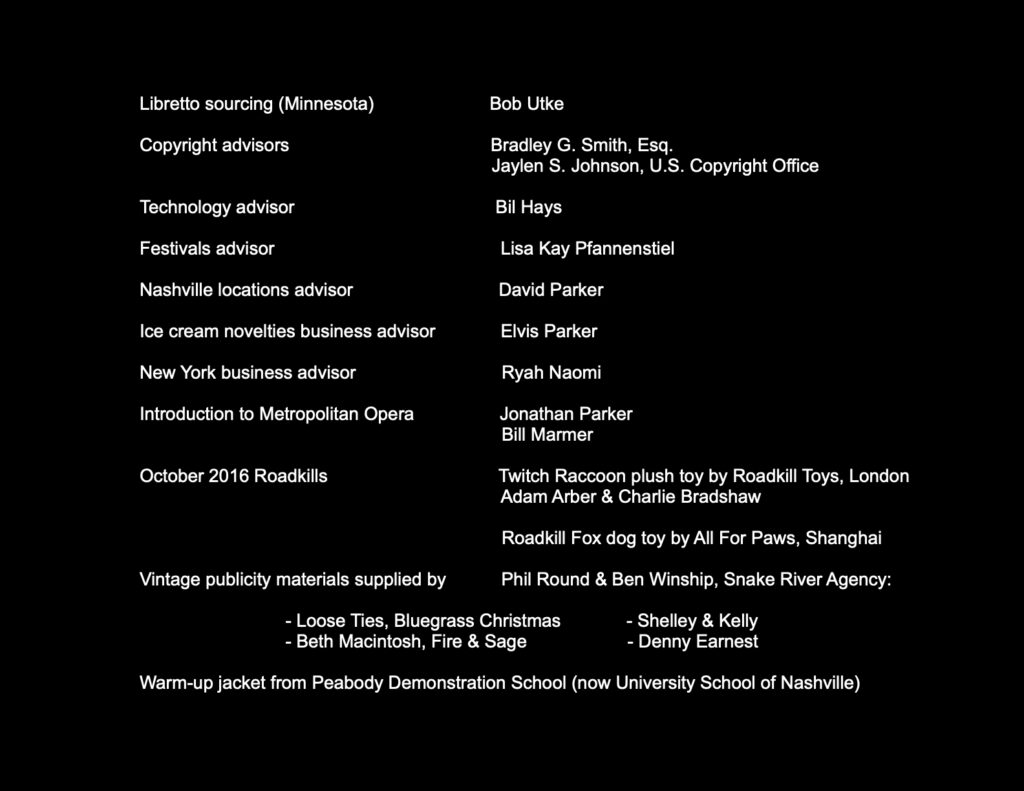
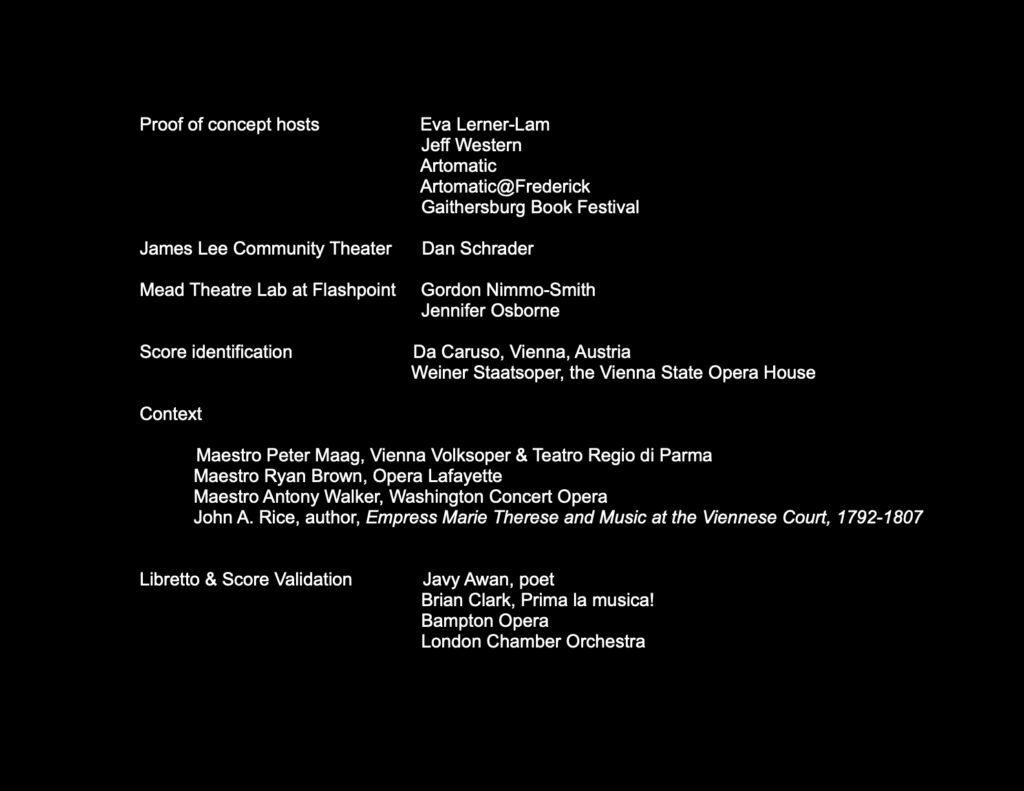
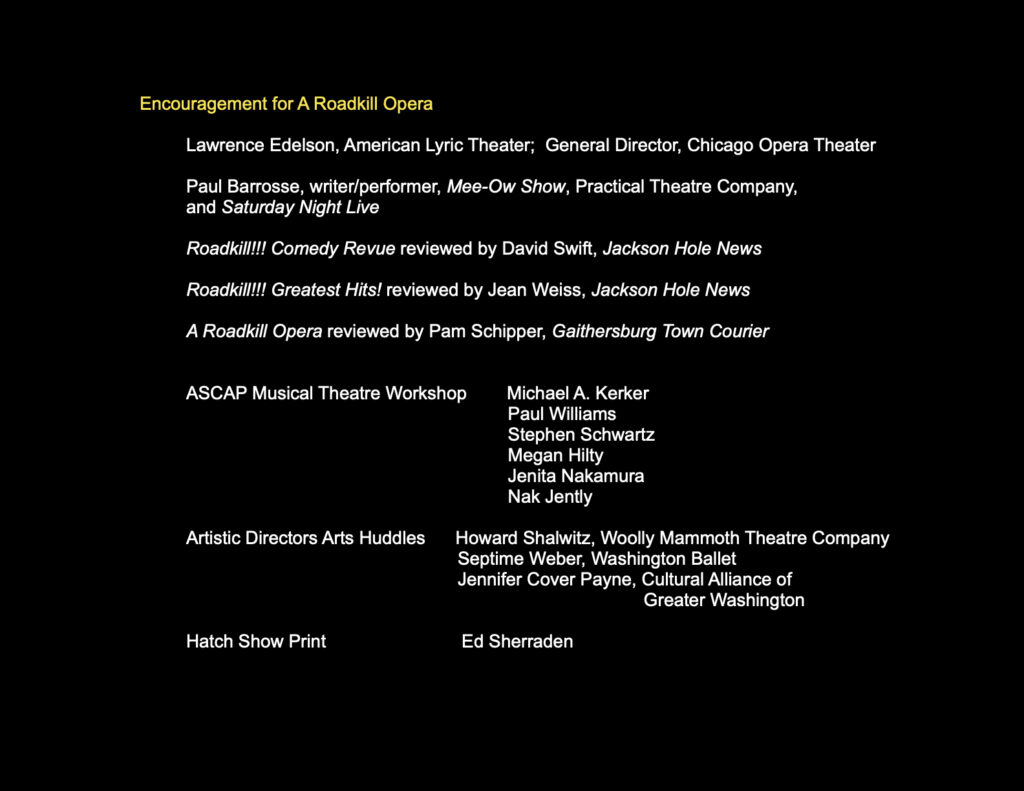
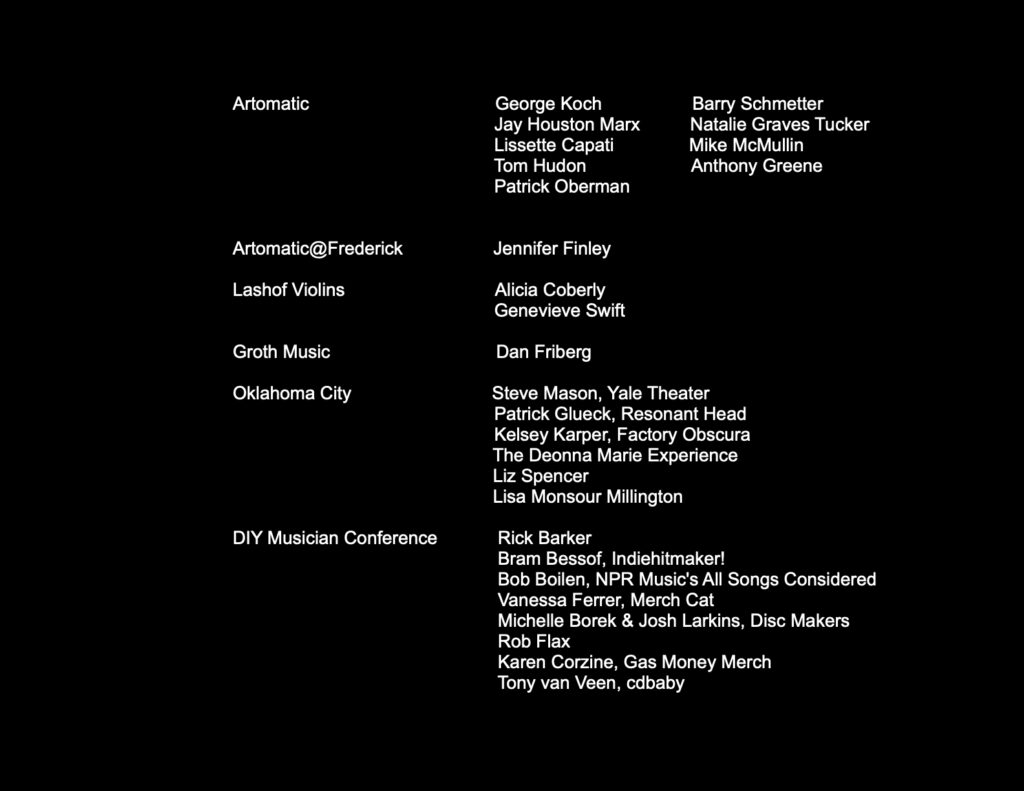
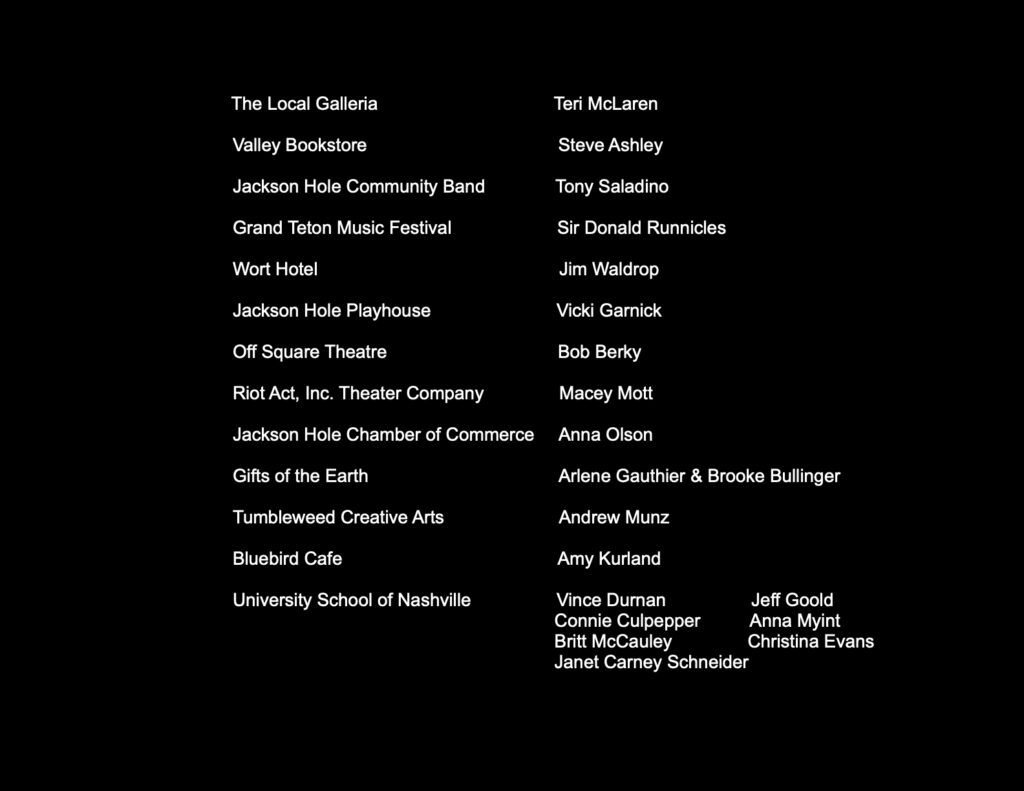
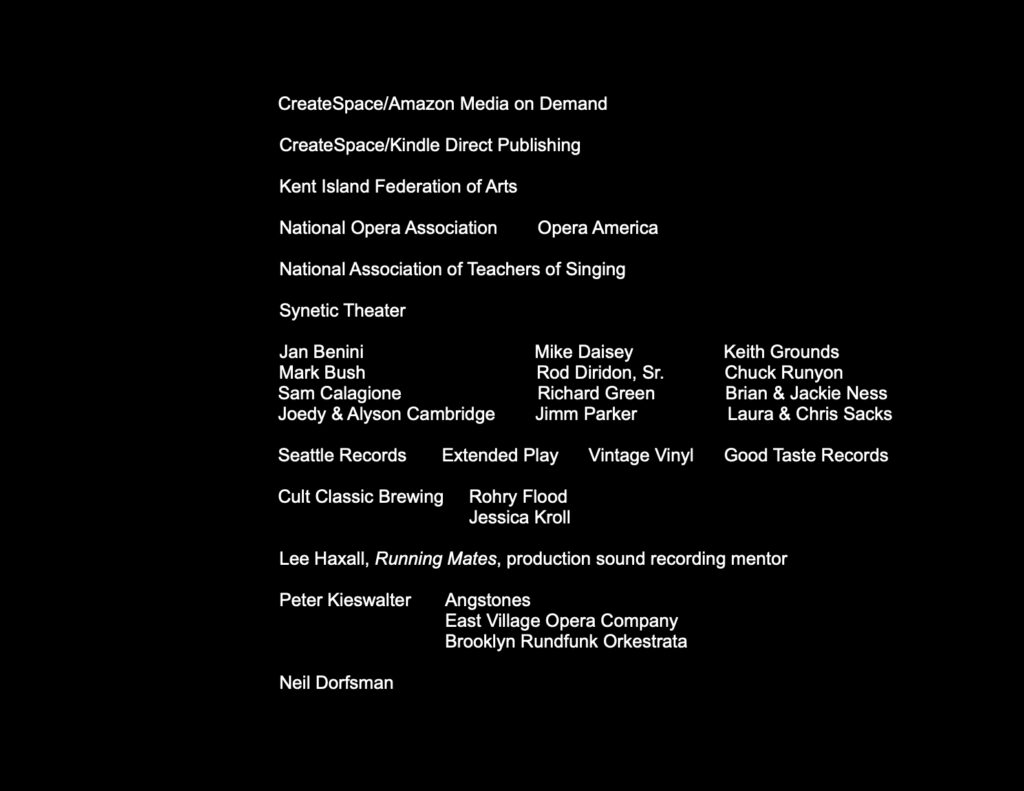
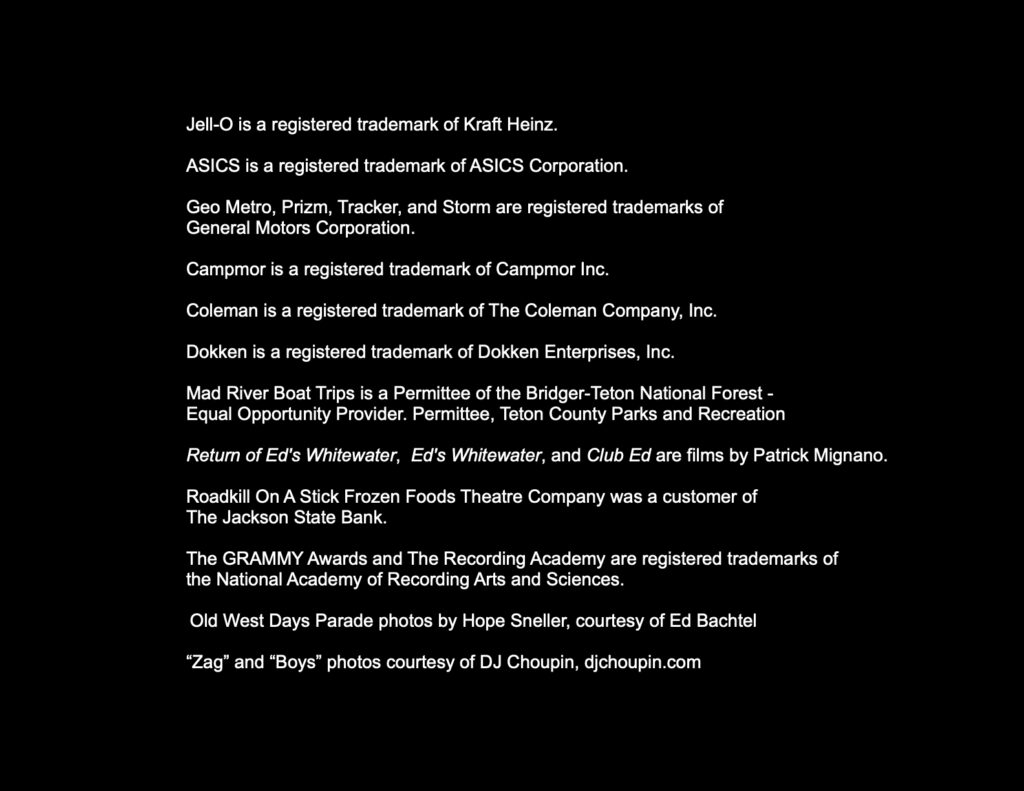
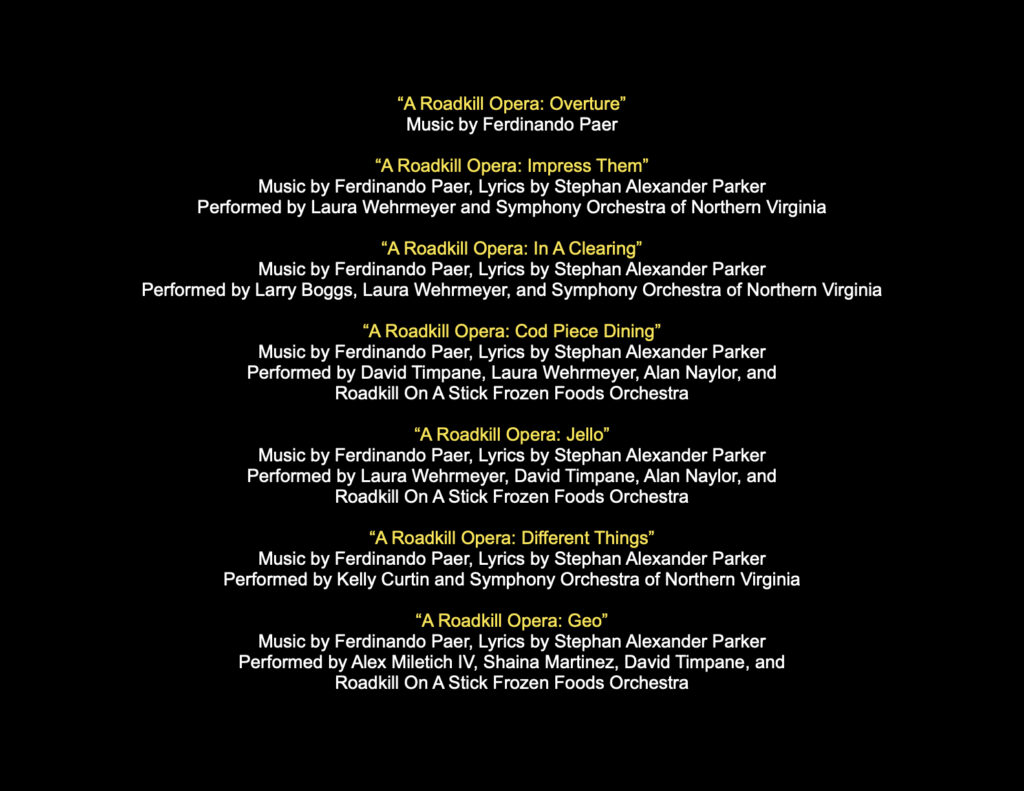
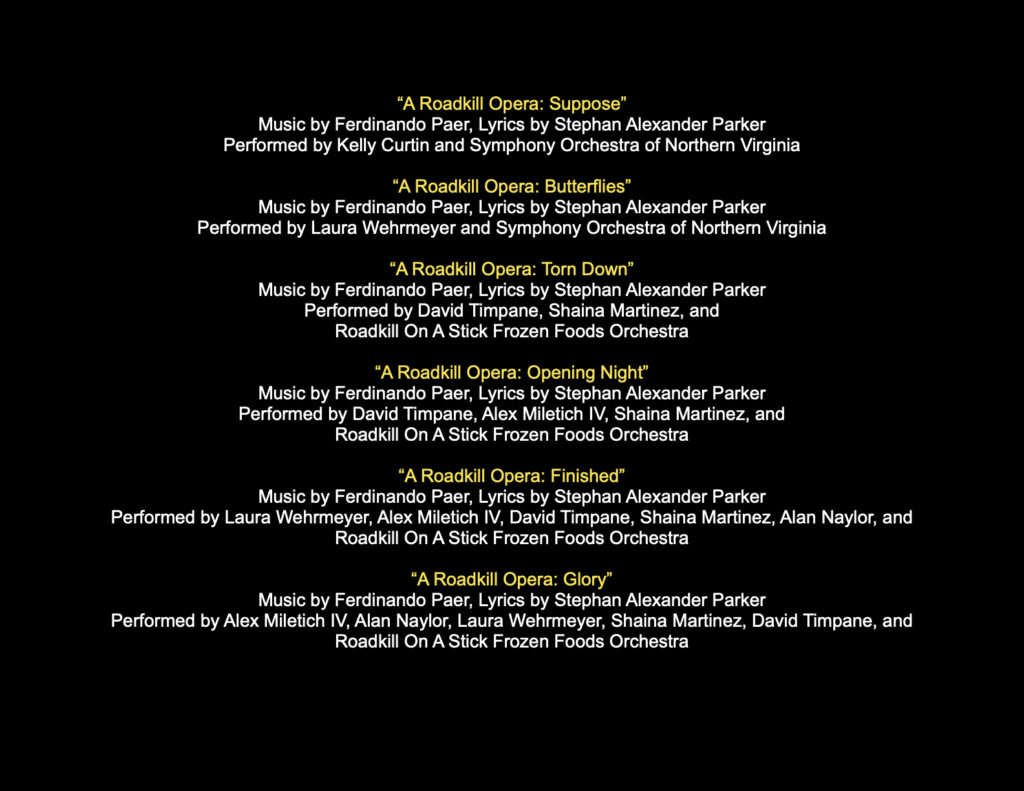
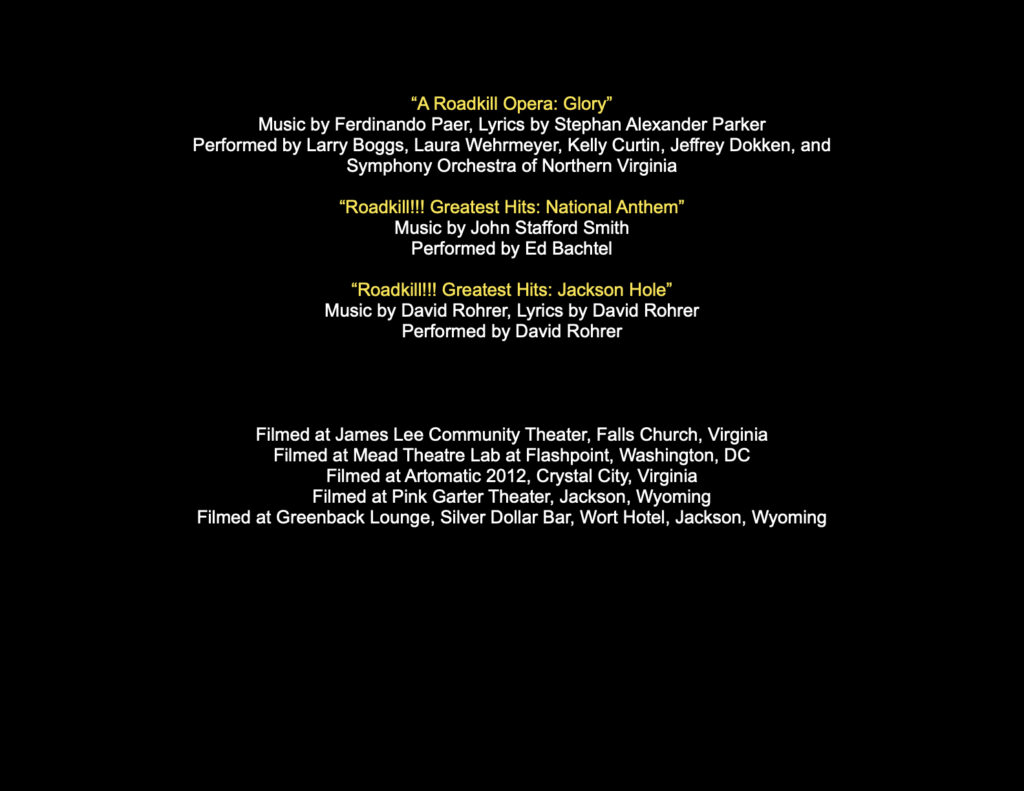
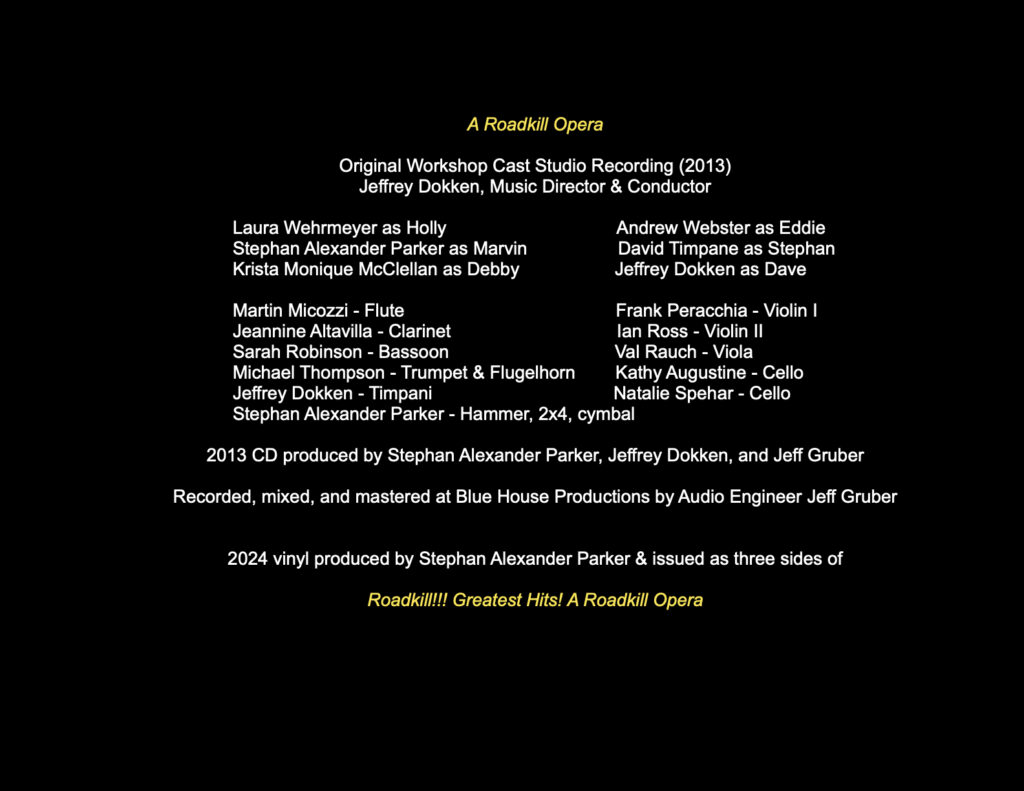
Movie Credits: Roadkill!!! Greatest Hits! A Roadkill Opera Movie