With the resumption of interest in opening nuclear power plants in the United States, it seems prudent to make this report more visible to interested parties. I would particularly call attention to a key question addressed in this report that remains most relevant: what constitutes “safe” disposal?
April 26, 2026, is the 40th anniversary of the 1986 Chernobyl disaster. It took place as a small research team assembled by the Beijer Institute was preparing for the first of two sets of visits with persons and organizations in the Federal Republic of Germany, France, Great Britain, Sweden, and Switzerland as well as international organizations headquartered in Belgium.
As stated in the Foreword to Technical and Sociopolitical Issues in Radioactive Waste Disposal, 1986, by Gordon T. Goodman, Executive Director, and Lars Kristoferson, Vice Executive Director of the Beijer Institute:
“We are extremely grateful to the Research Team for the highly competent and penetrating way in which they have prepared the material for this report. Not only is the topic an inherently difficult and complex one from the scientific point of view, but a series of extra complications were added by the Chernobyl accident which happened during the course of the Study. This made several drastic revisions of the original workplan necessary. Finally, the whole issue of radioactive waste management is so highly politicized that serious social controversies are the order of the day. We are sure that readers will be able to appreciate the team’s efforts in analyzing, assessing and presenting the issues and problems in a fair and comprehensive way.”
The work was ordered and funded by Statens Kärnbränslenämnd, SKN (The Swedish National Board for Spent Nuclear Fuel) and organized by The Beijer Institute. The report is now nearly 40 years old; much has happened in many of the countries described, even if these processes generally are very slow.
As stated in Chapter 1’s Initial Considerations section of Technical and Sociopolitical Issues in Radioactive Waste Disposal, 1986:
“…there is no single ‘correct’ answer to any of these questions any more than there is to what constitutes a ‘good life.’ In the succeeding chapters we shall detail how the commonalities as well as the differences affect the solutions reached in each of the countries.
“To make our understanding of the problems within the individual countries more complete, we visited not only the producers of nuclear waste, (which, depending upon the country, are state-owned, privately-owned, or some combination thereof) but also the agencies which regulate the disposal of nuclear waste(which, again, depending upon each country, may be the federal government, or be highly dependent upon local governments). In some countries, even though there is no legal requirement for the local political unit to make a decision, in fact, because of the power or influence of those units, it would be very difficult for the central government to establish a repository without the concurrence or at least the tolerance of the local government unit.
”In addition, we interviewed members of the environmental and ecological movements and/or political opposition or proponents in each of the countries.”
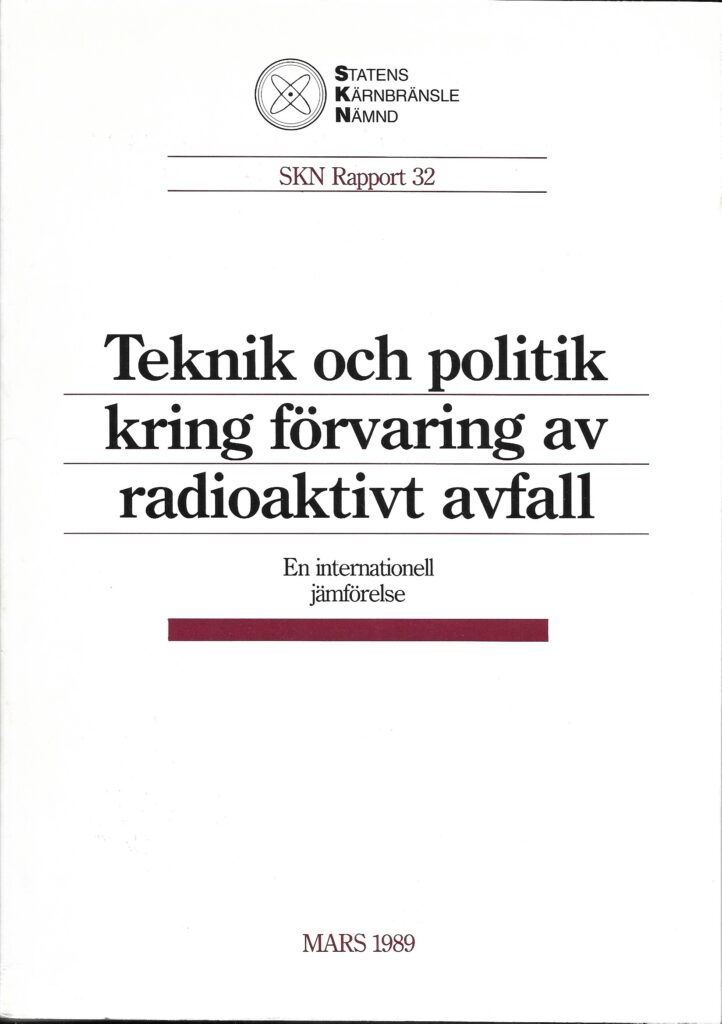
One of the members of the small research team assembled by the Beijer Institute was Tor Leif Andersson, Tellus Energi AB. SKN Report 17 was published in English; Tor Leif Andersson subsequently prepared a very popular, short version of SKN Report 17 in Swedish, issued as SKN Rapport 32.
Andersson, T. L. Teknik och politik kring förvaring av radioaktivt avfall. En internationell jämförelse. Stockholm: Statens Kärnbränslenämnd, 1989.
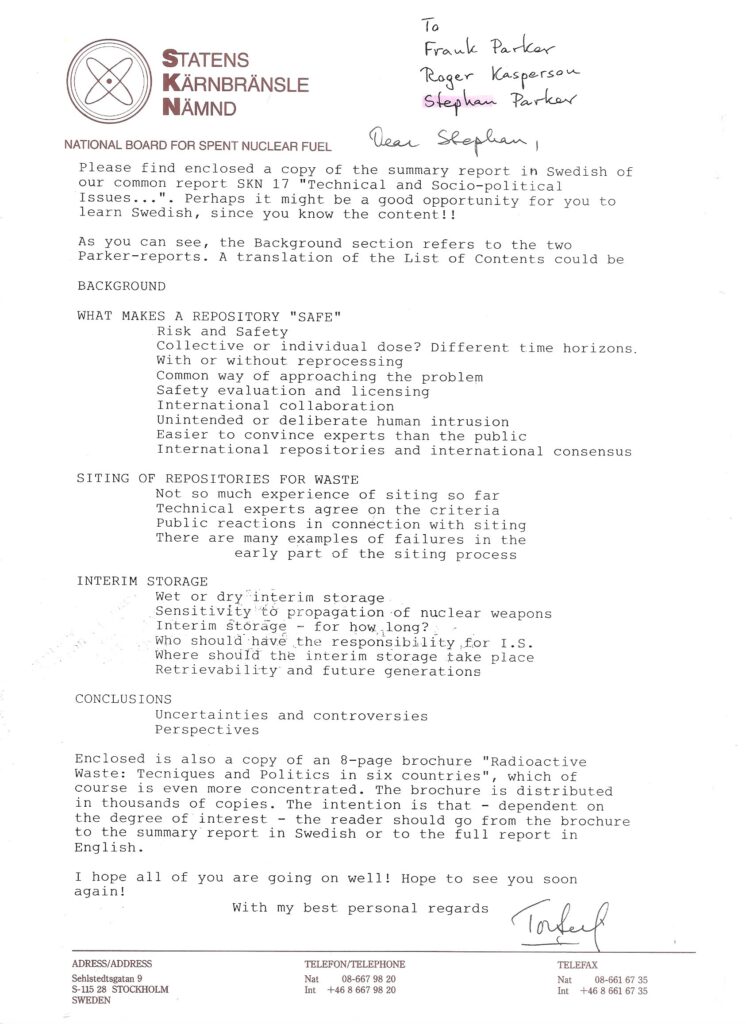
Tor Leif Andersson described our research team in his 1989 report’s Bakgrund (in part):
——————
Författarna
Frank Parker är professor i Environmental and Water Resources Engineering vid Vanderbilt University, Nashville, Tenn, USA. Han är även ordförande i Styrelsen för hantering av radioaktivt avfall (Chairman of the the Board of Radioactive Waste Management) nom USA:s vetenskapsakademi (US National Academy of Science).
Roger Kasperson är professor i geografi vid Clark University, Worcester, Mass, USA. Han har särskilt intresserat sig för hur allmänheten agerar i samband med olika stora projekt som i hög grad kan beröra större eller mindre grupper av befolkningen, såsom anläggning av storflygplatser, hamnar etc. Han har bl a skrivit boken “Equity Issues in Radioactive Waste Management” (Rättvisefrågor i samband med hantering av radioaktiv avfall).
Tor Leif Andersson är docent i fysik och verksam som energikonsult i Sverige.
Stephan Parker är forskningsassistent och redaktör. Sammanfattningen av materialet har gjorts av Tor Leif Anderson.
——————
The work was summed up in the section titled Radioactive Waste in Carl Gustaf Bernhard’s 1991 book, The Beijer Institute 1977-1989 [English translation by Roger Tanner].
One of the most difficult problems of the energy sector concerns the long-term consequences of energy policy. Climatological effects of the use of fossil fuels later came to be dealt with under one of the Institute’s main programmes (see below), while questions relating to the long-term deposition of radioactive waste were broached early on. Thus a series of studies was undertaken in collaboration with the National Nuclear Fuels Board (SKN) and other agencies, to see how Sweden and other advanced industrialised countries were dealing with these questions. The countries investigated were those with fully-fledged nuclear energy programmes, viz Belgium, Canada, West Germany, France, Japan, Switzerland and the USA.
The results were published, as work proceeded, in a series of reports from the Beijer Institute: “The Disposal of High-Level Radioactive Waste” (1984, Vols. I and II), by Frank L. Parker, Robert E. Broshears and Janos Pastor and
“Technical and Sociopolitical Issues in Radioactive Waste Disposal” (1986, Vols. I, IA and II) by Frank L. Parker, Roger E. Kasperson, Tor Leif Anderson and Stephan A. Parker.
These studies revealed, firstly, concurrence between the countries concerned on many of the technical issues but, secondly, considerable differences of attitude both politically and technically speaking. Public standpoints generally did a great deal to influence political decisions, while having little effect on technical decisions and risk appreciation. The politicisation of programmes for the deposition of radioactive waste appeared on the whole still to be increasing and to stand in the way of planning work.
All the above mentioned countries were resorting to intermediate storage, some of them close to the reactors, others in remote spots. Whereas West Germany and the USA were demanding terminal disposal of highly radioactive waste within the near future, Britain intended to continue with intermediate storage for at least a few more decades. In most countries, the problem was not finding a suitable place for deposition but rather gaining the public support needed for developing and using potential areas. In the case of small countries lacking suitable geological conditions for the purpose or having only limited nuclear programmes, international deposition, e.g. under the sea bed, seemed to be a desirable proposition. Deposition arrangements of this kind, however, have not been found acceptable either nationally or internationally, even though technically speaking they are a possible solution.
The palpable opposition occurring in many countries frequently has an ecological and philosophical background. To this are added international agreements which have obstructed the use of such forms of deposition. It should be added here that the research group was at pains to stress that it had found no cause for assuming that deep geological deposition of radioactive waste would lead to problems of catastrophic proportions.
The results were published in a series of monographs, and an evaluation of the current studies was made in 1985.
The work on risk-assessment and perception showed that these issues were so pervasive in the energy-environment field that it came to be integrated into the main fabric of all of its activities instead of, as previously, being conducted under a separate programme.
——————
Roger Kasperson was a member of the National Academy of Sciences and in 1999 was elected Director of the Stockholm Environment Institute, a post he held through 2004. He served on the Human Dimensions of Global Change Committee and the Committee on Strategic Advice for the Climate Change Program of the U.S. National Research Council, was co-chair of the scientific advisory committee of the Potsdam Institute for Climate Change, and was on the Executive Steering Committee of the START Programme of the IGBH. He was Research Professor and Distinguished Scientist at Clark University. He was the Executive Director of the Stockholm Environment Institute from 2000 to 2004. He passed away in April 2021.
Frank Parker was elected to the National Academy of Engineering (part of the National Academies) in 1988, the year after our report was published. He celebrated his 95th birthday in March 2021 and passed away in August 2022. He is also my father. On a 2021 visit with him, Frank mentioned that the report that he, Roger Kasperson, Tor Leif Andersson, and I authored is cited in the seminal work of the sustainability movement.
United Nations World Commission on Environment and Development, ed. Report of the World Commission on Environment and Development: Our Common Future. Oxford: Oxford University Press, 1987. http://www.un-documents.net/our-common-future.pdf
“The UN’s World Commission for Environment and Development, chaired by former Norwegian Prime Minister Gro Harlem Brundtland and thus referred to as the Brundtland Commission, published the report “Our Common Future,” also known as the “Brundtland Report,” in 1987. Influenced by the 1980 “World Conservation Strategy” of the International Union for Conservation of Nature (IUCN) the report defined the principle of sustainable development as “development that meets the needs of the present without compromising the ability of future generations to meet their own needs.” The publication of the report is considered a milestone in triggering international awareness and discourse on the importance of global sustainable development.” – Source: The Rachel Carson Center’s Environment & Society Portal http://www.environmentandsociety.org/mml/un-world-commission-environment-and-development-ed-report-world-commission-environment-and
The relevant section of Our Common Future is:
2.4 Radioactive Waste Disposal
52. Civil nuclear energy programmes worldwide have already generated many thousands of tons of spent fuel and high-level waste. Many governments have embarked on large-scale programmes to develop ways of isolating these from the biosphere for the many hundreds of thousands of years that they will remain hazardously radioactive.
53. But the problem of nuclear waste disposal remains unsolved. Nuclear waste technology has reached an advanced level of sophistication./50
Our Common Future footnote, on page 170:
50/ F.L. Parker et al., The Disposal of High Level Radioactive Waste – 1984, Vols. 1 & 2 (Stockholm: The Beijer Institute, 1984); F.L. Parker and R.E. Kasperson, International Radwaste Policies (Stockholm: The Beijer Institute, in press).
There are two Beijer Institute reports cited; the latter, cited while in press, was eventually published as
Parker, F., R.E. Kasperson, T. Anderson, and S. Parker. 1987. Technical and socio-political issues in radioactive waste disposal. Vol. I: Safety, siting, and interim storage. Vol. II: Subseabed disposal. Stockholm: The Beijer Institute. Also published in three volumes under the same title by Statens Kärnbränsle Nämnd (National Board of Spent Fuel) of Sweden, SKN Report 17, Stockholm: 1987.
As the Beijer Institute’s publication is not findable online, I have scanned and posted the covers and the Foreword. Those appear to be the only differences between the versions published by the two institutions.
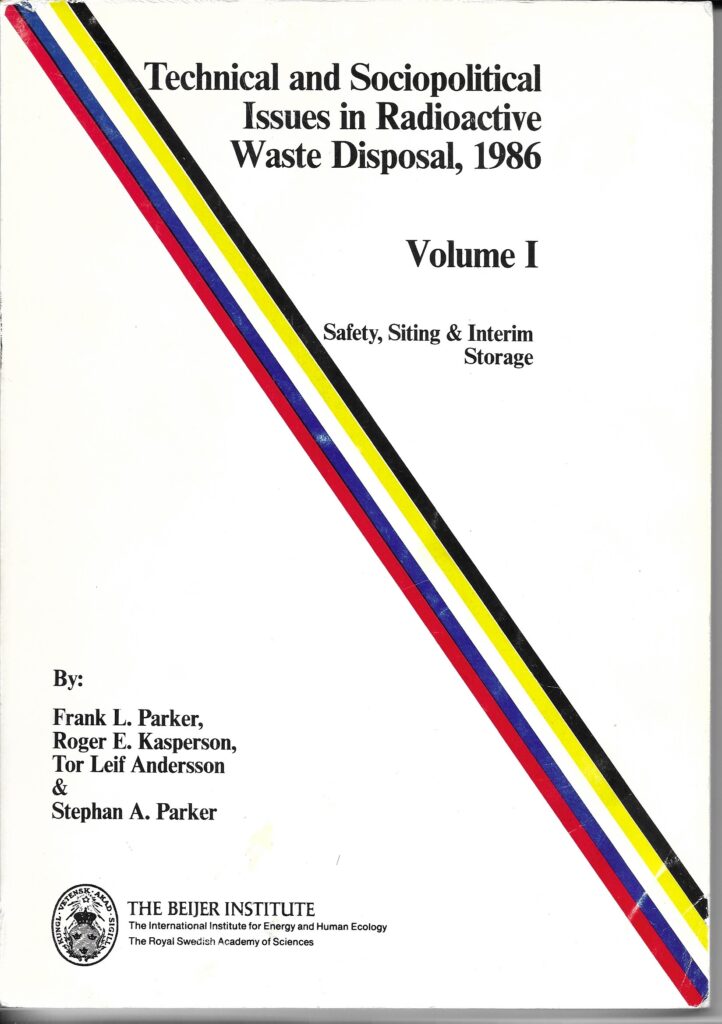
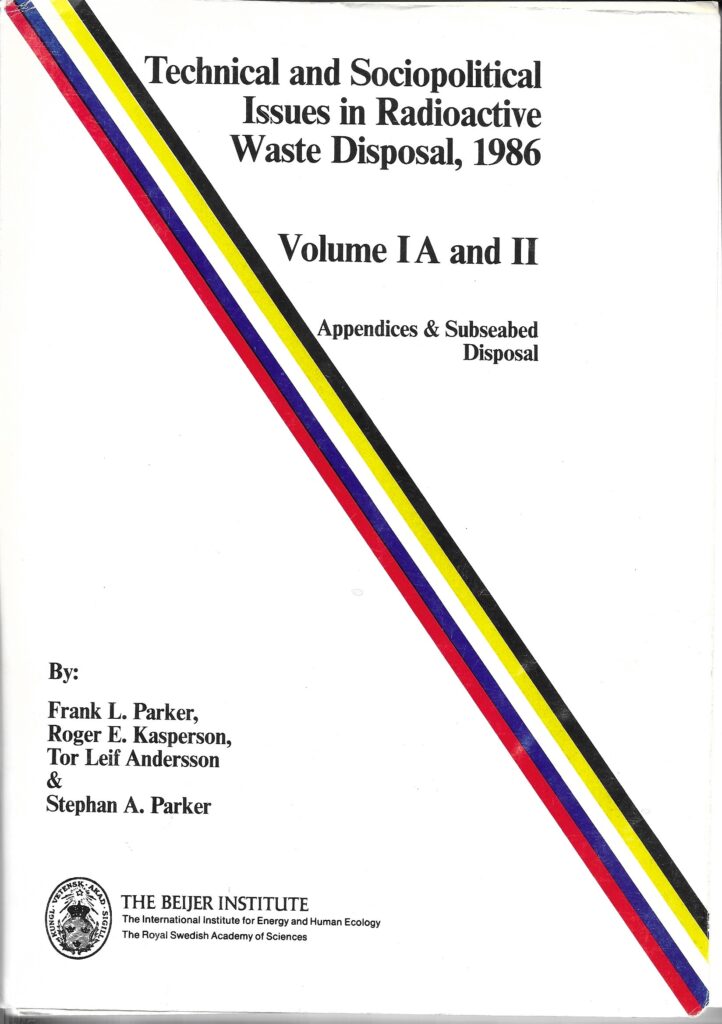
Full text PDFs of Technical and Sociopolitical Issues in Radioactive Waste Disposal, 1986, are available for free download:
Volume I: Safety, Siting and Interim Storage. Statens Kärnbränsle Nämnd (National Board of Spent Fuel) of Sweden, SKN Report 17, Stockholm: 1987. https://inis.iaea.org/collection/NCLCollectionStore/_Public/19/059/19059761.pdf?r=1
Vol. IA: Safety, Siting and Interim Storage. Statens Kärnbränsle Nämnd (National Board of Spent Fuel) of Sweden, SKN Report 17, Stockholm: 1987. https://inis.iaea.org/collection/NCLCollectionStore/_Public/19/059/19059665.pdf
Volume II: Subseabed Disposal. Statens Kärnbränsle Nämnd (National Board of Spent Fuel) of Sweden, SKN Report 17, Stockholm: 1987. https://inis.iaea.org/collection/NCLCollectionStore/_Public/19/059/19059762.pdf?r=1&r=1